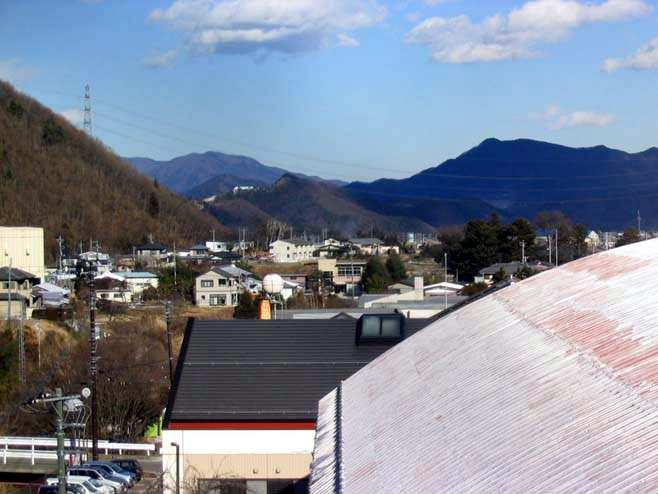
God, I used to love seeing The Country Rockers live, and I listened to this album obsessively when I was in Japan in 1988 - 90. Doug Easley had kindly sent me a copy of it (it was recorded at his studio, of course) on cassette, and on the flip-side was an interview Robert Gordon had conducted with the band, mainly Sam Baird (guitar, vocals) and Gaius Farnham, a.k.a. Ringo (drums, vocals). As I recall, Sam spent some considerable time talking about how wrestling was probably fake, while Gaius complained about the sizes of buttons on his shirts - he had very short fingers, which is where the nickname "Ringo" apparently came from, way before the lovable Liverpudlian - or so it was claimed. There was more to it than that, but those are my stand-out memories. I also recall Ron Easley (a.k.a. Durand Mysterion, bass, vocals, guitar) recounting how he had discovered Sam and Gaius (who I think was about 74 at the time this track was recorded) playing in some strange bar in South Memphis somewhere, and decided to take them under his wing. Thank God he did, because they were an absolute delight. This was about as real and elemental as music has ever come, in my book. Sam played a strange, cheap, generic electric guitar which I think I can recall seeing in the pages of a Fred P. Gattas catalogue as a kid, and apparently used to cut his guitar picks out of the tops of the plastic lids on Folgers Coffee cans. Gaius once told me he hadn't changed the heads on his drums (which were sheepskin) since the early 1960s. "There Stands the Glass" and "Barrooms to Bedrooms" were always my favorites, but this will more than do - even better that the TV Sam is watching in the video belonged to my friend John McClure. (The notes to the video on the YouTube site are enlightening. It turns out that the young Oriental women seen with the band sporadically in the closing seconds of the video, backstage at CBGB's, are none other than Shonen Knife.)
Friday, 13 November 2009

Monday, 9 November 2009
My grandad's naughty joke
My maternal grandfather was very much a man of his time and place. Humble and soft-spoken, he had grown up with nothing in rural Georgia, but was imbued with religious faith and a respect for learning and self-improvement. He was very affectionate to me, and I have very fond memories of him from my childhood. He was typically pretty reserved, and I can't ever remember him swearing or making off-color remarks of any sort.
In the early 1980's, however, he had to have heart bypass surgery, and something happened while he was on the table - something we couldn't ever really work out, and which he could never really articulate. We think he might have regained some level of consciousness while they had him opened up, because he seemed to be very traumatized by the experience. Whatever happened, he was never the same, and his health deteriorated over the years which followed.
But in the months after the surgery, he underwent a fascinating change of personality, partly, I think, due to the cocktail of drugs and steroids he was on, but also, I believe, due to some sort of organic change in his brain resulting from the operation. During this period, he actually became talkative, funny and irreverent in a way we had never seen before. He was dis-inhibited. He told me stories about working in the shipyards on the Gulf Coast of Texas during the war, building destroyers for the Navy, and other adventures he had during his younger life.
He also told a few risque jokes, which was certainly a new twist. These often involved a fictitious character, called "the country boy," who was forever getting into situations he didn't understand and embarrassing himself. I have always assumed that this was an idiom of joke-telling from a time when migrants to the cities from the country were keen to distance themselves from their greener cousins back home. Anyway, one day he told me the following joke, which I still struggle to grasp came from the mouth of my mild-mannered, tee-total, Bible-reading grandfather:
The country boy was in town, and he went to a saloon to drink some beer. After a while he had a powerful urge to go to the bathroom, so he went to the men's room, but the saloon was crowded and there was a long line of guys ahead of him. He noticed the ladies' room down the hall, and because he couldn't wait any longer, and because there didn't seem to be any women in the saloon, he went in, locked the door, and got down to business. Sure enough, just as soon as he'd started to relieve himself, there was a knock at the door. He said, "Hang on, I'll be out in a minute." The woman on the other side of the door was angry to hear a man's voice coming from inside, and she shouted, "Hey, don't you know that thing's for women to use?" The country boy said, "Yeah, I know, but right now I'm peein' through it!"
Strange as it may sound, I've always treasured this memory of him. I have many others which make me smile, but as a 40-something father, this memory in particular resonates because it gives me some idea of what was going on inside his head, of the person he really was behind my idealized notions of a grandfather, and of the power of humor to cope with fear and tragedy.
In the early 1980's, however, he had to have heart bypass surgery, and something happened while he was on the table - something we couldn't ever really work out, and which he could never really articulate. We think he might have regained some level of consciousness while they had him opened up, because he seemed to be very traumatized by the experience. Whatever happened, he was never the same, and his health deteriorated over the years which followed.
But in the months after the surgery, he underwent a fascinating change of personality, partly, I think, due to the cocktail of drugs and steroids he was on, but also, I believe, due to some sort of organic change in his brain resulting from the operation. During this period, he actually became talkative, funny and irreverent in a way we had never seen before. He was dis-inhibited. He told me stories about working in the shipyards on the Gulf Coast of Texas during the war, building destroyers for the Navy, and other adventures he had during his younger life.
He also told a few risque jokes, which was certainly a new twist. These often involved a fictitious character, called "the country boy," who was forever getting into situations he didn't understand and embarrassing himself. I have always assumed that this was an idiom of joke-telling from a time when migrants to the cities from the country were keen to distance themselves from their greener cousins back home. Anyway, one day he told me the following joke, which I still struggle to grasp came from the mouth of my mild-mannered, tee-total, Bible-reading grandfather:
The country boy was in town, and he went to a saloon to drink some beer. After a while he had a powerful urge to go to the bathroom, so he went to the men's room, but the saloon was crowded and there was a long line of guys ahead of him. He noticed the ladies' room down the hall, and because he couldn't wait any longer, and because there didn't seem to be any women in the saloon, he went in, locked the door, and got down to business. Sure enough, just as soon as he'd started to relieve himself, there was a knock at the door. He said, "Hang on, I'll be out in a minute." The woman on the other side of the door was angry to hear a man's voice coming from inside, and she shouted, "Hey, don't you know that thing's for women to use?" The country boy said, "Yeah, I know, but right now I'm peein' through it!"
Strange as it may sound, I've always treasured this memory of him. I have many others which make me smile, but as a 40-something father, this memory in particular resonates because it gives me some idea of what was going on inside his head, of the person he really was behind my idealized notions of a grandfather, and of the power of humor to cope with fear and tragedy.

Wrasslin'
As any Memphibian of standing will tell you, the other thing, besides music, which made Memphis great was old school professional wrestling. Memphis really invented the idiom, which in those more innocent days, also had its tender, human side, as Lance Russell shows us here at Christmas, 1976.

Walkin'? In Memphis?
Before I moved to London in July, 1995, I spent the last couple of months living in my parents' house off North Mendenhall in East Memphis. The lease on my tiny Midtown apartment had expired, and I needed to save some money, plus it was a good chance to spend some time with them before I flew off to the great unknown Blighty.
One day I felt a bit restless, so I decided to go out for a walk around some of the beauty spots of East Memphis, such as Summer Avenue. Heading back home, I was walking on White Station Road, when in the corner of my eye I perceived a car slowing down next to me at the curb. The passenger-side window rolled down to reveal that the driver was Tommy Hull, legendary songwriter, possessor of a heavenly singing voice, and co-founder of the Randy Band, the first live band I ever saw in Memphis - an experience which changed my life. I had known Tommy for years, and always liked him, and he me, apparently.
He shouted out of the car, "Hey, are you okay?" "Hi Tommy, yeah, I'm fine." "Has your car broken down or something?" "No, I'm just taking a walk." "Get in, I'll give you a lift home." "That's very kind, but I actually want to walk. I'm just out walking for a bit of exercise."
He cocked his head and knitted his brow, uncomprehendingly, and said "Okay, whatever, take it easy." I think I even saw him shaking his head as he drove off.
One day I felt a bit restless, so I decided to go out for a walk around some of the beauty spots of East Memphis, such as Summer Avenue. Heading back home, I was walking on White Station Road, when in the corner of my eye I perceived a car slowing down next to me at the curb. The passenger-side window rolled down to reveal that the driver was Tommy Hull, legendary songwriter, possessor of a heavenly singing voice, and co-founder of the Randy Band, the first live band I ever saw in Memphis - an experience which changed my life. I had known Tommy for years, and always liked him, and he me, apparently.
He shouted out of the car, "Hey, are you okay?" "Hi Tommy, yeah, I'm fine." "Has your car broken down or something?" "No, I'm just taking a walk." "Get in, I'll give you a lift home." "That's very kind, but I actually want to walk. I'm just out walking for a bit of exercise."
He cocked his head and knitted his brow, uncomprehendingly, and said "Okay, whatever, take it easy." I think I even saw him shaking his head as he drove off.
Sunday, 8 November 2009
My Pal Foot Foot
I remember the first time I played this song for The Grundies' drummer Bob Fordyce. He was mesmerized, and when it was over, he said, "I want to play in a band that sounds like that." I knew exactly what he meant.
Saturday, 7 November 2009
The Grundies, 1991 - 92
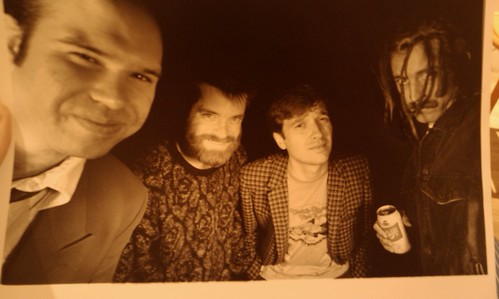
The four faces looking out at you from another decade are those of a long-forgotten Memphis band called The Grundies, in their second incarnation. From left to right: Bob "Slyce" Fordyce (drums, vocals), Trey Harrison (guitar, vocals), James Enck (tenor sax, guitar, bass, vocals), and Jeff Green (bass, guitar, vocals). The picture was taken on a very cold night in the winter of 1991/92, in the backyard of Jeff's house on Rembert Street in Midtown Memphis. I lived just down the road at the intersection with Poplar, and the street was also at the time the home of now-eminent music writers Robert Gordon and Tara McAdams, and the uber-talented chef John Pearson. Jeff Buckley also lived on Rembert Street when he made his move to Memphis to record "My Sweetheart the Drunk," in a house that was just a stone's throw from my apartment, though I was already in London by that time. Trey, a very talented and enthusiastic photographer, had brought his camera and some lights over to Jeff's house, and we set up in the backyard to take some band photos. The photo was actually snapped by Bob, which is why he is so far forward in the frame.
The Grundies began as a trio of Bob, Jeff and Trey, sometime in 1990, I think, and by the time I encountered them, they had written and recorded a number of songs at the new Easley Recording studio, two of which ("McLemore Avenue" and "Eyepatch") I later added horns to. I began sitting in with them on tenor sax (which I had acquired from Jim Duckworth and played primitively and often painfully - my primary obvious influence being the squeakier output of Pharoah Sanders), and eventually joined as a fully-fledged member. We had, however, all known one another for many years. I first met Jeff in 1980, when I started working at the barftastic Steak and Ale on Poplar, where he trained me on my first night on the dishwasher. It was also through Jeff that I would meet his classmate, Kurt Ruleman, drummer in my first band Pseudobop with Linda Heck, who now plays with Linda once again. I met Bob sometime in 1982 or so, and I don't remember where or how, but I suspect it might have been because he was the drummer for the great and all-too-short-lived band Shagnasty, which also included Mark Harrison of Snakehips. Trey I knew of, but didn't actually properly meet until 1986, ironically on a trip to see my former Pseudobop band mates Mark Edwards and Richard Young in Berkeley, California.
The Grundies were an interesting musical collision between the primitive and the refined, which generated occasional moments of brilliance and beauty, but was forever on the verge of spinning out of control and crossing the line into The Unlistenable - territory we unfortunately spent a lot of time probing during our live sets. Bob was an exceptionally talented drummer, with formal training gained through participation in his high school's drum corps, and lengthy experience in a number of bands. I was a reasonably proficient guitarist, and had played with a number of bands. Jeff and Trey were much less experienced. Trey had been an occasional member of the Odd Jobs, probably one of Memphis' best, bravest and most challenging bands of the 1980s, but I think he might have only played slide guitar then, and Jeff had never played in a band before as far as I am aware. But Trey and Jeff were both naturally talented and charismatic vocalists, with a highly developed appreciation of the absurd, and this force of personality had instant appeal for almost anyone who saw them play - well, it certainly did for me.
In the first incarnation of the band, sans moi, this tension between experience and raw enthusiasm created an interesting dynamic, with the drums really providing the focal point for the listener in search of movement and accent, because most of what was going on with the bass and guitar was very stripped down indeed. I have a tape of the original Grundies sessions at Easley, which contains some fantastic performances, which I hope to obtain in digital format at some point.
For my money, the definitive Grundies song comes from these sessions, and it is called "Fire in the Driveway." The performance is fast-paced, with the guitar recorded very hot, and Trey's characteristically powerful vocal dry and right up front, with fantastic drum fills from Bob during the frequent stops. It is a concise and irresistible encapsulation of The Grundies' proposition - simple, hard-rocking, and absurd:
Well, there's a fire in the driveway (Jeff on backing vocals, "Yea-uh, yea-uh"),
And I can't quite figure it out,
Well, there's a fire in the driveway,
And everybody's rushing about,
Is it the carburetor?
He said, "No!"
Is it the radiator?
He said, "No!"
Is it the potentator?
He said, "No!"
Is it the lickulater?
He said, "No, no, no, no!"
This early recording contains many other gems:
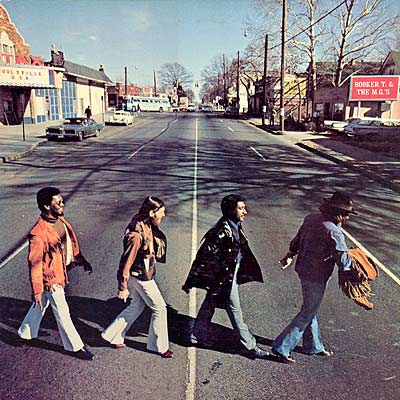
"McLemore Avenue" (for those not aware, this is the South Memphis street which was home to Stax Records, as well as the name of the fine Booker T. & the MGs album covering "Abbey Road"), on which I appear as a sort of zombified version of the Memphis Horns, is a funky instrumental featuring what we described as the "pyramid of entertainment" - in which Jeff's funky bass riff opens and is later joined by Trey's guitar, then Bob's drums, and lastly my horns. The suspense is almost unbearable!
"Go-Kart Track" is another defining piece of Grundiania. We used to rehearse at Jeff's family business, a landscape architecture company with a complex of nurseries and buildings on Summer Avenue, right next to the go-kart track at the Putt Putt miniature golf site. Before I joined, I guess on the 4th of July, the guys emerged from the rehearsal space to note that there was no one left at the go-kart track. This would probably account for the only lyrics of the song, which were:
There's nobody left at the go-kart track (x3),
And it's the 4th of July.
Another great song from that first session is "Pyroflatulence," which has a very delicate and understated instrumental opening, with vocal to match. Things gradually build to a crescendo and eventual disintegration.
Feeling like a fool,
In a brand new school,
Thought I was hip,
I had a pocket full of French Dip.
Hey, what's your name?
I am a human flame (x3).
Pyroflatulence.
Pyroflatulence.
My personal favorite from this session was "Cinco de Mayo," alternatively known as "Cinco de Mayonnaise." As the name suggests, it is an instrumental in 5/8 time signature, with the amazing Bob playing drum rolls throughout, while the bass and guitar (and sax in subsequent live performances) play an E chord in a 1, 1-2, 1-2-3, 1-2-3-4, 1-2-3-4-5 rhythmic pattern, punctuated by a bluesy refrain in between. It's difficult to describe, and I'm not sure that my description does the piece any justice, but I remember hearing it for the first time and thinking that it was totally infectious. Robert Gordon shot a music video of this song in Jeff's backyard, which I used to have a copy of, and would love to see again.
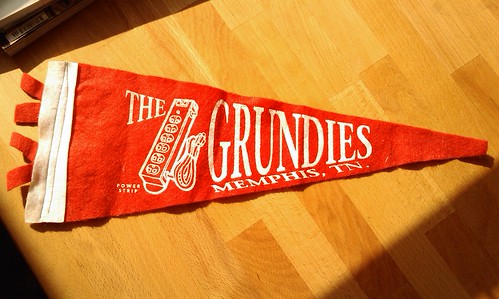
While the group was musically fairly erratic, the strong graphic arts background and sensibility of most the members meant that we excelled at non-musical representations of the group. At some point, I found a couple of painted gourds in a thrift (charity) shop on Summer Avenue, one of which had an unusual shape and the word "Jim" written on it. This became the de facto icon for The Grundies, which featured on numerous fliers and a T-shirt which I wish I still had (I think I gave it to a girlfriend). There was also a limited edition of pennants, one of which I still have and is pictured later in this post.
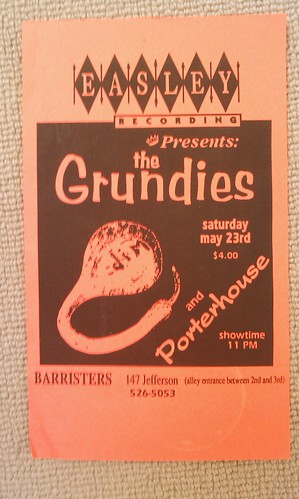
The Grundies played a few highly unusual shows during the short life of the band. We played in a soybean field next to a tenant farmer's shack near Horseshoe Lake in Arkansas, which was a very odd experience. The day was sunny and beautiful, and a large part of it was captured on video by Robert Gordon, though I have never seen any of the footage. The locals, all poor black tenant farmers, were very welcoming, and we found ourselves the guests of honor at a fish fry that night, where the music on offer consisted entirely of a peculiar mix of Michael Jackson's Bad, NWA, and Z.Z. Hill.
We also played a gig with legendary Memphis hard rockers Neighborhood Texture Jam (NTJ) and the unintentionally hilarious epic metal band False Facade, at a stock car racing track (dirt) north of Memphis - I think it was in Woodstock. Jeff had organized this show around some event his Ultimate Frisbee team was involved in, but unfortunately it hadn't been given adequate publicity, so virtually no one turned up. Normally we wouldn't have cared, except that he had given the NTJ guys a guarantee. I had to leave after our set to play a show with Linda Heck back in town, but everyone else stayed at the race track and drove their cars around the circuit, which was apparently part of the package for hiring the venue.
A few weeks later, we played another gig with NTJ on the 5th of July at the New Daisy Theater on Beale Street. The night before, there had been a professional boxing match held in the venue, and NTJ had somehow convinced the management to leave the ring set up for the bands to play in. I wore some suitable gym shorts and a robe, and bounced off the ropes like a professional wrestler as we played our set, which I recall was one of our best ever, and certainly the most fun. By this time I was mostly playing guitar, and I had forced the other members in the band to learn NTJ's signature piece "Borax Factory," which we played very convincingly as our last song, both as a genuine tribute to their musical genius, but also because they had insisted on being paid their guarantee at the racetrack despite the obvious failure of the event and the fact that we all believed we were friends up to that point. I left that night before the fireworks started, but apparently Jeff and Trey were involved in some backstage slanging with some NTJ members around the issues of money and ethics, the outcome of which I'm still not sure about.
Throughout the life of the group, we had played a couple of times in Memphis with the Chicago band Shrimp Boat, which contained former Memphians Eric and Ian Schneller, the latter of whom had been in the Odd Jobs and was still close to Trey and Bob. In August, 1992, we traveled to Chicago to play a gig with them. I recall that when we left Memphis, it was about 95 degrees Fahrenheit, but we arrived in Chicago the next morning to find that it was rainy and 45 or so. Jeff, who had come up in shorts, a tank top and flip-flops, was taken immediately to a local thrift store to buy some more substantive clothing. Our show in Chicago was a failure on the whole, as the recording of the event validates. I think our self-deprecating, absurdist Southern humor and primitivist musical approach was lost on the audience, who were really there to see the far more sophisticated Shrimp Boat. We probably also didn't help our case by playing an atonal version of "Beer Barrel Polka" as a tribute to the citizens of Chicago. By this point in the band's evolution, we were overindulging in atonal free-form stuff, which did not show us at our best. Shrimp Boat themselves were wonderful hosts, and I enjoyed the few days we spent hanging out at their warehouse space. Ian and Eric were great fun, and I recall that Sam was deeply into the jazz thing, as was I, and had a fantastic vinyl collection. But, alas, I had a new job to return to in Memphis and realized that the wild and wacky life of touring penury was not for me.
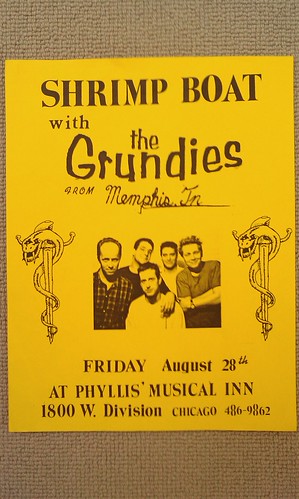
It was the new job, my growing fatigue with loud music (we were very loud), as well as a general sense that we had pretty much exhausted our potential and were not particularly enjoying one another's company that much anymore, which led me to exit in September, 1992. The band pretty much ended then, though we did a recording session at Easley - McCain Studios after our return from Chicago, which sounds great in retrospect and yielded a single on Ed Porter's Loverly Records, and can be found on the fine double CD compilation "The Singles: 1993 - 1994". I have seen it available on the net for as little as 89 cents, which is ludicrously good value. The single was "San Antonio"/"You Look Good," on both of which I played bass, and horns on "You Look Good". "San Antonio" has one of the best opening lines of any Grundies song: "I can say beyond a shadow of a doubt, I read a book, I didn't know what it was about, down in San Antonio." If you have a vinyl copy of this single, you are part of a very small club, because I don't think any effort was ever mounted to distribute or promote it. The real gems of the session, however, were both obscure covers, "I Found My Love in Memphis" and "Lawman."
"I Found My Love in Memphis" was a song I discovered in a thrift store in Binghampton when I was living briefly on Forrest Street near East Parkway and Summer Avenue after my return from Japan in 1990. This thrift store had multiple copies of what looked like vanity singles from obscure local labels with names like "Pretty Girl," all of which seemed to be connected in some way. I bought several of them one day, most of which were terrible in an unremarkable way, but "I Found My Love in Memphis," written and sung by a long-forgotten man named George Clappes, was terrible in a really special way. I went back to the shop the next day and bought several more copies, which I gave to friends whom I thought would appreciate it. It feels more like a song poem than a song, I suppose, but the musical structure is so peculiar, and the lyrics so daftly charming, that it was screaming to be covered. It was recorded as a mid-tempo country song, but The Grundies' version rocked it, which actually seemed more appropriate to the strange chord changes (verses: B - C sharp - B - C sharp - A - E - F sharp - A - B - C sharp - B; bridge: B - E - F sharp - E - F sharp - E - F sharp - E - F sharp - B - E - B - A - B - A - B). I often wondered if the lyrics were written sincerely, or if George Clappes was gunning for a lucrative deal with the Chamber of Commerce, because for a song about love, it's very long on municipal amenities and very short on love.
I traveled over many a land,
Even through the desert sand,
Nowhere was I satisfied,
'Til I came to the riverside of Memphis
I got me a job and I settled down,
Right here in this nice big town,
Lots of girls there are around,
I found my love in Memphis
Now I have plenty of everything,
Even to my wedding ring,
I just go around and sing,
I found my love in Memphis
Bridge:
Listen to me friends wherever you are,
All round close or way off far,
There's lots of music and lots of fun,
I found my love in Memphis
We've got more churches and fillin' stations,
One of the best cities in the nation,
And there are industries everywhere,
I found my love in Memphis
We've got new buildings up to the sky,
Come on friends and start a new life,
Well that's exactly what I did,
I found my love in Memphis,
I found my love in Memphis
If you never heard The Grundies perform this song, you're probably not encouraged by my description, but trust me it was very, very good, particularly the version we recorded at that final session.
Our other epic cover, "Lawman," was a fairly lame country recording by Eddie Bond, one of his many musical tributes to Buford Pusser, with whom he had something of an obsession. The Grundies also had something of an Eddie Bond obsession: one of the early Grundies songs was "Eddie Bond" (the sole lyrics of which were his name), Jeff had a number of Eddie Bond albums, and he also produced an Eddie Bond frisbee featuring an unflattering caricature of the man drawn by Bob. We reworked it as a southern rock anthem, in which Trey, Jeff, and Bob all took turns singing the verses, ending with the singalong chorus from "Hey Jude," re-purposed as "Na, na, na, na-na-na-na, na-na-na-na, hey Buford." This was frequently a set-closer for the band, and I think it often made up for a wealth of musical transgressions perpetrated earlier in the evening.
Black smoke's rising from the poplar trees,
They're making moonshine liquor down in Tennessee,
Look out, bootleggers, Buford comes around,
He's got a nose for whiskey like a hot bloodhound,
He's a lawman
Well he could stare down the barrel of a 44,
And leave six men lying on a barroom floor,
Buford won't back down when the going gets tough,
If he comes to getcha, you can pack your stuff,
'Cause he's a lawman
God help you boy if you carry a bounty,
Don't plant your feet in McNairy County,
They got a man with a plan for upholding the law,
Standin' proud and walkin' tall
Towhead White's been comin' around,
He told the whole dang town he's gonna gun you down,
Towhead White, I'd hate to be in your shoes,
When Buford comes around and starts looking for you
'Cause he's a lawman
Well they said "Buford why don't you get outta town while you've still got your life?,
You've been shot six times, now they've killed your wife,"
He said, "They buried my Pauline in the cold, cold ground,
Nah boy, nah, I ain't leavin' town.
I'm a lawman."
Between the two very different recording sessions at the beginning and end of the band's life, there is adequate material for an album, almost all of it very good. I have a compilation tape of the two which contains:
Fire in the Driveway
Eyepatch
McLemore Avenue
Tip, or Dump
Mary's Head (two versions, one fast, one ambient)
Cinco de Mayonnaise
Eddie Bond
Hurry Up and Stop
Go-Kart Track
Clam Ranch
Jimma Lee
Pyroflatulence
You Look Good
San Antonio
Cowboy Song (written by Trey's then-toddler son, Red)
Buddy Up
Wise Without Study
Fire in the Driveway (flamenco version)
Lawman
I Found My Love in Memphis
Assuming that the tapes survived the Easley - McCain studio fire, I would love it if someone assembled a definitive collection, to share the vision of The Grundies with the world. I think we could all use a smile right about now. Thanks for the memory, fellas.

Friday, 6 November 2009
An English joke
Jeremy Clarkson, famous Francophobe, advocate of ozone depletion, proponent of homicidal driving behavior, and all-round pompous cock, is shooting an episode of Top Gear in France. During a break, he goes to a local restaurant for lunch. The waiter is, of course, dismissive and inattentive, as Clarkson knew he would be. Unable to contain his rising ire as the waiter ignores yet another beckoning gesture, Clarkson shouts out, "Bloody French, what makes you think your country is so superior? Take away the cuisine, viniculture, literature, painting, cinema, philosophy, fashion, and beautiful women, and what have you got, tell me?" The waiter smiles and replies, "England."
Wednesday, 4 November 2009
Monday, 2 November 2009

Sunday, 1 November 2009
Time is tight
After my family moved to Memphis in 1974, I went to sixth grade at the MSU Campus School, which I have to honestly say was a pretty shambolic example of 1970s-style open-classroom independent learning. One of my teachers there was a woman by the name of Barbara Jackson, who sported a frighteningly unrealistic wig and amazing array of super-flared pant suits in a variety of garish colors and materials, including leather. We kids preferred the leather ones, because we could hear her squeaking down the hall back towards the classroom after one of her frequent forays elsewhere in the building. We preferred to have advance warning of her return so as to avoid being told off for rowdiness.
Anyway, this frequently terrifying figure was actually married to none other than Al Jackson, who visited the school on a number of occasions, and looked very cool indeed. They lived just around the corner from the school on Central, giving Barbara almost certainly the shortest commute of any teacher in the Memphis City School system, though she still drove her Cadillac, of course. This was Memphis, after all. It was in this house that Al Jackson would be killed a year later. For as long as I lived in Memphis, I thought about this whenever I drove past that house, and wondered what really went on that night, because the accounts all sounded very strange at the time.
Thirty years later, in April 2005, the "It Came From Memphis" season at the Barbican presented a Stax reunion show, and the fabulous Jim Spake got me a backstage pass. I arrived early at the venue to meet up with Jim and managed to catch him with Ben Cauley and Booker T. & the MGs rehearsing "Your Good Thing (is About to End)" with Mable John, which sent chills down my spine. After this we retreated to the catering room for a curry, which we ate with William Bell (who seemed like a really nice guy) and Skip Pitts. At one point I had to find the men's room, and on my way back I encountered Booker T. and his wife, attempting to find the dining room (the Barbican is notorious as a place where people get hopelessly lost), and I showed them the way, for which they seemed very thankful.
Later on, I was hanging out backstage, standing next to Deanie Parker, when up walked a very friendly and unassuming Eddie Floyd. He asked me who I was, and I shook his hand, told him it was a great pleasure to meet him, and asked him if he could possibly sing "I Stand Accused," one of my favorites. He looked into the middle distance, as if mentally time-traveling, and then said with a vaguely pained expression, "You know, I sure wish I could, but I only have time for three songs." Mable John won the audience's heart before her song when she thanked them and said how nice it was to be back in London, where people had treated her so well when she had last visited - in 1967. It was an amazing night. As I have just celebrated yet another birthday, I'm reminded that sadly time is tight for these remaining treasures of Memphis music (as it is for us all) and I'm glad to have crossed paths with and witnessed as many as I have over the years, and grateful for this music like no other.
Monday, 26 October 2009
The most minimalist fan video ever
I don't know who you are Creaturebuilder, but dude, I like your style - and taste in music!
Sunday, 25 October 2009
Hot Joe (sporadically 1987 - 94)
It's a curious and oddly satisfying thing to have a band take shape around you, and then to watch it take on a life of its own in your absence, both when you're out of the country and also back in again. Such was the case with Hot Joe, still one of Memphis' finest and weirdest groups, in my humble and probably irrelevant opinion.
As a natural extension of the friendship between Linda Heck and The Train Wreck and K9 Arts, I started hanging out with K9 guitarist Jim Duckworth and my band mate John McClure in 1987 and working up some songs, mostly old standards, with me as the vocalist. Jim had an amazing music collection and an encyclopedic knowledge of jazz from its earliest roots to the modern experimental scene, and he turned me on to a lot of wonderful music. These afternoons spent at Jim's house were usually accompanied by copious amounts of coffee, so naming the group was a very easy exercise indeed.
Our first gig was with Rich Trosper on drums, I believe at some sort of art opening or party in Downtown Memphis, though the venue and occasion totally evades me, probably because I was fairly terrified at the time by the prospect of fronting a band as vocalist for only the second time ever. I can't recall exactly what our set was, but it contained "Cheek to Cheek," "Moody's Mood for Love," "Strawberry Fields Forever" (yes, a straight jazz version), and God knows what else. At some point we debuted a version of "Ornithology" with original lyrics by me, which so exited an apparently well-known local "jazz dude" in the audience that said enthusiast mounted the stage and commandeered the microphone to "scat". I've always hated scat. I was very irritated by this man at the time, but ended up being mightily amused by the fact that, whenever the imperious scat-cat wannabe in question ordered (rather than requested) Rich to "lay out," Rich responded with a very loud rim-shot or flam of some sort to piss the interloper off. Eventually he gave up and left the stage.
From these humble beginnings arose Hot Joe, and the group, in various permutations, began to get real paying gigs, mostly weddings and cocktail receptions, which, in addition to a civilized audience and a guaranteed pay check, also typically included free food and drink - not a bad alternative to the thankless smoke-filled dives we were used to. The line-up of the group evolved over time, though the core was typically Jim and John, plus Jim Spake on saxes and either Ross Johnson or Doug Garrison on drums (sometimes both together). On a couple of occasions Jim Duckworth had other obligations, and I recall doing two nice gigs with John Gaskill (a wedding) and Ed Finney (some sort of corporate event in the garden at Brooks Museum) on guitar. I was intrigued by Ed, who wore a compass on his wrist as opposed to a watch - which he explained something along the lines of "I may not be on time, but at least I know which way I'm headed."
Sometime after I left for Japan in 1988, Robert Palmer turned up in Memphis and became part of the band - his skronky clarinet an interesting foil to Jim Spake's refined playing. This line-up, which often included both drummers, became very popular over the next two years, and while maintaining the civilized paying gigs, also played harder-edged material in the clubs. They worked up a rocking mash-up of two of the best Mingus tunes, "Better Get Hit in Your Soul" and "Wednesday Night Prayer Meeting," a very fast, Klezmeric version of "Over, Under, Sideways, Down," with Jim Spake and Bob Palmer trading solos, and expanded "Strawberry Fields" into a long medley improbably including "Don't Stop 'til You Get Enough," "Haitian Fight Song," "The Immigrant Song," and "When the Saints Go Marching In." There were also a few fine originals by Jim Duckworth, including "Mimi" (a K9 Arts song) and "Jonah," which was a beautiful song, and Linda Heck's "Look Out for Love."
In the summer of 1989, I came back to Memphis during the summer break, and the guys very kindly arranged a recording session while I was in town, and we also played a gig at the P&H Cafe, which I think might have been a WEVL benefit. I don't remember that much about the gig, apart from the fact that we played versions of "My Favorite Things" and "'Round Midnight" with original lyrics I had written. The recording session, on the other hand, I remember very well, and still have tapes from it to remind me of what a pleasant experience it was. The full line-up (Jim D., Jim S., John, Ross, Doug, Bob, me and Linda Heck) went into Doug Easley's studio behind his house on Marion Street off South Highland on a Saturday night and recorded into the wee hours. We cut "Better Get Hit/Wednesday Night Prayer Meeting," "Over, Under, Sideways, Down," "Mimi," "Strawberry Fields Forever," "'Round Midnight" (with my lyrics), "Ornithology" (ditto), an old Linda Heck and The Train Wreck song "My Crying is Done," two versions of "Look Out for Love" (one with Linda on vocals, and an "answer version" with me substituting my own lyrics), and a very short "Cottontail." It was a blast, and the music still sounds wonderful today.
Jim Duckworth drove me back to my parents' house that night, and Bob Palmer, who was along for the ride, regaled us with some very funny stories of his adventures. My parents' house is not far from the home of the late Sam Phillips, whom I saw many times over the years mowing his own grass, and this triggered an anecdote from Bob, which he attributed to Sam Phillips himself. It seems that when Fidel Castro was in New York City in 1959, Sam Phillips managed to get the number of his hotel room, and possibly somewhat the worse for wear at the time, called it. Bob claimed that Fidel's brother Raul had answered the phone, and told Sam that Fidel was unavailable, to which Sam apparently said, "Well, I just want to wish him well with that revolution down in Cuba, but tell him that if it doesn't work out, he always has a home in Memphis, Tennessee, and that comes from Sam C. Phillips."
I have no idea whether this story was true at all, but I found Bob Palmer to be a delightful storyteller and a very funny man. And he was into Persian classical music, as was I, and I seem to recall we ended up talking about parallels between the Charles Mingus band in 1964 and Persian classical ensemble performances, which are punctuated by unaccompanied solo segments from each of the instruments. That was the sort of conversational side alley you could find yourself wandering down when talking to Bob Palmer. Wish I'd had a chance to get to know him better.
I would really like to see a comprehensive list of all the songs played during the life of Hot Joe, because it would almost certainly run to hundreds. The paying gigs, when they required a vocalist (which was by no means always the case) often came with an obligation to learn some new songs, and I recall that we worked up a really nice version of "I've Never Been in Love Before" for some newlyweds' first dance, and another couple wanted the Beach Boys' "Wouldn't it be Nice?" for their first song. We played it faithfully, and luckily I have a pretty wide vocal range, because it's a hell of a song to sing as the first of the night.
The paying gigs, particularly the corporate stuff, gave license for some fairly subversive material, because typically no one was really paying attention, so it was not uncommon to hear the likes of "See Emily Play" slipped in among the Chet Baker numbers. It was also an interesting opportunity to observe people, because the band members were typically ignored and I was singing maybe one in three songs, so I had ample opportunity to look around the room. At one wedding reception, I remember Jim Spake was featured on a particularly fine version of (I think) "In a Sentimental Mood" and a very old woman stood close by and cried her eyes out until someone took her back to her seat to comfort her.
My abiding memory of the remarkable experiences I had with this group, beyond the awesome recording session, was a Christmas show we did on Wally Hall's Memphis Beat program on WEVL, I believe in 1991. The full line-up was there, minus Bob Palmer, and Linda Heck and I traded vocal duties, teaming up on "Let it Snow, Let it Snow, Let it Snow" and "Christmas Time is Here." The evening ended with me behind Ross' drum kit beside Doug Garrison as we all accompanied Ross doing a predictably hilarious reading of "The Night Before Christmas" (including ad libs such as in the description of Santa Claus, "There were broken veins in his nose - he'd been drinkin'") which I have on tape somewhere and is still one of the funniest things I have ever heard.
I always enjoyed getting to see these guys play up close - being allowed to sing with them, and even getting paid, was purely a bonus.
Wednesday, 21 October 2009
Wednesday, 14 October 2009
Monday, 12 October 2009
The Great Memphis Earthquake of 2003
Back in the 1980s, Memphis was still struggling to come to terms with the disregard it had shown for its musical heritage. The Beale Street renovation wasn't complete until October 1983, and even with this positive step forward, it felt to me (and I'm sure I wasn't alone) that the comeback strategy was more about emulating Bourbon Street than about highlighting what was really special about the musical legacy. It's not as if there was any shortage of raw material to work with at that time, but opportunities were missed or deferred, and the city still has a lot to answer for in its treatment of both people and historical sites - I still find it unfathomable that both the Stax and American studios were demolished. It was a time when giants wandered forgotten and unrecognized. On the positive side, there was always a chance that you could run into a hero or two if you were in the right place at the right time.
Sometime in 1983, I remember dropping by Dan and Linda's "Green Acres" shack in Binghampton, and there sitting on the sofa, was an older man who was introduced to me as Paul Burlison. I mean, Paul Burlison, hanging out in the ghetto with some impoverished kids, goddamn! Someone told me later that he hadn't touched a guitar in years at that point, and might have even forgotten some of the old Rock-n-Roll Trio numbers.
Sometime in the winter of 1987/88, Hans Faulhaber, an architect and musician I knew, invited me to play rhythm guitar on a single he was going to record at Phillips Recording, around the corner from Sun Studios. Just the chance to set foot in such a hallowed studio again (I had done another session there in 1984) was enough for me, but to make it even better, I was going to get to play with Roy Brewer (drums), Doug Easley (bass), and Bruce Lester, the lead guitarist from The Beat Cowboys, a hot-ass Nashville-style guitar picker of the Telecaster-slinging variety. I think I was going to get paid too, which was a rare surprise in my musical career. But the real surprise was still in store, for when I arrived at the studio, I discovered that the session was going to be engineered by none other than Roland Janes. Roland Janes - the most influential and recognizable unknown guitarist of his age, creator of some of the wildest and most provocative guitar stylings of the rock-n-roll era.
He was a really nice man, very funny and curious about things. There didn't seem to be that much going on at Phillips Recording back then, and I don't know how connected to the wider music world he really was at that point. Like Paul Burlison, he was eventually given the attention and recognition he so richly deserved, but at that point in time I sense that he was still living through the nuclear winter which all but the most popular of his generation were enduring. As he and Doug were setting the levels on the drums, I was already in position with the acoustic guitar, absentmindedly playing and singing a few songs to amuse myself, one of which was an early Beatles' song, possibly "I Should Have Known Better." Roland hit the studio intercom button. "What's that song you're playing? I like that." He didn't seem overly familiar with the Beatles' catalogue. George Harrison would probably have given his favorite sitar for a chance to be there with that man just then, and he (Roland) may not really have had that much idea of his own influence on the world. Presumably he got some inkling once things picked up for him.
We recorded two songs that day, written and sung by Hans, and released as a 45. The songs were:
Evil - A song inspired by an altercation with some belligerent rednecks at (I believe) an Elvis Costello show. It was a fast country number with some unbelievable guitar playing, and an almost out-of-control vocal performance by Hans.
"There's evil in the home of rock-n-roll,
Of that I'm sure, how much I just don't know,
It comes out in the night,
It's dressed in red and it likes to fight,
I don't."
2003 - This was an odd sort of loping country-reggae song, which I would really like to hear again if I could only find my copy. It's the only song I can think of on the topic of earthquake preparedness, something which Hans, as an architect, was very concerned about - with just cause, of course, because the last major New Madrid Fault quake was so fierce that the Mississippi flowed backwards in some places and church bells rang on the East Coast. In the last line of the song, he sings, "I can't say when it will be, my choice would be 2003." Indeed 2003 seemed to be a long way off back in 1987, but it sure came and went fast, luckily with no earthquake. That's no excuse for complacency.
"Big quake's comin', now you better beware,
It's gonna get the best of me and you,
It's gonna tumble old Memphis down,
We're gonna really be the Home of the Blues.
That fault's gonna open so wide,
Ain't gonna be no place to hide.
It happened here once before,
When we weren't even around,
Next one's gonna be twice as bad,
It's gonna shake this city down.
That fault's gonna open so wide,
Ain't gonna be no place to hide.
So get your people settled down,
And talk to 'em logically,
Explain in no uncertain terms,
What is and what will be,
Prepare them for the time,
They gotta start a brand new life,
They gotta start out on their own,
They gotta build a brand new home."
I always really liked this song, both the music and the message, which still seems to go largely unheeded. Hans delivered my copy of the single in person, when he came to visit me in Tsuru City, Japan, shortly after I moved there on a two-year teaching gig in August, 1988. We hung out for a week, he played me some amazing recordings he had made with Tommy Hull, and I even arranged a few proper Japanese earthquakes for him.
Sometime in 1983, I remember dropping by Dan and Linda's "Green Acres" shack in Binghampton, and there sitting on the sofa, was an older man who was introduced to me as Paul Burlison. I mean, Paul Burlison, hanging out in the ghetto with some impoverished kids, goddamn! Someone told me later that he hadn't touched a guitar in years at that point, and might have even forgotten some of the old Rock-n-Roll Trio numbers.
Sometime in the winter of 1987/88, Hans Faulhaber, an architect and musician I knew, invited me to play rhythm guitar on a single he was going to record at Phillips Recording, around the corner from Sun Studios. Just the chance to set foot in such a hallowed studio again (I had done another session there in 1984) was enough for me, but to make it even better, I was going to get to play with Roy Brewer (drums), Doug Easley (bass), and Bruce Lester, the lead guitarist from The Beat Cowboys, a hot-ass Nashville-style guitar picker of the Telecaster-slinging variety. I think I was going to get paid too, which was a rare surprise in my musical career. But the real surprise was still in store, for when I arrived at the studio, I discovered that the session was going to be engineered by none other than Roland Janes. Roland Janes - the most influential and recognizable unknown guitarist of his age, creator of some of the wildest and most provocative guitar stylings of the rock-n-roll era.
He was a really nice man, very funny and curious about things. There didn't seem to be that much going on at Phillips Recording back then, and I don't know how connected to the wider music world he really was at that point. Like Paul Burlison, he was eventually given the attention and recognition he so richly deserved, but at that point in time I sense that he was still living through the nuclear winter which all but the most popular of his generation were enduring. As he and Doug were setting the levels on the drums, I was already in position with the acoustic guitar, absentmindedly playing and singing a few songs to amuse myself, one of which was an early Beatles' song, possibly "I Should Have Known Better." Roland hit the studio intercom button. "What's that song you're playing? I like that." He didn't seem overly familiar with the Beatles' catalogue. George Harrison would probably have given his favorite sitar for a chance to be there with that man just then, and he (Roland) may not really have had that much idea of his own influence on the world. Presumably he got some inkling once things picked up for him.
We recorded two songs that day, written and sung by Hans, and released as a 45. The songs were:
Evil - A song inspired by an altercation with some belligerent rednecks at (I believe) an Elvis Costello show. It was a fast country number with some unbelievable guitar playing, and an almost out-of-control vocal performance by Hans.
"There's evil in the home of rock-n-roll,
Of that I'm sure, how much I just don't know,
It comes out in the night,
It's dressed in red and it likes to fight,
I don't."
2003 - This was an odd sort of loping country-reggae song, which I would really like to hear again if I could only find my copy. It's the only song I can think of on the topic of earthquake preparedness, something which Hans, as an architect, was very concerned about - with just cause, of course, because the last major New Madrid Fault quake was so fierce that the Mississippi flowed backwards in some places and church bells rang on the East Coast. In the last line of the song, he sings, "I can't say when it will be, my choice would be 2003." Indeed 2003 seemed to be a long way off back in 1987, but it sure came and went fast, luckily with no earthquake. That's no excuse for complacency.
"Big quake's comin', now you better beware,
It's gonna get the best of me and you,
It's gonna tumble old Memphis down,
We're gonna really be the Home of the Blues.
That fault's gonna open so wide,
Ain't gonna be no place to hide.
It happened here once before,
When we weren't even around,
Next one's gonna be twice as bad,
It's gonna shake this city down.
That fault's gonna open so wide,
Ain't gonna be no place to hide.
So get your people settled down,
And talk to 'em logically,
Explain in no uncertain terms,
What is and what will be,
Prepare them for the time,
They gotta start a brand new life,
They gotta start out on their own,
They gotta build a brand new home."
I always really liked this song, both the music and the message, which still seems to go largely unheeded. Hans delivered my copy of the single in person, when he came to visit me in Tsuru City, Japan, shortly after I moved there on a two-year teaching gig in August, 1988. We hung out for a week, he played me some amazing recordings he had made with Tommy Hull, and I even arranged a few proper Japanese earthquakes for him.
Subscribe to:
Posts (Atom)


 Posts
Posts