Fittingly, it was just today that I realized that Linda Heck yesterday posted this track to her SoundCloud. I think it may well be my favourite song of hers, and I love this recording of it (I've also done my own, in typically primitive fashion). It comes from the "Lost Album," most of which was recorded at Easley - McCain in Memphis in 1991, with a few songs and overdubs added in 1992, before being somewhat hastily mixed and then, more or less, abandoned. I still hold out hope that it may eventually be released in some form. There are 21 songs on it, in all, and I like all of them, but some clearly stand out from others. I think this one is the real highlight, and I stand by my description from a previous post: "One of the very best Linda Heck songs, and one of the most
exciting to play live in my opinion. Written for the late Craig Shindler to
wish him well at a low point in life, it has a positive message characteristic
of its vintage: 'Pain will go, before you know, Let it fall away, Happiness is within you, And it can be today' It's an unusual and intriguing structure, which is probably
why I have always liked it, because it feels like it's always moving to a new
level. Starting in C and reverting there for the bridge, switching to B for the
verses, with the odd A to F-sharp interlude. Outstanding performance from Doug
here, and I like the rising harmony vocals in the instrumental section. Linda
is sublime throughout."
I do recall that Doug Garrison (drums), who was a newcomer to all these songs, wasn't completely happy with his performance here, but we managed to convince him it was a keeper. He is such a consummate drummer that, even finding his way through the unusual section changes in this song, he brings a real drive and immediacy to the whole thing. I'm pretty sure it doesn't get any better than this.
I'm at something of a loss to explain why I haven't previously posted anything on my American trip in late July/early August, the highlight of which was the August 4th CD release party and gig for Linda Heck's incredible "Transformed" album, which I was so fortunate to be involved with. Maybe I've been processing it all, against a background of other stuff happening, and the demands of daily life. It's certainly not like it wasn't a deep experience - quite the contrary.
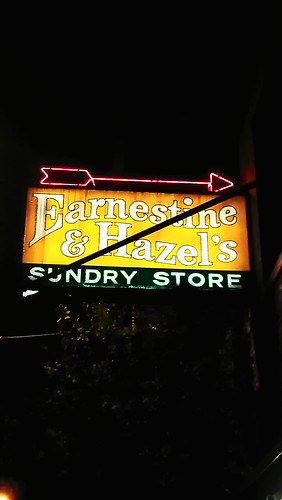
This gig at the picturesque Ernestine & Hazel's on South Main was far and away the most sublime I've ever had the pleasure of taking part in, ranging from the duo set I did with Linda under the "ExCon" moniker, to the reconstituted Linda Heck and the Train Wreck power trio incarnation (with me on drums and the fabulous Jim Spake on sax), to the performance of the entire "Transformed" album as a quartet, with Spake beautifully augmenting the line-up as required.
It couldn't have possibly been better, and there were moments where I felt I was floating above it all, as a detached observer. Sadly, there is very little in the way of documentation of this amazing night. The venue was dark, and what little light there was emanated from behind the band, which works for the human eye, but not so much for the video camera.
It was a profound experience all around, and I felt incredibly alive and attuned to my surroundings for the four days of recording sessions and rehearsals running up to this night, and even more so on the night itself. Then the next day I was on a plane back to London.
Tonight Linda is holding a CD release party in Sewanee, Tennessee, her adopted home town. The plan is apparently to hold one event in every place where recording for the album took place, which just leaves Nashville and London on the list.
Onward!
Linda Heck & The Train Wreck
Linda Heck - Guitar and vocals
John McClure - Bass
Jimi Inc. - Drums & vocals
Jim Spake - Sax
The Linda Heck Experiment
Linda Heck - Guitar and vocals
John McClure - Bass
Kurt Ruleman - Drums
Jimi Inc. - Guitar and vocals
Jim Spake - Sax
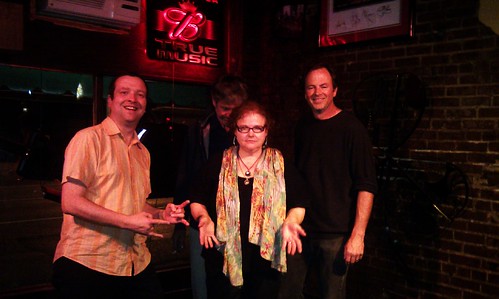
Just back from a great 10-day visit to Memphis, encompassing a lot of good food, family, friends, a bit of final studio work on the Linda Heck album, and a very enjoyable show at Murphy's, across from the once mighty Antenna Club - now occupied by a photography studio.
Chris Davis of the Memphis Flyer gave us some nice coverage, which elicited some interesting geekfeedback when I posted it to Twitter. Here are a few of what felt (to me) like highlights of the show, though it's important to note that we had no rehearsal. (Poor Kurt had never even heard half the songs in the first set, some of which dated back to the earliest period of Linda Heck and The Train Wreck. It's a testament to his musicianship that no one in the audience would have been any the wiser if we hadn't said something in his defence - not that he needed defending. He and John are the dream rhythm section.) These four songs are from the new project, hopefully coming to a pair of ears near you sometime soon. Extra special thanks to Doug Easley and Davis McCain for the fine guitars and amp.
The burst of beautiful spring weather we've had recently has evaporated, and I find myself looking out my window on a grey and unseasonably cold London Sunday afternoon, struggling to grasp that the events of the past week were real, not imagined.
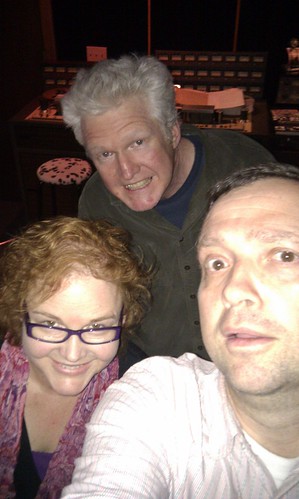
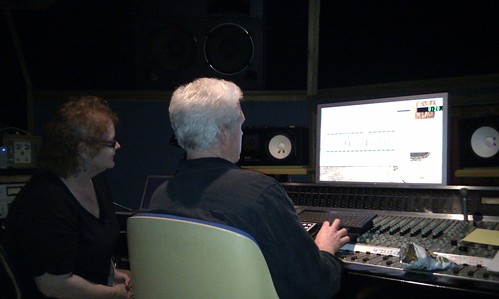
I returned Thursday morning from a four-day lightning trip to Memphis, having at last escaped the clutches of Eyjafjallajokull. There I had the indescribable delight of three days in the studio with Linda Heck and the ever-amazing Doug Easley.
I shot plenty of video on my Flip Mino, but sadly this precious device seems to have died somewhere along the way, and I can't even retrieve the videos. I do have this one short segment shot on my phone, wherein we're listening as our old band mate Kurt Ruleman adds some percussion parts to a track.
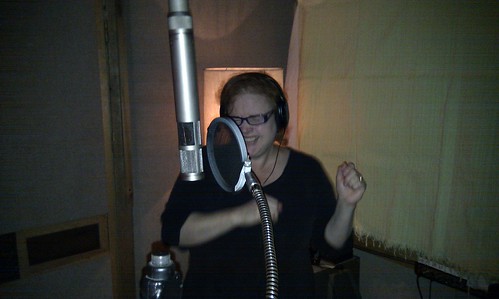
The main focus of these sessions was vocals: Linda re-cut a couple of main vocals, and I added my voice to ten tracks, on some of which Linda sang with me. We have always had a deep unspoken musical understanding, and I find that harmony ideas flow thick and fast in my mind when I hear her sing. We also have a tendency to sound alike, or more accurately, I have a tendency to sound like her when I sing with her. I am curious to see if, when this collection of songs sees the light of day, listeners will even realize it's not all her.
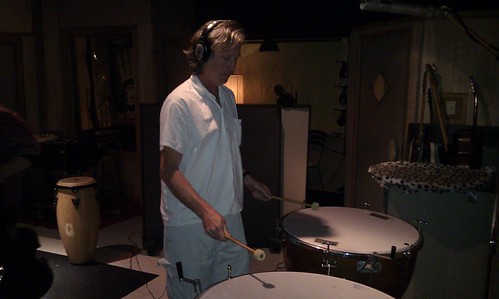
We also synched up the guitar parts I recorded for four songs in London, so she and Doug could hear properly for the first time what we did (as opposed to the mp3 versions I sent previously, which have a Phil Spector-esque quality to them - as in it is often hard to unpick sounds). Kurt came in to do some percussion, including playing Doug's tympanis, which used to belong to Stax.
There were some more details added here and there: Linda played some sparse pedal steel parts on "Transformed," to which I also added pedal steel (though in my case it is strummed slowly, to sound like a tanbura); Doug added some beautiful pedal steel and virtual vibes to "At Your Door"; and in the absence of our friend John McClure I punched in a sparse bass line during the breaks in the same song.
So, at this point, I'm guessing this project may be near completion, apart from the mixing, not quite two months since it was begun. Linda, John and Kurt cut 15 basic tracks and vocals at the beginning of March, I did my basement sessions later the same month, Greg Easterly and Mark Harrison added strings, sparse guitar and synth to a couple of songs in Nashville in April, and this string of vocal/percussion/overdubs sessions in Memphis takes things to a pretty complete level, at least as far as I can hear.
I am as excited about this as anything I've ever been involved with, and I love every second of the 51 minutes or so which these songs comprise. I think Linda's writing and singing is in top form, and the playing from her and Messrs. McClure/Ruleman/Spake/Duckworth/Easley/Easterly/Harrison is tasteful and fine throughout. For my own part, having put the guitar down for 15 years, I feel like I play better than I ever did when I was trying consistently. Perhaps I should not play more often.
Seriously though, it's interesting to have the perspective of time to put things into context. I used to find it daunting to go into the studio in isolation to do guitar or vocal parts, and was prone to clowning in order to hide my discomfort or lack of self-confidence. I also recall many times being in the studio with no clear idea of what we were trying to achieve - this sometimes gave rise to interesting accidents, but more often led to indifferent results.
The contrast with the past could not be greater in this project, at least as I have experienced it. For once, I have felt a sense of lucidity and calm throughout, in having ideas worked out in advance which ended up being executed as planned or improved through collaboration with others. I guess this is the much-vaunted "confidence and ease that comes with age and experience," and I can only hope it eventually permeates all other aspects of my life.
The material in question also makes a good contrast with the much-lamented "Lost Album." Whereas we either ran out of money or patience, or perhaps both, before that body of songs could be satisfactorily mixed and presented as a finished, polished product, every song here already feels like a complete, self-contained work. Every song here, bar one, has a definite ending, rather than a lazy fade. The arrangements are more sophisticated and there is much more going on sonically, but the sound is much sparser - another lesson of experience being a greater capacity to listen and self-edit. Saying nothing, or little, usually carries more weight and meaning than a filibuster.
And the nature of the songs in this set is also a long way from 1992. What are the songs about? One thing I have realized after all these years is that Linda's writing process is probably a much more complex affair than might seem apparent to anyone but her, which makes interpretation a fairly treacherous task. There are some non-obvious shifts in point-of-view which I am now aware of, and in one case I assumed a song to be about a very specific individual, only to be told that the lyrics had the widest and most general application imaginable. So, in short, it's not for me to try to interpret or explain, because I may be wrong, apart from the songs I have asked about and had explained to me. However, I do hear some common themes cutting across most of the songs involved here: emotional estrangement (both from the other and the self), death (in a variety of senses/guises), vulnerability, acceptance, forgiveness, self-discovery, rebirth. Grown-up stuff, but beautiful and a lot of fun. I am ecstatic and thankful that I got the chance to be a part of it.
At our New Year's Day show at The Cove, we played precisely four covers: Donovan's "Hurdy Gurdy Man," Micky and Sylvia's "Love is Strange," a David Wills song called "Barrooms to Bedrooms" which The Country Rockers used to do a beautiful version of, and this oddity.
I described the song and my discovery of it, and also put the lyrics and chord progression in this earlier post on The Grundies, for whom this was something of a signature tune. The one detail I left out of that post was the name of the producer responsible for the cache of weird records I found along with "I Found My Love in Memphis," mainly because I couldn't remember. My friend Doug Easley, with whom I had the pleasure of spending time before the gig, reminded me that it was one Style Wooten, who had a studio on Park Avenue in Memphis, and whom Doug had once met. (Doug also reminded me that the flipside of this George Clappes single was a terrible song called "The Sound of Wedding Bells," and that Memphis blues standard-bearer Don McMinn is rumored to have played on some of Style Wooten's records.) It seems as though not a lot else is known about Style Wooten, or what happened to him. Jim Spake, who played some wonderful sax with us, and whose voice can be heard off-camera here at the end, said he found a similar cache of Style Wooten records somewhere in the middle of nowhere in Arkansas - maybe he retired there.
We played this in our truncated third set on New Year's Day (truncated because almost everyone had gone home), and I forgot at the time to dedicate it to our friends Jack and Amy, who say this is their song. In this video, I am showing everyone else how this very peculiar song goes, or at least the way the Grundies played it. We were never that sure from listening to the record because the bass player seemed to be playing it for the first time when they cut it. All very strange, but oddly appealing.
It's a curious and oddly satisfying thing to have a band take shape around you, and then to watch it take on a life of its own in your absence, both when you're out of the country and also back in again. Such was the case with Hot Joe, still one of Memphis' finest and weirdest groups, in my humble and probably irrelevant opinion.
As a natural extension of the friendship between Linda Heck and The Train Wreck and K9 Arts, I started hanging out with K9 guitarist Jim Duckworth and my band mate John McClure in 1987 and working up some songs, mostly old standards, with me as the vocalist. Jim had an amazing music collection and an encyclopedic knowledge of jazz from its earliest roots to the modern experimental scene, and he turned me on to a lot of wonderful music. These afternoons spent at Jim's house were usually accompanied by copious amounts of coffee, so naming the group was a very easy exercise indeed.
Our first gig was with Rich Trosper on drums, I believe at some sort of art opening or party in Downtown Memphis, though the venue and occasion totally evades me, probably because I was fairly terrified at the time by the prospect of fronting a band as vocalist for only the second time ever. I can't recall exactly what our set was, but it contained "Cheek to Cheek," "Moody's Mood for Love," "Strawberry Fields Forever" (yes, a straight jazz version), and God knows what else. At some point we debuted a version of "Ornithology" with original lyrics by me, which so exited an apparently well-known local "jazz dude" in the audience that said enthusiast mounted the stage and commandeered the microphone to "scat". I've always hated scat. I was very irritated by this man at the time, but ended up being mightily amused by the fact that, whenever the imperious scat-cat wannabe in question ordered (rather than requested) Rich to "lay out," Rich responded with a very loud rim-shot or flam of some sort to piss the interloper off. Eventually he gave up and left the stage.
From these humble beginnings arose Hot Joe, and the group, in various permutations, began to get real paying gigs, mostly weddings and cocktail receptions, which, in addition to a civilized audience and a guaranteed pay check, also typically included free food and drink - not a bad alternative to the thankless smoke-filled dives we were used to. The line-up of the group evolved over time, though the core was typically Jim and John, plus Jim Spake on saxes and either Ross Johnson or Doug Garrison on drums (sometimes both together). On a couple of occasions Jim Duckworth had other obligations, and I recall doing two nice gigs with John Gaskill (a wedding) and Ed Finney (some sort of corporate event in the garden at Brooks Museum) on guitar. I was intrigued by Ed, who wore a compass on his wrist as opposed to a watch - which he explained something along the lines of "I may not be on time, but at least I know which way I'm headed."
Sometime after I left for Japan in 1988, Robert Palmer turned up in Memphis and became part of the band - his skronky clarinet an interesting foil to Jim Spake's refined playing. This line-up, which often included both drummers, became very popular over the next two years, and while maintaining the civilized paying gigs, also played harder-edged material in the clubs. They worked up a rocking mash-up of two of the best Mingus tunes, "Better Get Hit in Your Soul" and "Wednesday Night Prayer Meeting," a very fast, Klezmeric version of "Over, Under, Sideways, Down," with Jim Spake and Bob Palmer trading solos, and expanded "Strawberry Fields" into a long medley improbably including "Don't Stop 'til You Get Enough," "Haitian Fight Song," "The Immigrant Song," and "When the Saints Go Marching In." There were also a few fine originals by Jim Duckworth, including "Mimi" (a K9 Arts song) and "Jonah," which was a beautiful song, and Linda Heck's "Look Out for Love."
In the summer of 1989, I came back to Memphis during the summer break, and the guys very kindly arranged a recording session while I was in town, and we also played a gig at the P&H Cafe, which I think might have been a WEVL benefit. I don't remember that much about the gig, apart from the fact that we played versions of "My Favorite Things" and "'Round Midnight" with original lyrics I had written. The recording session, on the other hand, I remember very well, and still have tapes from it to remind me of what a pleasant experience it was. The full line-up (Jim D., Jim S., John, Ross, Doug, Bob, me and Linda Heck) went into Doug Easley's studio behind his house on Marion Street off South Highland on a Saturday night and recorded into the wee hours. We cut "Better Get Hit/Wednesday Night Prayer Meeting," "Over, Under, Sideways, Down," "Mimi," "Strawberry Fields Forever," "'Round Midnight" (with my lyrics), "Ornithology" (ditto), an old Linda Heck and The Train Wreck song "My Crying is Done," two versions of "Look Out for Love" (one with Linda on vocals, and an "answer version" with me substituting my own lyrics), and a very short "Cottontail." It was a blast, and the music still sounds wonderful today.
Jim Duckworth drove me back to my parents' house that night, and Bob Palmer, who was along for the ride, regaled us with some very funny stories of his adventures. My parents' house is not far from the home of the late Sam Phillips, whom I saw many times over the years mowing his own grass, and this triggered an anecdote from Bob, which he attributed to Sam Phillips himself. It seems that when Fidel Castro was in New York City in 1959, Sam Phillips managed to get the number of his hotel room, and possibly somewhat the worse for wear at the time, called it. Bob claimed that Fidel's brother Raul had answered the phone, and told Sam that Fidel was unavailable, to which Sam apparently said, "Well, I just want to wish him well with that revolution down in Cuba, but tell him that if it doesn't work out, he always has a home in Memphis, Tennessee, and that comes from Sam C. Phillips."
I have no idea whether this story was true at all, but I found Bob Palmer to be a delightful storyteller and a very funny man. And he was into Persian classical music, as was I, and I seem to recall we ended up talking about parallels between the Charles Mingus band in 1964 and Persian classical ensemble performances, which are punctuated by unaccompanied solo segments from each of the instruments. That was the sort of conversational side alley you could find yourself wandering down when talking to Bob Palmer. Wish I'd had a chance to get to know him better.
I would really like to see a comprehensive list of all the songs played during the life of Hot Joe, because it would almost certainly run to hundreds. The paying gigs, when they required a vocalist (which was by no means always the case) often came with an obligation to learn some new songs, and I recall that we worked up a really nice version of "I've Never Been in Love Before" for some newlyweds' first dance, and another couple wanted the Beach Boys' "Wouldn't it be Nice?" for their first song. We played it faithfully, and luckily I have a pretty wide vocal range, because it's a hell of a song to sing as the first of the night.
The paying gigs, particularly the corporate stuff, gave license for some fairly subversive material, because typically no one was really paying attention, so it was not uncommon to hear the likes of "See Emily Play" slipped in among the Chet Baker numbers. It was also an interesting opportunity to observe people, because the band members were typically ignored and I was singing maybe one in three songs, so I had ample opportunity to look around the room. At one wedding reception, I remember Jim Spake was featured on a particularly fine version of (I think) "In a Sentimental Mood" and a very old woman stood close by and cried her eyes out until someone took her back to her seat to comfort her.
My abiding memory of the remarkable experiences I had with this group, beyond the awesome recording session, was a Christmas show we did on Wally Hall's Memphis Beat program on WEVL, I believe in 1991. The full line-up was there, minus Bob Palmer, and Linda Heck and I traded vocal duties, teaming up on "Let it Snow, Let it Snow, Let it Snow" and "Christmas Time is Here." The evening ended with me behind Ross' drum kit beside Doug Garrison as we all accompanied Ross doing a predictably hilarious reading of "The Night Before Christmas" (including ad libs such as in the description of Santa Claus, "There were broken veins in his nose - he'd been drinkin'") which I have on tape somewhere and is still one of the funniest things I have ever heard.
I always enjoyed getting to see these guys play up close - being allowed to sing with them, and even getting paid, was purely a bonus.
Back in the 1980s, Memphis was still struggling to come to terms with the disregard it had shown for its musical heritage. The Beale Street renovation wasn't complete until October 1983, and even with this positive step forward, it felt to me (and I'm sure I wasn't alone) that the comeback strategy was more about emulating Bourbon Street than about highlighting what was really special about the musical legacy. It's not as if there was any shortage of raw material to work with at that time, but opportunities were missed or deferred, and the city still has a lot to answer for in its treatment of both people and historical sites - I still find it unfathomable that both the Stax and American studios were demolished. It was a time when giants wandered forgotten and unrecognized. On the positive side, there was always a chance that you could run into a hero or two if you were in the right place at the right time.
Sometime in 1983, I remember dropping by Dan and Linda's "Green Acres" shack in Binghampton, and there sitting on the sofa, was an older man who was introduced to me as Paul Burlison. I mean, Paul Burlison, hanging out in the ghetto with some impoverished kids, goddamn! Someone told me later that he hadn't touched a guitar in years at that point, and might have even forgotten some of the old Rock-n-Roll Trio numbers.
Sometime in the winter of 1987/88, Hans Faulhaber, an architect and musician I knew, invited me to play rhythm guitar on a single he was going to record at Phillips Recording, around the corner from Sun Studios. Just the chance to set foot in such a hallowed studio again (I had done another session there in 1984) was enough for me, but to make it even better, I was going to get to play with Roy Brewer (drums), Doug Easley (bass), and Bruce Lester, the lead guitarist from The Beat Cowboys, a hot-ass Nashville-style guitar picker of the Telecaster-slinging variety. I think I was going to get paid too, which was a rare surprise in my musical career. But the real surprise was still in store, for when I arrived at the studio, I discovered that the session was going to be engineered by none other than Roland Janes. Roland Janes - the most influential and recognizable unknown guitarist of his age, creator of some of the wildest and most provocative guitar stylings of the rock-n-roll era.
He was a really nice man, very funny and curious about things. There didn't seem to be that much going on at Phillips Recording back then, and I don't know how connected to the wider music world he really was at that point. Like Paul Burlison, he was eventually given the attention and recognition he so richly deserved, but at that point in time I sense that he was still living through the nuclear winter which all but the most popular of his generation were enduring. As he and Doug were setting the levels on the drums, I was already in position with the acoustic guitar, absentmindedly playing and singing a few songs to amuse myself, one of which was an early Beatles' song, possibly "I Should Have Known Better." Roland hit the studio intercom button. "What's that song you're playing? I like that." He didn't seem overly familiar with the Beatles' catalogue. George Harrison would probably have given his favorite sitar for a chance to be there with that man just then, and he (Roland) may not really have had that much idea of his own influence on the world. Presumably he got some inkling once things picked up for him.
We recorded two songs that day, written and sung by Hans, and released as a 45. The songs were:
Evil - A song inspired by an altercation with some belligerent rednecks at (I believe) an Elvis Costello show. It was a fast country number with some unbelievable guitar playing, and an almost out-of-control vocal performance by Hans.
"There's evil in the home of rock-n-roll, Of that I'm sure, how much I just don't know, It comes out in the night, It's dressed in red and it likes to fight, I don't."
2003 - This was an odd sort of loping country-reggae song, which I would really like to hear again if I could only find my copy. It's the only song I can think of on the topic of earthquake preparedness, something which Hans, as an architect, was very concerned about - with just cause, of course, because the last major New Madrid Fault quake was so fierce that the Mississippi flowed backwards in some places and church bells rang on the East Coast. In the last line of the song, he sings, "I can't say when it will be, my choice would be 2003." Indeed 2003 seemed to be a long way off back in 1987, but it sure came and went fast, luckily with no earthquake. That's no excuse for complacency.
"Big quake's comin', now you better beware, It's gonna get the best of me and you, It's gonna tumble old Memphis down, We're gonna really be the Home of the Blues.
That fault's gonna open so wide, Ain't gonna be no place to hide.
It happened here once before, When we weren't even around, Next one's gonna be twice as bad, It's gonna shake this city down.
That fault's gonna open so wide, Ain't gonna be no place to hide.
So get your people settled down, And talk to 'em logically, Explain in no uncertain terms, What is and what will be, Prepare them for the time, They gotta start a brand new life, They gotta start out on their own, They gotta build a brand new home."
I always really liked this song, both the music and the message, which still seems to go largely unheeded. Hans delivered my copy of the single in person, when he came to visit me in Tsuru City, Japan, shortly after I moved there on a two-year teaching gig in August, 1988. We hung out for a week, he played me some amazing recordings he had made with Tommy Hull, and I even arranged a few proper Japanese earthquakes for him.
I had a long Skype chat with Linda Heck yesterday, ahead of her solo gig at Otherlands in Memphis. She said in passing that she had always had an awful lot of material beyond what the band played, which I guess I should have expected, but this revelation still took me by surprise. I have never heard this stuff, and maybe no one else has either. The mind boggles. During its various incarnations, my guess is that the total Train Wreck repertoire of Hecktunes ran to 60 songs, or thereabouts. The 21 songs on what I have taken to calling "The Lost Album" are a pretty representative cross-section of the material the band played during its life, with a bias towards material written in the later period, when Linda had really hit her stride.
Sometime during the final incarnation of the band in 1988, Linda had begun seeing Clayton Rogers, to whom she is now married. Clayton lived in the same building as our mutual friend Belinda Killough, and became part of the social circles in which we all shuffled. I have always been surprised that we hadn't met previously. He was raised in East Memphis, as was I, and we knew a lot of people in common (he went to MUS boys' school, the Midtown contingent of which I knew because some of them dated girls in my high school). Clayton is wicked smart, with a surreal sense of humor, and is a very generous person. A talented architect, he totally revamped the big house they ended up buying on Madison in Midtown after I returned from Japan in 1990, which had been a doctor's office for years and was in need of a lot of loving care. It was a fairly Herculean task, having seen it in its unadorned state, but he and Linda made it something truly impressive during the time they were there, as an expression of their shared love of design and all things cool.
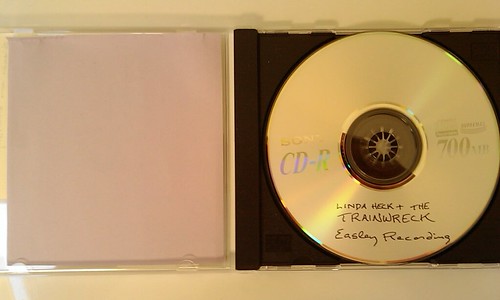
Clayton's father had died unexpectedly some time before, at a tragically young age, and had left him some money, a part of which he decided should go to fund a proper recording session for Linda and the band. Sometime in the late spring/early summer of 1991, we went into the fantastic Easley-McCain studio (back then it was known simply as Easley Recording) to begin work. I had visited the studio when it was still in the process of refurbishment from the dilapidated state in which they acquired it, and had also seen photos of what it looked like before it had been touched. Doug Easley and Davis McCain had worked wonders with it. It was an amazing place to be, and I always looked forward to going there, as I would do for various sessions over the years, or just for a social visit. A rather unassuming building from the outside, it had a nice, homey feel to it inside, with a comfortably decorated reception/chill-out lounge just inside the door, leading to the control room and main room. There was an office upstairs, where presumably Chips Moman sat at a desk at some stage counting his gold records, and as I recall there were two reverb chambers running vertically through the building, which were actually used from time to time. The main room was colossal, maybe something like 1600 square feet, with three isolation booths, and what must have been a 40-foot ceiling. My estimates of dimensions may be off a little bit, but to put things in perspective, you could have comfortably fit a small symphony orchestra in the main room with no problem.
Working with Doug and Davis was a great experience. We had known them for years and all got on very well. I had first seen Doug playing in a band with his brother Ron and Bob Holmes, later of the Modifiers, at a fraternity party at MSU in 1980 - I was there because some of the older guys I worked with were members. Davis I met probably in 1981/2, when I unsuccessfully auditioned to be the second guitarist in his band Barking Dog. Davis was later the sound man at The Antenna Club for a number of years, and I think this experience of doing things under pressure and being pragmatic was one thing which made him so easy to work with in the studio. It always struck me that Doug and Davis were more concerned with capturing a vibe or performance when the timing was perfect than with over-engineering things. In contrast, I remember a session I once worked on at a different studio, wherein the miking of the drums alone took four hours, during which I lost the will to live, let alone record. Doug had a particular talent for surrendering to serendipity and accidents that occurred, and letting them guide the process, which suited me fine.
We initially recorded the basic tracks over three or four sessions, in three different configurations based on who was drumming. As had been the case through too much of the band's life, it was the ever-rotating drum stool which drove the process. Doug Garrison (whom we had played with in Hot Joe, but who will be better known for his work with Alex Chilton, Charlie Rich, and The Iguanas) graced us with some fine drumming on seven songs, Ross Johnson played on five songs, and I played on the other nine. We were joined on four songs by Jack Adcock (611, The Bum Notes, Professor Elixir's Southern Troubadors) on miscellaneous percussion. Jim Duckworth (Panther Burns, The Gun Club, Marilyn and The Monroes, K9 Arts, Hot Joe) played some characteristically beautiful guitar on four tracks, and the inimitable Jim Spake played sax on three tracks (should have been more!). Clayton contributed water-filled wine glasses and whirring plastic tubes to the eerie "Chalk Outline" track. Everything else was covered by Linda, John, and me.
Bafflingly, once we had recorded the basic tracks for 18 songs, the whole project seemed to go dormant for a year. Linda and Clayton had a lot of other stuff going on, as did we all, but in retrospect it strikes me as odd that, given how well those first sessions went, we weren't all impatient to finish things up. It was a more than a year later before we would return to the studio to do some refinements and mix. We realized we had more space left on one tape reel, so we quickly recorded three more songs, which are far less produced than most of the rest of the album, though I think they are all good performances: "When Water Burns," "If I'm So Smart," and "Sunday."
I am still very moved by this recording, a mixture of pride and nostalgia for what were very enjoyable sessions with wonderful people in the best studio in the world. I play it for my children from time to time, and they enjoy it as much for its musical merits as for their delight at the occasions where they can pick my voice out of the backing vocals. As with everything viewed retrospectively, I can hear things which I would want to do over if given a chance, and I would love to remix one or two songs completely. I am not sure if the master tapes even survived the fire at the studio in 2005, so the idea of remixing it one day may be a complete impossibility. Speaking strictly for myself, I think we could have spent more time differentiating some of the guitar parts and making them more forceful, but we had a fairly limited budget. It's always possible to over-analyze things across a temporal gulf such as that which separates me from these recordings, but as a package, I think they are wonderful just as they are. But don't take my word for it. Eight of the highlight tracks currently appear in the music player on Linda's MySpace page, so listen for yourself (these songs are marked with an asterisk below). Perhaps someday the entire album will see the light of day.
The Songs
1) Dig (also known as Dig My Own Hole)* [2:18]
Linda Heck - vocal, electric guitar John McClure - bass guitar James Enck - electric guitar Doug Garrison - drums Jim Spake - baritone sax Jim Duckworth - electric guitar
This song has been featured on a couple of compilations, and is something of a signature tune for Linda. An ode to defiance and self-reliance:
"Do my own thing in my own time, I'll live my own life, speak my own lines, My ears are closed, my shoulder is cold, I'll make my own bed, dig my own hole"
Fantastic guitar work by Mr. Duckworth and a strong vocal performance by Linda.
2) Professor of Love [3:11]
Linda Heck - vocal, acoustic guitar John McClure - upright bass, acoustic guitar, synthesizer (faux marimba sound) James Enck - electric guitar, trumpet, backing vocal Doug Garrison - drums Jack Adcock - guiro
I never quite understood the derivation of this song, but I think it started from a character idea that Roy Barnes had come up with for a film - a mysterious expert in love for troubled hearts. Roy later shot a music video for this song, which did not, in fact feature a Professor of Love character. Would love to re-do the end of the guitar solo, but that's life. The rest of it is spectacular.
3) Failing Sky* [2:49]
Linda Heck - vocal, electric guitar John McClure - electric bass James Enck - drums Jim Duckworth - electric guitar Jim Spake - tenor sax
One of my very favorites, with some really special guitar work from Jim Duckworth, and a splendid solo by Mr. Spake.
4) Laff* [2:06]
Linda Heck - vocals, electric guitar John McClure - electric bass, electric guitar James Enck - electric guitar, drums Jim Duckworth - electric guitar
This song was written about Jim Duckworth as part of the K9 Arts trilogy, as I recall in recognition of his undying appreciation of all things Linda Heck and The Train Wreck. Jim laid down an intro part which was amazing but very heavy and a bit sinister, which we felt was out of character with the sentiment of the tune, so we stuck to his straightforward chordal accompaniment until the end of the song, when we faded in two lead parts. I was never sure that he was happy with this arrangement, but I think it works beautifully.
5) Sunday [2:21]
Linda Heck - vocal, acoustic guitar John McClure - electric bass James Enck - electric guitar, drums
A great song about self-realization, inspired by a long night out. This was probably the most basic arrangement on the entire album, and I like its understated quality. We recorded it pretty much on the fly at the end of the process, and it felt really nice at the time. Great vocal performance, and I still find it hard to believe that's me on the drums (ditto for the preceding track).
6) When Water Burns [2:53]
Linda Heck - vocal, acoustic guitar John McClure - electric bass James Enck - electric guitar, drums, backing vocal
This was a barn-burner from the Roy Brewer era of the band, which we decided to record at the end of the sessions when we realized we had tape left over. The bass isn't high enough in the mix for my liking, but it's a spirited performance.
7) If I'm So Smart [2:30]
Linda Heck - vocals, electric guitar John McClure - electric bass James Enck - electric guitar, drums, backing vocal
A country rocker, also recorded at the end almost as an afterthought, but it's an honest and strong performance.
8) Every Mother's Son [2:55]
Linda Heck - vocal, electric guitar John McClure - upright bass James Enck - drums, flute, recorder, bass recorder
A beautiful song, apparently about the uncritical love of a parent for a child, as observed by a third party. I had made a four-track demo of this with Linda (where is that, I wonder?), but we struggled a bit with this one. I suggested to John that he think about "Pet Sounds" for the bass part, and his playing really makes it what it is, and we later added a droning bowed bass part. Doug thought my flute/recorder bit sounded like a calliope, which I suppose it does. The reverb on Linda's voice is a tad overwrought. This is one I would remix given the chance, but it is still beautiful.
9) Chalk Outline [2:31]
Linda Heck - vocal, electric guitar John McClure - electric bass James Enck - drums, electric guitar Clayton Rogers - whirling plastic tubes, musical wine glasses, bathroom sink Jack Adcock - nut shells, flexitone
The serenity of a picnic is rudely disturbed by the discovery of a chalk outline of a body.
10) It Is Alright* [2:35]
Linda Heck - vocal, electric guitar John McClure - electric bass, piano, crash cymbal James Enck - drums, electric guitar Jack Adcock - vibraslap
This one still gives me goose pimples. Written for Linda's roommate of the time, Melissa Thornton. It's mostly Linda and John for two-thirds of the way, very subtle and beautiful, with a just a bit of cymbal work from me and Jack's vibraslap, but the ending I find uplifting, to match the message of the song. I had to overdub the crash cymbal with mallets to build up the suspense for the break to the finale, and then John (standing next to me) came in and knocked it home.
11) At A Party* [2:49]
Linda Heck - vocals, electric guitar John McClure - electric bass James Enck - drums, electric guitar
This track, like the preceding one, is recorded with Linda playing a guitar strung with the high strings tuning (which Jones Rutledge describes as "Angel Hair") I alluded to in a previous post. This, coupled with my electric, occasionally sounds like a 12-string - very full. The arrangement is very simple, but it sounds complete, and I like my drumming here. The ending is a bit odd, and I'm not sure how that happened, or why we didn't fix it.
12) Magic Wand* [1:52]
Linda Heck - vocals, electric guitar John McClure - electric bass, electric 12-string guitar, backing vocal James Enck - electric guitar, backing vocal Ross Johnson - drums
I think this may be one of the earliest Linda Heck songs I can recall hearing. I'm pretty sure it was on that original home demo cassette she returned to Memphis with in 1986. It's a great song about the desire for escape. One of the few occasions in which we attempted multi-part harmony, with good results. We should have done so more often.
13) House is Burning* [2:11]
Linda Heck - vocals, electric guitar John McClure - electric bass James Enck - backing vocal Doug Garrison - drums Jim Spake - baritone sax Jack Adcock - bongos
I think I was still stuck at work when this was recorded in a session starting at midday, but when I heard it I thought there was no need for another guitar because it sounded perfect as it was. And so it remained. As I wrote earlier, Cordell Jackson thought this song was about cocaine addiction, but anyone actually listening to the lyrics will realize it is about gossip and schadenfreude, recurring features of life in Memphis, and indeed anywhere where humans are present.
14) Split the Earth [2:34]
Linda Heck - vocals, electric guitar John McClure - electric bass James Enck - electric guitar, backing vocal Doug Garrison - drums
Another rocking song from the reinvigorated, newly empowered Linda Heck songbook of the 1987/88 vintage. I used to really enjoy playing this one live. I recall that Doug Garrison wasn't particularly satisfied with his playing on this track, but we assured him it was awesome, which it is.
15) Slipping Away [2:02]
Linda Heck - vocal, electric guitar John McClure - fretless electric bass, electric guitar James Enck - electric guitar Doug Garrison - drums
Some very dreamy guitar textures here, a nice melody line, and great lyrics about procrastination. John lays down a great lead guitar part, demonstrating why he was always more than just a pretty bass.
16) He Rode By [2:34]
Linda Heck - vocal, acoustic guitar John McClure - upright bass, electric guitar Doug Garrison - drums
The other song I missed due to the time slot, but there was nothing I could add. It is simple and elegant.
17) Today* [3:12]
Linda Heck - vocal, electric guitar John McClure - electric bass, backing vocal James Enck - electric guitar, backing vocal Doug Garrison - drums
One of the very best Linda Heck songs, and one of the most exciting to play live in my opinion. Written for the late Craig Shindler to wish him well at a low point in life, it has a positive message characteristic of its vintage:
"Pain will go, before you know, Let it fall away, Happiness is within you, And it can be today"
It's an unusual and intriguing structure, which is probably why I have always liked it, because it feels like it's always moving to a new level. Starting in C and reverting there for the bridge, switching to B for the verses, with the odd A to F-sharp interlude. Outstanding performance from Doug here, and I like the rising harmony vocals in the instrumental section. Linda is sublime throughout.
18) B-Movie [2:13]
Linda Heck - vocal, electric guitar John McClure - electric bass, acoustic guitar James Enck - electric guitar, backing vocal Ross Johnson - drums
"'She's in the arms of another man,' he said, 'What should I do, shoot myself dead?' Now wait a minute, that's quite extreme, How dramatic, how B-Movie, Is it worth it? After all, just think how it would really be, Just think how it would really be."
Great Nashville-style acoustic picking from John here, and I like the way my harmony voice only comes in as the voice of the lovesick loser.
19) Nightmare [2:18]
Linda Heck - vocal, electric guitar John McClure - electric bass, acoustic guitar James Enck - electric guitar Ross Johnson - drums
A song, unsurprisingly, about a nightmare, apparently about being chased by dogs, but with a happy ending. Trippy, echo-laden vibrato guitar which I like.
20) Beer and Guitars [2:24]
Linda Heck - vocal, electric guitar John McClure - electric bass, electric guitar, backing vocal James Enck - electric guitar, backing vocal Ross Johnson - drums
I can remember thinking at the time this song was written that it was a gentle joke, and perhaps it was, but as I grow older, I find it to be increasingly poignant. The title evokes the sign of Fred's Hideout (which featured a cartoon mug of draft beer and a guitar), our beloved dive of old where so many great shows took place, but which was also the home to many hopeless, broken alcoholics, whom this song seems to portray.
"Well there's nothing like whiskey and drums, To ease the pain when it comes, We see hope in each glass, As we twiddle our thumbs, There is nothing like whiskey and drums, 'Cept bourbon and rain, And beer and guitars"
Beautiful volume-pedal guitar from John, approximating the sound of the honky-tonk pedal steel as it might have appeared on Sister Lovers.
21) 'Tis the Season [7:22]
Linda Heck - vocal, electric guitar John McClure - electric bass, Hammond organ James Enck - electric guitar, tenor sax Ross Johnson - drums Jim Duckworth - electric guitar
This was a song Linda wrote in 1987 for the 20th anniversary of the Summer of Love, which we used to do towards the end of shows at the time. The night that Ross sat in with us on short notice at Fred's Hideout in July 1987 to fill in for Roy Brewer after the birth of his first daughter Eva, we played a fairly raucous version of it, so it seemed natural to have Ross back for this recording. No one was disappointed. As I recall the song was vaguely inspired by a particularly demented contemporary Sky Saxon EP I had bought, and we pretty much cover all the psychedelic cliches here with feeling, including the "Helter Skelter" false fadeout and return (without which the track would be closer to ten minutes). Ross has the last words, which are "Ice cold Molson!" Amen.
*Available for streaming at www.myspace.com/thereallindaheck All songs by Linda Heck. Recorded at Easley-McCain Studios, Memphis, TN, summers 1991 and 1992. Engineered by Doug Easley and Davis McCain. Produced by Linda Heck, John McClure, James Enck, Clayton Rogers, Doug Easley and Davis McCain.
James Enck would like to thank all involved for a wonderful time, and the late Rich Trosper - whether you knew it or not, I was watching and learning. Thank you.


 Posts
Posts