Showing posts with label Ross Johnson. Show all posts

Friday, 20 November 2009

The Bumnotes/drum circle/Skronkadelic: 1990 - 1994

When I returned from my second stay in Japan in late summer 1990, I was thinner than when I left and had a pretty full beard, which I had insisted on growing in my second year on the JET Programme, mainly to piss off some of the conservative ideologues in the local office which had hired me. We're not talking ZZ Top, but nevertheless a respectable beard. I think I had only been back in Memphis a day or two when I went to see a band, I believe it was K9 Arts, at The Pyramid Club on Madison downtown. The Pyramid was a venue which had sprung up in my absence, about which I had heard varying reports, and my sense of displacement when I got there was heightened by the fact that my beard seemed to make me unrecognizable to a large number of people I had known for years. I decided to just roll with it, as a kind of experiment, and for most of that night, I felt like I was in some sort of parallel universe where I did not exist. Like George Bailey, or some sort of ghost.

It had never previously occurred to me that only two years away from Memphis would make re-entry such a strange experience. Time may flow slowly in Memphis, but it flows nevertheless, much like the Mississippi, which appears placid at the surface, but deceptively hides violent churning currents beneath. When you take yourself out of it, you may think that you can return to the place you left and dive back in, but it doesn't work that way. At least not for me, it didn't. As an older man, I now take all this for granted, but the younger me found it all a bit jarring.

Familiar music venues had gone, and new ones sprung up. There was the scene taking shape around Shangri-La and its emerging aspirations as a record label. The trio A Band Called Bud, which I had seen at Skateland Summer during my summer visit in 1989, had been threatened with legal action by Anheuser-Busch and had since become a quartet known as The Grifters. There was a definite sense of momentum building in the music scene, of ferment of some sort taking place. New bands, new people, a different vibe. Most of the musical projects I had been connected with were either on hold, defunct, or only required sporadic input from me. I would have to explore something different.

The Grundies and the revitalized Linda Heck phase was yet to come, and I started hanging out with my old friends Jack Adcock and Amy Blumenthal (now Adcock), who at that time lived in an oddly shaped building in an oddly shaped part of town - the forlorn virtual no-man's land between Union and Madison west of Forrest Park downtown. This area had seen widespread property accumulation in the 1970s and 1980s by some of Memphis' most prominent real estate speculators, in anticipation of some sort of boom which never materialized.

Jack and Amy lived on Marshall, around the corner from both Sun and Phillips Studios, and just down the street from the Bluff City Body Shop where the early Hell on Earth events took place. The body shop itself was adjacent to another locus of music making and band formation, Mark Gooch's loft space, also known by many as "The Sad Pad." Mark was the guitarist in legendary 1980s Memphis band The Odd Jobs, and also in the fantastic, but far too short-lived early 1990's band Bob's Lead Hyena, the drummer of which was Sad Pad resident Roy Berry, now of Lucero, and certainly one of the most interesting and refined drummers I have ever had the pleasure of hearing and playing with.

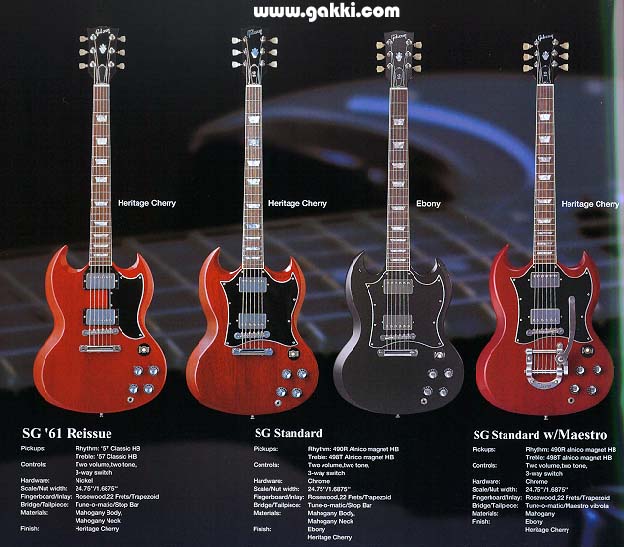
Mark Gooch also had one of the greatest guitar anecdotes I have ever heard. As I recall it, he had, as a teenager, owned a Gibson SG, which was stolen sometime in the 1970s in a burglary. Sometime in the early 1990s, he had walked past a pawn shop and seen an SG hanging on the wall through the window. Feeling nostalgic, he went in and had a look at it. Realizing that it was, in fact, his long lost guitar, he informed the pawn shop owner, went home to find the original purchase receipt with serial number, involved the police, returned to the shop, and reclaimed his guitar.

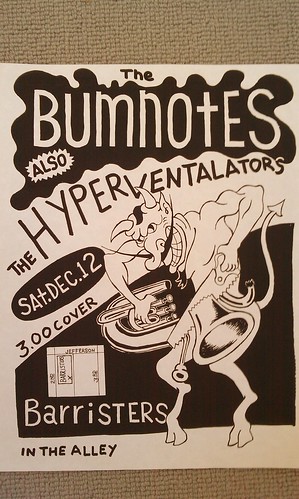
Anyway, back to Jack and Amy. I had known Amy since my university days, and I had met Jack back during the early days of Linda Heck and The Train Wreck. They had gotten together personally and musically, and their oddly-shaped apartment on Marshall had a sizable rehearsal room for the various things they were involved in. One of these was The Bumnotes, which had formed some time earlier, I don't know exactly when, how or why. However, the lineup during my involvement with the band was usually Jack on percussion and occasional drums, Amy on bass, Randy Uhlig also on bass, the incredible Bob Elbrecht on guitar, Wally Hall on vocals, slide guitar, and keyboards, Joey Pegram on drums, Brian Collins (who had played with Jack in 611, the first band to release a single on Shangri-La Records) on guitar and vocals, and me on tenor sax, percussion, guitar, or drums.
IMAG0677

The mention of Randy Uhlig indirectly brings to mind another amusing anecdote. Randy, who has been involved in the production of many Memphis films, also played the A&R man in the Roy Barnes film "Gone Down South," which features the Hellcats. Besides contributing an awful faux speed metal song to the soundtrack, which Randy's A&R man character plays for the Hellcats as an example of the kind of music he produces, I also contributed some sound effects for the film. These included a radio DJ voiceover used in the film, featuring WEVL announcer Catman, a German rockabilly enthusiast and tour promoter who was married to Barbara Pittman. (I never knew Catman's real name, but in writing this piece I have discovered it is/was Willie Gutt.) Catman was to come to my apartment on Forrest one evening to record the voiceover, and Roy arrived earlier to work on some sound effects with me first. My downstairs neighbor at the time was a very straight-laced and highly strung young woman, and unfortunately, Catman had gotten the apartment number wrong and knocked on her door first. She opened her door to find a fairly muscular German with greased-back hair, leather jacket, and motorcycle boots, whose first words to her were, "I'm looking for a guy named Barnes. He's makin' a movie." She apparently said, "Leave now or I'll call the police." God knows what she thought was about to take place upstairs, but it was nothing more exotic than Catman standing in my closet while he recited his DJ rap into a mic.

But alas, I once again digress. The Bumnotes used to rehearse at Jack and Amy's place every Monday evening, which made a nice start to the week after a first day back at work. We played gigs mostly at The Loose End/Epicenter Lounge, Antenna, and Barristers, and our material consisted of a roughly equal split between improvised psychedelic/ambient instrumental jams and psychedelic and blues covers. I recall we also once played a gig in the heat of the midday sun during the summer, on Mud Island (beside the River Walk model, not in the amphitheater, sadly). Jack, who is originally from Louisiana and has a wide range of unusual sayings, was suffering in the heat, and in a quiet moment blurted out, "I'm sweatin' like a whore in church!"

Most of the band's material escapes my recall, but I remember we had a great version of Albert King's "Born Under a Bad Sign" which featured Bob's scintillating guitar playing and Wally on vocals. There is also recorded evidence in the form of a number of live recordings I have on cassette but have not listened to recently, as well as two tracks recorded at Easley-McCain for the Loverly Records compilation: a Yoko Ono song called "Move on Fast," with vocals by Brian Collins, on which I play sax; and Butch Hancock's "Boxcars," with vocals by Wally Hall, on which I for some mysterious reason ended up playing Hammond organ, and it sounds surprisingly good.

I think it was sometime around 1992 that Jack and Amy moved to a house on South Cox in the pre-gentrification Cooper-Young neighborhood, and I began joining in with their Sunday afternoon percussion group, which typically featured them, Joey Pegram, Amy's brother Mike, Memphis artist David Hall, and sometimes the amazing Richard Graham, who in addition to being a very talented percussionist, is also a serious scholar of Latin percussion traditions. We played a variety of traditional African, Asian and Latin instruments, but Jack, who was always a very enthusiastic and energetic experimenter, had also made a variety of instruments, including berimbau, spike fiddles with gourd resonators, slit drums, a diddly bow, a kora, and a peculiar instrument called The Hell Harp, which consisted of the gas tank from a pickup truck with a metal arch welded on, from which a number of guitar strings were strung and anchored in the gas can resonator. It was played with a bow, and genuinely sounded like something from the bowels of Hades. Joey Pegram and I had both learned to throat sing around the same time, and I have some recordings made at the house which feature this along with the unusual mix of instruments on hand at the time.

The drum circle, which never had a proper name, played a number of public shows, all of which were organized by Richard Graham. One was during the dinner hour at the refectory at Rhodes College, wherein we marched around tables of very unimpressed frat boys and sorority girls playing our miniature version of a Brazilian batucada ensemble. This lineup was also featured in a performance in Handy Park on Beale Street, during the Memphis in May festival in 1994, when we accompanied a large steel band from Trinidad on a version of "Brazil." We also played at the Overton Park Shell opening for a children's percussion and dance ensemble called "Watoto d'Afrique."

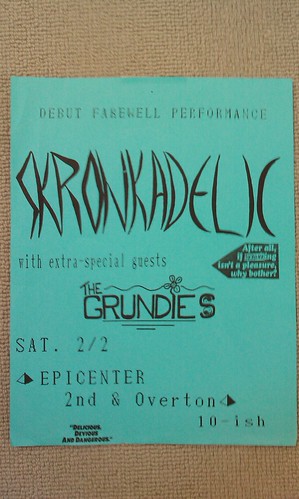
In early 1991, I decided to create a free-jazz big band for one performance. I had for some time thought about this, and had earmarked the name Skronkadelic for such an event - a combination of Funkadelic and the word "skronk," which I had heard Robert Palmer use to describe the less melodic sounds produced by wind instruments. I managed to convince about 20 people to join me in this enterprise - most of them amateur or non-horn players, but with John McClure on bass and I think both Ross Johnson and Keith Padgett on drums, Jack and Amy on percussion, and accomplished alto sax player John Ingle joining as well. I came up with some suggestive titles and general instructions to give the players, and we just played, with me playing tenor and attempting to guide/conduct them. Some of the horn players thought the point was to play as cacophonously as possible throughout, but the others got the idea as we went along. It was fairly chaotic, as I had expected, but there were moments of beauty.
IMAG0687

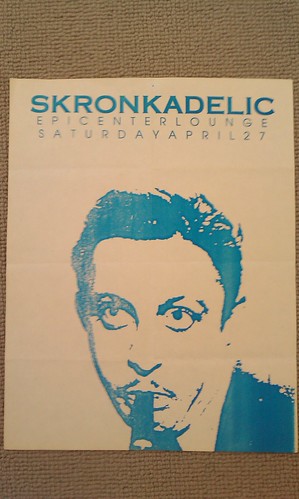
As the flier states, our performance of February 2, 1991 was to be a debut/farewell performance, which was my intention and recollection. However, I recently came across a second flier, from an apparent second show in April of that year, of which I have no recollection. It could be that what I recall as the single show is an amalgamation of memories from both. If anyone out there took part in either and can clarify what went on and who else was there, I will amend the post accordingly. (UPDATE: Jill Johnson has pinged me to remind me that a scaled down version of Skronkadelic played with the drum circle at her apartment during a Cheap Art event. I think the lineup was me, John Ingle and Fields Trimble on horns, with Jack, Amy, Joey and David Hall (?) on percussion.)
IMAG0676


Jack and Amy remain good friends across the Atlantic in coastal Virginia. I always highly valued their companionship and generosity during my time back in Memphis, and our various musical adventures and misadventures. They also turned me on to some great music along the way.

Sunday, 25 October 2009

Hot Joe (sporadically 1987 - 94)

It's a curious and oddly satisfying thing to have a band take shape around you, and then to watch it take on a life of its own in your absence, both when you're out of the country and also back in again. Such was the case with Hot Joe, still one of Memphis' finest and weirdest groups, in my humble and probably irrelevant opinion.

As a natural extension of the friendship between Linda Heck and The Train Wreck and K9 Arts, I started hanging out with K9 guitarist Jim Duckworth and my band mate John McClure in 1987 and working up some songs, mostly old standards, with me as the vocalist. Jim had an amazing music collection and an encyclopedic knowledge of jazz from its earliest roots to the modern experimental scene, and he turned me on to a lot of wonderful music. These afternoons spent at Jim's house were usually accompanied by copious amounts of coffee, so naming the group was a very easy exercise indeed.

Our first gig was with Rich Trosper on drums, I believe at some sort of art opening or party in Downtown Memphis, though the venue and occasion totally evades me, probably because I was fairly terrified at the time by the prospect of fronting a band as vocalist for only the second time ever. I can't recall exactly what our set was, but it contained "Cheek to Cheek," "Moody's Mood for Love," "Strawberry Fields Forever" (yes, a straight jazz version), and God knows what else. At some point we debuted a version of "Ornithology" with original lyrics by me, which so exited an apparently well-known local "jazz dude" in the audience that said enthusiast mounted the stage and commandeered the microphone to "scat". I've always hated scat. I was very irritated by this man at the time, but ended up being mightily amused by the fact that, whenever the imperious scat-cat wannabe in question ordered (rather than requested) Rich to "lay out," Rich responded with a very loud rim-shot or flam of some sort to piss the interloper off. Eventually he gave up and left the stage.

From these humble beginnings arose Hot Joe, and the group, in various permutations, began to get real paying gigs, mostly weddings and cocktail receptions, which, in addition to a civilized audience and a guaranteed pay check, also typically included free food and drink - not a bad alternative to the thankless smoke-filled dives we were used to. The line-up of the group evolved over time, though the core was typically Jim and John, plus Jim Spake on saxes and either Ross Johnson or Doug Garrison on drums (sometimes both together). On a couple of occasions Jim Duckworth had other obligations, and I recall doing two nice gigs with John Gaskill (a wedding) and Ed Finney (some sort of corporate event in the garden at Brooks Museum) on guitar. I was intrigued by Ed, who wore a compass on his wrist as opposed to a watch - which he explained something along the lines of "I may not be on time, but at least I know which way I'm headed."

Sometime after I left for Japan in 1988, Robert Palmer turned up in Memphis and became part of the band - his skronky clarinet an interesting foil to Jim Spake's refined playing. This line-up, which often included both drummers, became very popular over the next two years, and while maintaining the civilized paying gigs, also played harder-edged material in the clubs. They worked up a rocking mash-up of two of the best Mingus tunes, "Better Get Hit in Your Soul" and "Wednesday Night Prayer Meeting," a very fast, Klezmeric version of "Over, Under, Sideways, Down," with Jim Spake and Bob Palmer trading solos, and expanded "Strawberry Fields" into a long medley improbably including "Don't Stop 'til You Get Enough," "Haitian Fight Song," "The Immigrant Song," and "When the Saints Go Marching In." There were also a few fine originals by Jim Duckworth, including "Mimi" (a K9 Arts song) and "Jonah," which was a beautiful song, and Linda Heck's "Look Out for Love."

In the summer of 1989, I came back to Memphis during the summer break, and the guys very kindly arranged a recording session while I was in town, and we also played a gig at the P&H Cafe, which I think might have been a WEVL benefit. I don't remember that much about the gig, apart from the fact that we played versions of "My Favorite Things" and "'Round Midnight" with original lyrics I had written. The recording session, on the other hand, I remember very well, and still have tapes from it to remind me of what a pleasant experience it was. The full line-up (Jim D., Jim S., John, Ross, Doug, Bob, me and Linda Heck) went into Doug Easley's studio behind his house on Marion Street off South Highland on a Saturday night and recorded into the wee hours. We cut "Better Get Hit/Wednesday Night Prayer Meeting," "Over, Under, Sideways, Down," "Mimi," "Strawberry Fields Forever," "'Round Midnight" (with my lyrics), "Ornithology" (ditto), an old Linda Heck and The Train Wreck song "My Crying is Done," two versions of "Look Out for Love" (one with Linda on vocals, and an "answer version" with me substituting my own lyrics), and a very short "Cottontail." It was a blast, and the music still sounds wonderful today.

Jim Duckworth drove me back to my parents' house that night, and Bob Palmer, who was along for the ride, regaled us with some very funny stories of his adventures. My parents' house is not far from the home of the late Sam Phillips, whom I saw many times over the years mowing his own grass, and this triggered an anecdote from Bob, which he attributed to Sam Phillips himself. It seems that when Fidel Castro was in New York City in 1959, Sam Phillips managed to get the number of his hotel room, and possibly somewhat the worse for wear at the time, called it. Bob claimed that Fidel's brother Raul had answered the phone, and told Sam that Fidel was unavailable, to which Sam apparently said, "Well, I just want to wish him well with that revolution down in Cuba, but tell him that if it doesn't work out, he always has a home in Memphis, Tennessee, and that comes from Sam C. Phillips."

I have no idea whether this story was true at all, but I found Bob Palmer to be a delightful storyteller and a very funny man. And he was into Persian classical music, as was I, and I seem to recall we ended up talking about parallels between the Charles Mingus band in 1964 and Persian classical ensemble performances, which are punctuated by unaccompanied solo segments from each of the instruments. That was the sort of conversational side alley you could find yourself wandering down when talking to Bob Palmer. Wish I'd had a chance to get to know him better.

I would really like to see a comprehensive list of all the songs played during the life of Hot Joe, because it would almost certainly run to hundreds. The paying gigs, when they required a vocalist (which was by no means always the case) often came with an obligation to learn some new songs, and I recall that we worked up a really nice version of "I've Never Been in Love Before" for some newlyweds' first dance, and another couple wanted the Beach Boys' "Wouldn't it be Nice?" for their first song. We played it faithfully, and luckily I have a pretty wide vocal range, because it's a hell of a song to sing as the first of the night.

The paying gigs, particularly the corporate stuff, gave license for some fairly subversive material, because typically no one was really paying attention, so it was not uncommon to hear the likes of "See Emily Play" slipped in among the Chet Baker numbers. It was also an interesting opportunity to observe people, because the band members were typically ignored and I was singing maybe one in three songs, so I had ample opportunity to look around the room. At one wedding reception, I remember Jim Spake was featured on a particularly fine version of (I think) "In a Sentimental Mood" and a very old woman stood close by and cried her eyes out until someone took her back to her seat to comfort her.

My abiding memory of the remarkable experiences I had with this group, beyond the awesome recording session, was a Christmas show we did on Wally Hall's Memphis Beat program on WEVL, I believe in 1991. The full line-up was there, minus Bob Palmer, and Linda Heck and I traded vocal duties, teaming up on "Let it Snow, Let it Snow, Let it Snow" and "Christmas Time is Here." The evening ended with me behind Ross' drum kit beside Doug Garrison as we all accompanied Ross doing a predictably hilarious reading of "The Night Before Christmas" (including ad libs such as in the description of Santa Claus, "There were broken veins in his nose - he'd been drinkin'") which I have on tape somewhere and is still one of the funniest things I have ever heard.

I always enjoyed getting to see these guys play up close - being allowed to sing with them, and even getting paid, was purely a bonus.


Sunday, 11 October 2009

Liner notes to "The Lost Album"

The Lost Album


I had a long Skype chat with Linda Heck yesterday, ahead of her solo gig at Otherlands in Memphis. She said in passing that she had always had an awful lot of material beyond what the band played, which I guess I should have expected, but this revelation still took me by surprise. I have never heard this stuff, and maybe no one else has either. The mind boggles. During its various incarnations, my guess is that the total Train Wreck repertoire of Hecktunes ran to 60 songs, or thereabouts. The 21 songs on what I have taken to calling "The Lost Album" are a pretty representative cross-section of the material the band played during its life, with a bias towards material written in the later period, when Linda had really hit her stride.

Sometime during the final incarnation of the band in 1988, Linda had begun seeing Clayton Rogers, to whom she is now married. Clayton lived in the same building as our mutual friend Belinda Killough, and became part of the social circles in which we all shuffled. I have always been surprised that we hadn't met previously. He was raised in East Memphis, as was I, and we knew a lot of people in common (he went to MUS boys' school, the Midtown contingent of which I knew because some of them dated girls in my high school). Clayton is wicked smart, with a surreal sense of humor, and is a very generous person. A talented architect, he totally revamped the big house they ended up buying on Madison in Midtown after I returned from Japan in 1990, which had been a doctor's office for years and was in need of a lot of loving care. It was a fairly Herculean task, having seen it in its unadorned state, but he and Linda made it something truly impressive during the time they were there, as an expression of their shared love of design and all things cool.

Clayton's father had died unexpectedly some time before, at a tragically young age, and had left him some money, a part of which he decided should go to fund a proper recording session for Linda and the band. Sometime in the late spring/early summer of 1991, we went into the fantastic Easley-McCain studio (back then it was known simply as Easley Recording) to begin work. I had visited the studio when it was still in the process of refurbishment from the dilapidated state in which they acquired it, and had also seen photos of what it looked like before it had been touched. Doug Easley and Davis McCain had worked wonders with it. It was an amazing place to be, and I always looked forward to going there, as I would do for various sessions over the years, or just for a social visit. A rather unassuming building from the outside, it had a nice, homey feel to it inside, with a comfortably decorated reception/chill-out lounge just inside the door, leading to the control room and main room. There was an office upstairs, where presumably Chips Moman sat at a desk at some stage counting his gold records, and as I recall there were two reverb chambers running vertically through the building, which were actually used from time to time. The main room was colossal, maybe something like 1600 square feet, with three isolation booths, and what must have been a 40-foot ceiling. My estimates of dimensions may be off a little bit, but to put things in perspective, you could have comfortably fit a small symphony orchestra in the main room with no problem.

Working with Doug and Davis was a great experience. We had known them for years and all got on very well. I had first seen Doug playing in a band with his brother Ron and Bob Holmes, later of the Modifiers, at a fraternity party at MSU in 1980 - I was there because some of the older guys I worked with were members. Davis I met probably in 1981/2, when I unsuccessfully auditioned to be the second guitarist in his band Barking Dog. Davis was later the sound man at The Antenna Club for a number of years, and I think this experience of doing things under pressure and being pragmatic was one thing which made him so easy to work with in the studio. It always struck me that Doug and Davis were more concerned with capturing a vibe or performance when the timing was perfect than with over-engineering things. In contrast, I remember a session I once worked on at a different studio, wherein the miking of the drums alone took four hours, during which I lost the will to live, let alone record. Doug had a particular talent for surrendering to serendipity and accidents that occurred, and letting them guide the process, which suited me fine.

We initially recorded the basic tracks over three or four sessions, in three different configurations based on who was drumming. As had been the case through too much of the band's life, it was the ever-rotating drum stool which drove the process. Doug Garrison (whom we had played with in Hot Joe, but who will be better known for his work with Alex Chilton, Charlie Rich, and The Iguanas) graced us with some fine drumming on seven songs, Ross Johnson played on five songs, and I played on the other nine. We were joined on four songs by Jack Adcock (611, The Bum Notes, Professor Elixir's Southern Troubadors) on miscellaneous percussion. Jim Duckworth (Panther Burns, The Gun Club, Marilyn and The Monroes, K9 Arts, Hot Joe) played some characteristically beautiful guitar on four tracks, and the inimitable Jim Spake played sax on three tracks (should have been more!). Clayton contributed water-filled wine glasses and whirring plastic tubes to the eerie "Chalk Outline" track. Everything else was covered by Linda, John, and me.

Bafflingly, once we had recorded the basic tracks for 18 songs, the whole project seemed to go dormant for a year. Linda and Clayton had a lot of other stuff going on, as did we all, but in retrospect it strikes me as odd that, given how well those first sessions went, we weren't all impatient to finish things up. It was a more than a year later before we would return to the studio to do some refinements and mix. We realized we had more space left on one tape reel, so we quickly recorded three more songs, which are far less produced than most of the rest of the album, though I think they are all good performances: "When Water Burns," "If I'm So Smart," and "Sunday."

I am still very moved by this recording, a mixture of pride and nostalgia for what were very enjoyable sessions with wonderful people in the best studio in the world. I play it for my children from time to time, and they enjoy it as much for its musical merits as for their delight at the occasions where they can pick my voice out of the backing vocals. As with everything viewed retrospectively, I can hear things which I would want to do over if given a chance, and I would love to remix one or two songs completely. I am not sure if the master tapes even survived the fire at the studio in 2005, so the idea of remixing it one day may be a complete impossibility. Speaking strictly for myself, I think we could have spent more time differentiating some of the guitar parts and making them more forceful, but we had a fairly limited budget. It's always possible to over-analyze things across a temporal gulf such as that which separates me from these recordings, but as a package, I think they are wonderful just as they are. But don't take my word for it. Eight of the highlight tracks currently appear in the music player on Linda's MySpace page, so listen for yourself (these songs are marked with an asterisk below). Perhaps someday the entire album will see the light of day.

The Songs

1) Dig (also known as Dig My Own Hole)* [2:18]

Linda Heck - vocal, electric guitar
John McClure - bass guitar
James Enck - electric guitar
Doug Garrison - drums
Jim Spake - baritone sax
Jim Duckworth - electric guitar

This song has been featured on a couple of compilations, and is something of a signature tune for Linda. An ode to defiance and self-reliance:

"Do my own thing in my own time,
I'll live my own life, speak my own lines,

My ears are closed, my shoulder is cold,

I'll make my own bed, dig my own hole"


Fantastic guitar work by Mr. Duckworth and a strong vocal performance by Linda.


2) Professor of Love [3:11]

Linda Heck - vocal, acoustic guitar
John McClure - upright bass, acoustic guitar, synthesizer (faux marimba sound)
James Enck - electric guitar, trumpet, backing vocal
Doug Garrison - drums
Jack Adcock - guiro

I never quite understood the derivation of this song, but I think it started from a character idea that Roy Barnes had come up with for a film - a mysterious expert in love for troubled hearts. Roy later shot a music video for this song, which did not, in fact feature a Professor of Love character. Would love to re-do the end of the guitar solo, but that's life. The rest of it is spectacular.


3) Failing Sky* [2:49]

Linda Heck - vocal, electric guitar
John McClure - electric bass
James Enck - drums
Jim Duckworth - electric guitar
Jim Spake - tenor sax

One of my very favorites, with some really special guitar work from Jim Duckworth, and a splendid solo by Mr. Spake.


4) Laff* [2:06]

Linda Heck - vocals, electric guitar
John McClure - electric bass, electric guitar
James Enck - electric guitar, drums
Jim Duckworth - electric guitar

This song was written about Jim Duckworth as part of the K9 Arts trilogy, as I recall in recognition of his undying appreciation of all things Linda Heck and The Train Wreck. Jim laid down an intro part which was amazing but very heavy and a bit sinister, which we felt was out of character with the sentiment of the tune, so we stuck to his straightforward chordal accompaniment until the end of the song, when we faded in two lead parts. I was never sure that he was happy with this arrangement, but I think it works beautifully.


5) Sunday [2:21]

Linda Heck - vocal, acoustic guitar
John McClure - electric bass
James Enck - electric guitar, drums

A great song about self-realization, inspired by a long night out. This was probably the most basic arrangement on the entire album, and I like its understated quality. We recorded it pretty much on the fly at the end of the process, and it felt really nice at the time. Great vocal performance, and I still find it hard to believe that's me on the drums (ditto for the preceding track).


6) When Water Burns [2:53]

Linda Heck - vocal, acoustic guitar
John McClure - electric bass
James Enck - electric guitar, drums, backing vocal

This was a barn-burner from the Roy Brewer era of the band, which we decided to record at the end of the sessions when we realized we had tape left over. The bass isn't high enough in the mix for my liking, but it's a spirited performance.


7) If I'm So Smart [2:30]

Linda Heck - vocals, electric guitar
John McClure - electric bass
James Enck - electric guitar, drums, backing vocal

A country rocker, also recorded at the end almost as an afterthought, but it's an honest and strong performance.


8) Every Mother's Son [2:55]

Linda Heck - vocal, electric guitar
John McClure - upright bass
James Enck - drums, flute, recorder, bass recorder

A beautiful song, apparently about the uncritical love of a parent for a child, as observed by a third party. I had made a four-track demo of this with Linda (where is that, I wonder?), but we struggled a bit with this one. I suggested to John that he think about "Pet Sounds" for the bass part, and his playing really makes it what it is, and we later added a droning bowed bass part. Doug thought my flute/recorder bit sounded like a calliope, which I suppose it does. The reverb on Linda's voice is a tad overwrought. This is one I would remix given the chance, but it is still beautiful.


9) Chalk Outline [2:31]

Linda Heck - vocal, electric guitar
John McClure - electric bass
James Enck - drums, electric guitar
Clayton Rogers - whirling plastic tubes, musical wine glasses, bathroom sink
Jack Adcock - nut shells, flexitone

The serenity of a picnic is rudely disturbed by the discovery of a chalk outline of a body.


10) It Is Alright* [2:35]

Linda Heck - vocal, electric guitar
John McClure - electric bass, piano, crash cymbal
James Enck - drums, electric guitar
Jack Adcock - vibraslap

This one still gives me goose pimples. Written for Linda's roommate of the time, Melissa Thornton. It's mostly Linda and John for two-thirds of the way, very subtle and beautiful, with a just a bit of cymbal work from me and Jack's vibraslap, but the ending I find uplifting, to match the message of the song. I had to overdub the crash cymbal with mallets to build up the suspense for the break to the finale, and then John (standing next to me) came in and knocked it home.


11) At A Party* [2:49]

Linda Heck - vocals, electric guitar
John McClure - electric bass
James Enck - drums, electric guitar

This track, like the preceding one, is recorded with Linda playing a guitar strung with the high strings tuning (which Jones Rutledge describes as "Angel Hair") I alluded to in a previous post. This, coupled with my electric, occasionally sounds like a 12-string - very full. The arrangement is very simple, but it sounds complete, and I like my drumming here. The ending is a bit odd, and I'm not sure how that happened, or why we didn't fix it.


12) Magic Wand* [1:52]

Linda Heck - vocals, electric guitar
John McClure - electric bass, electric 12-string guitar, backing vocal
James Enck - electric guitar, backing vocal
Ross Johnson - drums

I think this may be one of the earliest Linda Heck songs I can recall hearing. I'm pretty sure it was on that original home demo cassette she returned to Memphis with in 1986. It's a great song about the desire for escape. One of the few occasions in which we attempted multi-part harmony, with good results. We should have done so more often.


13) House is Burning* [2:11]

Linda Heck - vocals, electric guitar
John McClure - electric bass
James Enck - backing vocal
Doug Garrison - drums
Jim Spake - baritone sax
Jack Adcock - bongos

I think I was still stuck at work when this was recorded in a session starting at midday, but when I heard it I thought there was no need for another guitar because it sounded perfect as it was. And so it remained. As I wrote earlier, Cordell Jackson thought this song was about cocaine addiction, but anyone actually listening to the lyrics will realize it is about gossip and schadenfreude, recurring features of life in Memphis, and indeed anywhere where humans are present.


14) Split the Earth [2:34]

Linda Heck - vocals, electric guitar
John McClure - electric bass
James Enck - electric guitar, backing vocal
Doug Garrison - drums

Another rocking song from the reinvigorated, newly empowered Linda Heck songbook of the 1987/88 vintage. I used to really enjoy playing this one live. I recall that Doug Garrison wasn't particularly satisfied with his playing on this track, but we assured him it was awesome, which it is.


15) Slipping Away [2:02]

Linda Heck - vocal, electric guitar
John McClure - fretless electric bass, electric guitar
James Enck - electric guitar
Doug Garrison - drums

Some very dreamy guitar textures here, a nice melody line, and great lyrics about procrastination. John lays down a great lead guitar part, demonstrating why he was always more than just a pretty bass.


16) He Rode By [2:34]

Linda Heck - vocal, acoustic guitar
John McClure - upright bass, electric guitar
Doug Garrison - drums

The other song I missed due to the time slot, but there was nothing I could add. It is simple and elegant.


17) Today* [3:12]

Linda Heck - vocal, electric guitar
John McClure - electric bass, backing vocal
James Enck - electric guitar, backing vocal
Doug Garrison - drums

One of the very best Linda Heck songs, and one of the most exciting to play live in my opinion. Written for the late Craig Shindler to wish him well at a low point in life, it has a positive message characteristic of its vintage:

"Pain will go, before you know,
Let it fall away,
Happiness is within you,
And it can be today"

It's an unusual and intriguing structure, which is probably why I have always liked it, because it feels like it's always moving to a new level. Starting in C and reverting there for the bridge, switching to B for the verses, with the odd A to F-sharp interlude. Outstanding performance from Doug here, and I like the rising harmony vocals in the instrumental section. Linda is sublime throughout.


18) B-Movie [2:13]

Linda Heck - vocal, electric guitar
John McClure - electric bass, acoustic guitar
James Enck - electric guitar, backing vocal
Ross Johnson - drums

"'She's in the arms of another man,' he said,
'What should I do, shoot myself dead?'
Now wait a minute, that's quite extreme,
How dramatic, how B-Movie,
Is it worth it?
After all, just think how it would really be,
Just think how it would really be."

Great Nashville-style acoustic picking from John here, and I like the way my harmony voice only comes in as the voice of the lovesick loser.


19) Nightmare [2:18]

Linda Heck - vocal, electric guitar
John McClure - electric bass, acoustic guitar
James Enck - electric guitar
Ross Johnson - drums

A song, unsurprisingly, about a nightmare, apparently about being chased by dogs, but with a happy ending. Trippy, echo-laden vibrato guitar which I like.


20) Beer and Guitars [2:24]

Linda Heck - vocal, electric guitar
John McClure - electric bass, electric guitar, backing vocal
James Enck - electric guitar, backing vocal
Ross Johnson - drums

I can remember thinking at the time this song was written that it was a gentle joke, and perhaps it was, but as I grow older, I find it to be increasingly poignant. The title evokes the sign of Fred's Hideout (which featured a cartoon mug of draft beer and a guitar), our beloved dive of old where so many great shows took place, but which was also the home to many hopeless, broken alcoholics, whom this song seems to portray.

"Well there's nothing like whiskey and drums,
To ease the pain when it comes,
We see hope in each glass,
As we twiddle our thumbs,

There is nothing like whiskey and drums,
'Cept bourbon and rain,
And beer and guitars"


Beautiful volume-pedal guitar from John, approximating the sound of the honky-tonk pedal steel as it might have appeared on Sister Lovers.


21) 'Tis the Season [7:22]

Linda Heck - vocal, electric guitar
John McClure - electric bass, Hammond organ
James Enck - electric guitar, tenor sax
Ross Johnson - drums
Jim Duckworth - electric guitar

This was a song Linda wrote in 1987 for the 20th anniversary of the Summer of Love, which we used to do towards the end of shows at the time. The night that Ross sat in with us on short notice at Fred's Hideout in July 1987 to fill in for Roy Brewer after the birth of his first daughter Eva, we played a fairly raucous version of it, so it seemed natural to have Ross back for this recording. No one was disappointed. As I recall the song was vaguely inspired by a particularly demented contemporary Sky Saxon EP I had bought, and we pretty much cover all the psychedelic cliches here with feeling, including the "Helter Skelter" false fadeout and return (without which the track would be closer to ten minutes). Ross has the last words, which are "Ice cold Molson!" Amen.

*Available for streaming at www.myspace.com/thereallindaheck
All songs by Linda Heck.
Recorded at Easley-McCain Studios, Memphis, TN, summers 1991 and 1992.
Engineered by Doug Easley and Davis McCain.
Produced by Linda Heck, John McClure, James Enck, Clayton Rogers, Doug Easley and Davis McCain.

James Enck would like to thank all involved for a wonderful time, and the late Rich Trosper - whether you knew it or not, I was watching and learning. Thank you.

Tuesday, 29 September 2009

Panther Burns (sporadically 1983 - 84, 1991)

The other day I was in a used book store on Charing Cross Road, when I came across the Economist Intelligence Unit's World Statistical Handbook for 1993. In the section on the global music industry, I was taken aback by the startling estimate that, as of December 1992, nearly 3% of the U.S. population had been members of Panther Burns at one time or another. This struck me as an improbably low number, but there you have it, "imperialist running dogs and backslidin' heifers" - the EIU doesn't lie - I am a member of a small and elite club. "Jam up and jelly tight. T-99!"

The first time I met Tav Falco was at the home of my classmate/friend/later girlfriend Gretchen Gassner, a beautiful minimalist modern single-level house on Harbert in Midtown, designed and built by her late father, Francis Gassner, an eminent Memphis architect. I have a feeling this might have been before I saw the Panther Burns for the first time, because I don't remember having any immediate association of Tav with music when I met him, though some of the more unkind among music critics might say this is just a natural reaction. If it was before I first saw him play, then this would probably have been late 1979 to mid-1980, but we're splitting hairs here. Tav, or as he was introduced to me, Gus, was big sister Amy Gassner's beau at the time, and we were all having dinner together with Gretchen and Amy's mother and step-father.

Gus was, as anyone who has encountered Tav might guess, impeccably dressed from another era, very articulate, well-mannered and charming. I recall him mentioning his work with Televista, and also the fact that he was a tango instructor, I believe at the Fred Astaire school in Memphis. To the 17 year-old me, this was about as close as I had ever been to time travel, though I now engage in it frequently.

As it happens, I think I also met Alex Chilton around the same time at the same house, though this time there was no parental supervision, and he was watching TV with Amy in the living room. Given that I was born in 1962 and didn't move to Memphis until 1974, I didn't really have any understanding at this point of the significance of Memphis music in the 1960s. I knew the song "The Letter," of course. I can remember hearing it frequently on my parents' car radio in Texas in the late '60s. I had certainly never heard of Big Star. So to me, at that point, Alex Chilton was this pale guy in a leather jacket watching TV on the sofa. He seemed friendly enough, but didn't really say much.

Gretchen later told me that at some point this weird band from out of town called The Cramps had stayed at the house while they were in town working on a recording with Alex. I got the impression that they were a bit on the unfriendly side as far as she was concerned. Damned Yankees!

Anyway, the years passed, and Panther Burns released their seminal early recordings "Behind the Magnolia Curtain" and "Blow Your Top," and toured extensively, punctuated by the odd show in Memphis, one of which I seem to recall took place in the street outside a party at the old Lou's Antique Clothing in the then decidedly un-chic and un-reformed Cooper-Young district, sometime in 1982.

I think Alex Chilton was based in New York at this point, and then moved to New Orleans in 1983 or thereabouts, Jim Duckworth had fled into the arms of Jeffrey Lee Pierce, and I have some weird recollection of bassist Ron Miller having gone off to do serious jazz stuff with Archie Shepp or someone like that. Tav, who had also been reliant upon out-of-towners for his touring band, seemed to reappear in Memphis on a more regular basis around this time, and was clearly in need of a local band.

Kings of the Western Bop, which plumbed the depths of a similar toxic cultural ditch to that of Tav, albeit with an overlay of professional wrestling and The Honeymooners, were on the scene in Memphis, and seemed to be the body least likely to reject a mutant strain of Panther Burn DNA. I knew most of the material already, Linda was quite capable of picking up the bass parts, and the band already contained founding Panther Burns drummer Ross Johnson, so we were obviously a capable and cheap proxy lineup for the purposes of local gigs. It didn't hurt that Linda and I were relatively young, inexperienced, and enthusiastic enough to be really flattered to be onstage with Tav. And, yes, he had been a big musical influence, and anyone who would have claimed otherwise was lying.

So we embarked on a string of local gigs in which KOWB would open for Panther Burns, the only difference between the two being the front men - much like a low-budget circus I saw as a child in which the Romanian Gypsy acrobat family bore an uncanny resemblance to the American Indian high wire act and the Brazilian trapeze artists. Venues included The Antenna and the old cinema on Highland (help, what was it called?). The set list was a mixture of older material, along with some relatively new additions, such as "Shade Tree Mechanic," and we didn't sound half bad, though this was a far cry from the original visceral screeching chaos of Panther Burns, and more a cabaret act.

In some cases, I recall Kai Eric from New York stepping in on bass, as in a gig in 1984 at the Old Daisy Theater on Beale Street, where Panther Burns were booked for two nights running. Originally, Kai and I were meant to have played both nights, but Alex Chilton and Rene Coman pitched up from New Orleans, and Tav was ready to bump us in favor of the first-string team. (This happened on one other occasion, the infamous gig opening for The Clash at Vanderbilt, though in retrospect maybe not being part of that was not such a bad thing afterall.) I reminded him that I had taken both weekend nights off work from my restaurant job, foregoing some much-needed income, and told him I was not happy about the prospect of being dumped. I think Kai, who had traveled from New York, felt similarly. So we agreed that Kai and I would play the Friday night show, and Alex and Rene would do Saturday night, which was an arrangement I could live with, and Alex and Rene agreed. (I have to say that, during the entire time I knew Alex, he was always kind and pleasant to me each and every time I saw him in Memphis, which I found very odd because I knew a lot of people who had nothing good to say on his behalf, but I speak as I find, and he was always cool with me.)

So, the show at the Old Daisy (a proper old movie house where the screen, and thus our stage, was at the back of the hall, meaning that the audience walked in past the stage) would take place with the first-string guitarist and bassist in the audience, which made me more than a little uneasy, but I wanted to get paid. I certainly earned my money during the opening act, when Ross, Kai and I accompanied Cordell Jackson through a very challenging opening set, complicated by the facts that 1) the songs had no clear beginnings or endings, 2) she had a very curious sense of tempo akin to a record skipping, and 3) Kai and I only knew a couple of her songs, neither of which sounded remotely the same when she played them live anyway. She was clearly completely mad, but very charming. Before we started I walked over to her and said, "It's a pleasure to play with you, but I'm afraid I don't know many of your songs," and she simply smiled and said "Don't worry, let's just have a good time," before launching into "Football Widow," or one of her other peculiar songs.

A couple of years later, a number of us young musical whipper-snappers would attend the Moon Records 40th Anniversary party at her home in Georgian Hills, where I also met Estelle Axton, which was really thrilling. Even later, Cordell would develop an interest in Linda Heck's songwriting, inviting her to her home to audition some songs. I recall Linda telling me that she played a recently-written piece, called "House is Burning" (an excellent version of which may be found, ahem, on the still unissued "Great Lost Linda Heck Album"), which was really about Memphis gossip and schadenfreude, and contained the tag lines, "Everyone knows your house is burning/everyone sees the straw foundation/everyone knows that there's no turning back," which Cordell thought had some sort of Satanic connection (UPDATE: I got this wrong. See Linda's comment below which clarifies that Cordell thought it was a song about cocaine addiction). Like I said, she was sweet, but probably nuts.

After Cordell, the Panther Burns took the stage and went through the typical set of the time, and we conducted ourselves pretty admirably. I'm pretty sure it was at my insistence that we included Conway Twitty's "It's Only Make Believe" in the set, and as I played the opening C-chord and Tav moaned the first line, "People see us everywhere..." a pained, pleading voice rose up from the audience, "Noooo! Noooo!" This voice I immediately recognized as that of one Alex Chilton, distressed to hear a beloved song about to be mercilessly vivisected. This incident makes me smile still after 25 years.

One other show from this period stands out in my mind. I believe this was also in 1984, and Linda and Dan Hopper were living at the Clarke's Quick Print building in downtown Memphis, which in those days was a virtual ghost town at night, and pretty much any other time. Legendary drummer Bob Fordyce worked downtown in the early '90s and once told me that on his lunch break one day, a German tourist, who was obviously looking to kill time on a lengthy layover at the Greyhound station, came up to ask him which way was downtown Memphis. Bob said, "This is it." The German tourist replied, "You're kidding!" Anyway, Linda and Dan were, as was so common back in those lean times, having a rent party/"happening" on the third floor, I seem to recall. It was a Saturday night, and I had to work, but I bribed someone to let me out first, so I raced downtown to play with Tav and Ross (we were bass-less for some reason I can't recall). Because I was getting there at 11:30 or something like that, I was the only person in the entire building (with the possible exception of Ross, who I believe was teetotal at that point, and Tav, who I don't recall ever drinking) who wasn't under the influence of anything. Everyone else seemed to be completely rat-assed in one way or another, and I arrived to see the aftermath of a minor physical misunderstanding between Tommy Hull, Linda and Dan, the details of which I don't really know. I also got stuck in the basement for about ten minutes at one point with Joey Garcia and Craig Shindler of Burnin' Schmen, due to some elevator malfunction. This was my first encounter with Craig, who was still in high school, but would later go on to form K9 Arts with Jim Duckworth and Rich Trosper, who, like Craig, is sadly no longer with us and fondly remembered.

I have a tape of the gig somewhere, and I think it was probably the best one I ever did as a Panther Imposter. Ross and I were both playing really well, and gelling, despite, or perhaps because of, not having a bass player, and Tav seemed genuinely excited and inspired. Perhaps it was the presence of a psychedelic oil wheel light show. The tuning of Tav's violin-shaped Hofner guitar (with built-in distortion button), however, started to drift, without intervention on his part. I recommended that we play The Doors' "You're Lost, Little Girl," a song I had heard Panther Burns play with Alex on guitar, and which Tav and I had messed around with a bit recently. We played it impeccably, except that by this time Tav was probably a half-step out of tune across the board, though playing quieter than I was, which created an almost redneck gamelan-like quality to the sound. The soundman, Tommy (surname?), cocked his head to one side, like when a dog hears something strange and incomprehensible. Tommy and I smiled at each other in mutual recognition of having reached a moment of microtonal Nirvana which Harry Partch himself would have envied, or at least that's what I thought. He might have been thinking, "Shit, I'll be glad to be outta here." When I later played this tape for Tav, he too smiled and said, "Sounds like a pack o' wild dogs off in the woods somewhere." I wish I had a Tav Falco speech synthesizer for times like this.

Lest I forget, there was also a recording session which took place in an empty Antenna Club (empty because it wasn't actually open to the public) on something like a Monday night, in early 1984, which consisted of Tav, Ross, Mark Harrison on guitar, Jim Spake on tenor sax, and me on guitar. As I recall, we recorded three songs: "Cuban Rebel Girl," on which I played through a hideous multi-effect box I had which made a sort of fuzz-bass sound, which made me the surrogate bass player, "Jump Suit," and "Hairdresser Underground," all of which later appeared on a cassette release called "1984," and which may have been re-released on vinyl or CD later. I think Kurt Ruleman may have also appeared on the same release, albeit in a different session. As far as I know, no one involved was ever paid anything for their efforts - it was all about the glory.

Anyway, I went off to Japan at the beginning of 1986 (awakening for my first day in the school dorm in Osaka to the news of the Challenger disaster, which should have told me something), came back, formed Linda Heck and The Train Wreck, went to Japan again, and came back to Memphis in 1990. During this time, Tav found international stardom on New Rose Records, prolifically releasing albums and touring behind them with an evermore eclectic lineup of musicians.

We next met in spring 1991, when I played a couple of gigs over one weekend with him, Ross and John McClure on bass. As I recall, we went to Little Rock, Arkansas, on a Friday to play to a very sparse crowd in a club whose name I have forgotten. I rode with Tav on the way over, and John on the way back, and it was the only time I ever had a chance to talk to Tav one-on-one at length when he wasn't more or less in character. We talked about Arkansas in the '60s, his time as a wandering artist, and life in general. He told me that he and Robert Palmer (with whom I had recorded in Hot Joe - another story) had been in the same fraternity at university, a revelation which he followed with the admonition, "Don't tell anyone." I couldn't tell if he was joking or not, but I guess the statute of limitations has passed in any event. It was an intriguing couple of hours, and I felt closer to him, but also somehow a bit sad.

When we got to the gig, however, Tav the difficult artist reappeared, giving the soundman a hard time during the sound check because he couldn't hear my guitar in the monitors. The soundman pretended to fiddle around with the settings, and Tav was satisfied, but later the soundman told me that he had merely turned Tav's guitar down a little bit. This difficulty with soundmen would manifest itself again the next night with an unlikely outcome. There was no opening act in Little Rock, but we were treated to an extended slide show from Tav's world travels as the Ambassador of Ditch-digging, stirring up the dark waters of the unconscious. Ross, John and I sat together, and Ross gave us one of his inimitable running commentaries as photo after photo scrolled by: Tav, carefree on the Champs Elysees; Tav, thinking deep thoughts beside the Trevi Fountain. We were in stitches. On another occasion, back in 1988, John and I had experienced a similar bout of convulsive laughter at the Overton Park Shell, with my Dad, who had come to see the Train Wreck play earlier, and stayed on for Panther Burns, which the three of us watched from seats near the stage. The sound was terrible, and Tav was very unhappy with the soundman, threatening to walk off if it didn't improve, and all this drama unfolded during the opening number, a 15-minute version of "Jungle Rock." We nearly wet ourselves, and my Dad was practically prostrate. It is one of my most prized musical memories from Memphis.

The next night, at the New Daisy Theater in Memphis, we played to pretty much a full house, and it was a good performance. However, at one point, Tav launched into a fairly harsh criticism of the soundman, an older, muscular ex-Marine named Johnny, whom he named and shamed in front of the audience. The gig over, no sooner had we come offstage and into the dressing room than Johnny stormed in, stuck his finger in Tav's face and said, "Tav, don't you ever call my name and talk to me like that in public again, got me?" Tav, who had a height disadvantage of about a foot, a weight disadvantage of probably eighty pounds, and had never been in the Marines, stood there impassively. John, Ross and I watched, and I expected Tav to either apologize or begin quoting Rimbaud, but instead he suddenly grabbed Johnny by the collar with both hands, said "Come git some, motherf*cker!" and physically manhandled him out of the dressing room, thereafter leaning against the door as Johnny gave it a frustrated kick or two. I was speechless. Suddenly everything stopped, and Tav moved away from the door. We all looked at one another. The door began to open slowly, and Tav picked up a folding chair, ready to brain Johnny when he stepped in the room. Ross restrained him, and around the door slowly appeared a smiling Alex Chilton, who said, "It's only me, man."