Monday, 12 October 2009

Sunday, 11 October 2009
Liner notes to "The Lost Album"
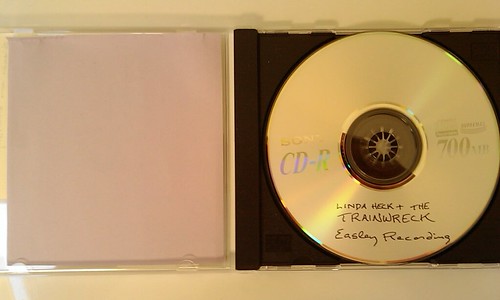
I had a long Skype chat with Linda Heck yesterday, ahead of her solo gig at Otherlands in Memphis. She said in passing that she had always had an awful lot of material beyond what the band played, which I guess I should have expected, but this revelation still took me by surprise. I have never heard this stuff, and maybe no one else has either. The mind boggles. During its various incarnations, my guess is that the total Train Wreck repertoire of Hecktunes ran to 60 songs, or thereabouts. The 21 songs on what I have taken to calling "The Lost Album" are a pretty representative cross-section of the material the band played during its life, with a bias towards material written in the later period, when Linda had really hit her stride.
Sometime during the final incarnation of the band in 1988, Linda had begun seeing Clayton Rogers, to whom she is now married. Clayton lived in the same building as our mutual friend Belinda Killough, and became part of the social circles in which we all shuffled. I have always been surprised that we hadn't met previously. He was raised in East Memphis, as was I, and we knew a lot of people in common (he went to MUS boys' school, the Midtown contingent of which I knew because some of them dated girls in my high school). Clayton is wicked smart, with a surreal sense of humor, and is a very generous person. A talented architect, he totally revamped the big house they ended up buying on Madison in Midtown after I returned from Japan in 1990, which had been a doctor's office for years and was in need of a lot of loving care. It was a fairly Herculean task, having seen it in its unadorned state, but he and Linda made it something truly impressive during the time they were there, as an expression of their shared love of design and all things cool.
Clayton's father had died unexpectedly some time before, at a tragically young age, and had left him some money, a part of which he decided should go to fund a proper recording session for Linda and the band. Sometime in the late spring/early summer of 1991, we went into the fantastic Easley-McCain studio (back then it was known simply as Easley Recording) to begin work. I had visited the studio when it was still in the process of refurbishment from the dilapidated state in which they acquired it, and had also seen photos of what it looked like before it had been touched. Doug Easley and Davis McCain had worked wonders with it. It was an amazing place to be, and I always looked forward to going there, as I would do for various sessions over the years, or just for a social visit. A rather unassuming building from the outside, it had a nice, homey feel to it inside, with a comfortably decorated reception/chill-out lounge just inside the door, leading to the control room and main room. There was an office upstairs, where presumably Chips Moman sat at a desk at some stage counting his gold records, and as I recall there were two reverb chambers running vertically through the building, which were actually used from time to time. The main room was colossal, maybe something like 1600 square feet, with three isolation booths, and what must have been a 40-foot ceiling. My estimates of dimensions may be off a little bit, but to put things in perspective, you could have comfortably fit a small symphony orchestra in the main room with no problem.
Working with Doug and Davis was a great experience. We had known them for years and all got on very well. I had first seen Doug playing in a band with his brother Ron and Bob Holmes, later of the Modifiers, at a fraternity party at MSU in 1980 - I was there because some of the older guys I worked with were members. Davis I met probably in 1981/2, when I unsuccessfully auditioned to be the second guitarist in his band Barking Dog. Davis was later the sound man at The Antenna Club for a number of years, and I think this experience of doing things under pressure and being pragmatic was one thing which made him so easy to work with in the studio. It always struck me that Doug and Davis were more concerned with capturing a vibe or performance when the timing was perfect than with over-engineering things. In contrast, I remember a session I once worked on at a different studio, wherein the miking of the drums alone took four hours, during which I lost the will to live, let alone record. Doug had a particular talent for surrendering to serendipity and accidents that occurred, and letting them guide the process, which suited me fine.
We initially recorded the basic tracks over three or four sessions, in three different configurations based on who was drumming. As had been the case through too much of the band's life, it was the ever-rotating drum stool which drove the process. Doug Garrison (whom we had played with in Hot Joe, but who will be better known for his work with Alex Chilton, Charlie Rich, and The Iguanas) graced us with some fine drumming on seven songs, Ross Johnson played on five songs, and I played on the other nine. We were joined on four songs by Jack Adcock (611, The Bum Notes, Professor Elixir's Southern Troubadors) on miscellaneous percussion. Jim Duckworth (Panther Burns, The Gun Club, Marilyn and The Monroes, K9 Arts, Hot Joe) played some characteristically beautiful guitar on four tracks, and the inimitable Jim Spake played sax on three tracks (should have been more!). Clayton contributed water-filled wine glasses and whirring plastic tubes to the eerie "Chalk Outline" track. Everything else was covered by Linda, John, and me.
Bafflingly, once we had recorded the basic tracks for 18 songs, the whole project seemed to go dormant for a year. Linda and Clayton had a lot of other stuff going on, as did we all, but in retrospect it strikes me as odd that, given how well those first sessions went, we weren't all impatient to finish things up. It was a more than a year later before we would return to the studio to do some refinements and mix. We realized we had more space left on one tape reel, so we quickly recorded three more songs, which are far less produced than most of the rest of the album, though I think they are all good performances: "When Water Burns," "If I'm So Smart," and "Sunday."
I am still very moved by this recording, a mixture of pride and nostalgia for what were very enjoyable sessions with wonderful people in the best studio in the world. I play it for my children from time to time, and they enjoy it as much for its musical merits as for their delight at the occasions where they can pick my voice out of the backing vocals. As with everything viewed retrospectively, I can hear things which I would want to do over if given a chance, and I would love to remix one or two songs completely. I am not sure if the master tapes even survived the fire at the studio in 2005, so the idea of remixing it one day may be a complete impossibility. Speaking strictly for myself, I think we could have spent more time differentiating some of the guitar parts and making them more forceful, but we had a fairly limited budget. It's always possible to over-analyze things across a temporal gulf such as that which separates me from these recordings, but as a package, I think they are wonderful just as they are. But don't take my word for it. Eight of the highlight tracks currently appear in the music player on Linda's MySpace page, so listen for yourself (these songs are marked with an asterisk below). Perhaps someday the entire album will see the light of day.
The Songs
1) Dig (also known as Dig My Own Hole)* [2:18]
Linda Heck - vocal, electric guitar
John McClure - bass guitar
James Enck - electric guitar
Doug Garrison - drums
Jim Spake - baritone sax
Jim Duckworth - electric guitar
This song has been featured on a couple of compilations, and is something of a signature tune for Linda. An ode to defiance and self-reliance:
"Do my own thing in my own time,
I'll live my own life, speak my own lines,
My ears are closed, my shoulder is cold,
I'll make my own bed, dig my own hole"
Fantastic guitar work by Mr. Duckworth and a strong vocal performance by Linda.
2) Professor of Love [3:11]
Linda Heck - vocal, acoustic guitar
John McClure - upright bass, acoustic guitar, synthesizer (faux marimba sound)
James Enck - electric guitar, trumpet, backing vocal
Doug Garrison - drums
Jack Adcock - guiro
I never quite understood the derivation of this song, but I think it started from a character idea that Roy Barnes had come up with for a film - a mysterious expert in love for troubled hearts. Roy later shot a music video for this song, which did not, in fact feature a Professor of Love character. Would love to re-do the end of the guitar solo, but that's life. The rest of it is spectacular.
3) Failing Sky* [2:49]
Linda Heck - vocal, electric guitar
John McClure - electric bass
James Enck - drums
Jim Duckworth - electric guitar
Jim Spake - tenor sax
One of my very favorites, with some really special guitar work from Jim Duckworth, and a splendid solo by Mr. Spake.
4) Laff* [2:06]
Linda Heck - vocals, electric guitar
John McClure - electric bass, electric guitar
James Enck - electric guitar, drums
Jim Duckworth - electric guitar
This song was written about Jim Duckworth as part of the K9 Arts trilogy, as I recall in recognition of his undying appreciation of all things Linda Heck and The Train Wreck. Jim laid down an intro part which was amazing but very heavy and a bit sinister, which we felt was out of character with the sentiment of the tune, so we stuck to his straightforward chordal accompaniment until the end of the song, when we faded in two lead parts. I was never sure that he was happy with this arrangement, but I think it works beautifully.
5) Sunday [2:21]
Linda Heck - vocal, acoustic guitar
John McClure - electric bass
James Enck - electric guitar, drums
A great song about self-realization, inspired by a long night out. This was probably the most basic arrangement on the entire album, and I like its understated quality. We recorded it pretty much on the fly at the end of the process, and it felt really nice at the time. Great vocal performance, and I still find it hard to believe that's me on the drums (ditto for the preceding track).
6) When Water Burns [2:53]
Linda Heck - vocal, acoustic guitar
John McClure - electric bass
James Enck - electric guitar, drums, backing vocal
This was a barn-burner from the Roy Brewer era of the band, which we decided to record at the end of the sessions when we realized we had tape left over. The bass isn't high enough in the mix for my liking, but it's a spirited performance.
7) If I'm So Smart [2:30]
Linda Heck - vocals, electric guitar
John McClure - electric bass
James Enck - electric guitar, drums, backing vocal
A country rocker, also recorded at the end almost as an afterthought, but it's an honest and strong performance.
8) Every Mother's Son [2:55]
Linda Heck - vocal, electric guitar
John McClure - upright bass
James Enck - drums, flute, recorder, bass recorder
A beautiful song, apparently about the uncritical love of a parent for a child, as observed by a third party. I had made a four-track demo of this with Linda (where is that, I wonder?), but we struggled a bit with this one. I suggested to John that he think about "Pet Sounds" for the bass part, and his playing really makes it what it is, and we later added a droning bowed bass part. Doug thought my flute/recorder bit sounded like a calliope, which I suppose it does. The reverb on Linda's voice is a tad overwrought. This is one I would remix given the chance, but it is still beautiful.
9) Chalk Outline [2:31]
Linda Heck - vocal, electric guitar
John McClure - electric bass
James Enck - drums, electric guitar
Clayton Rogers - whirling plastic tubes, musical wine glasses, bathroom sink
Jack Adcock - nut shells, flexitone
The serenity of a picnic is rudely disturbed by the discovery of a chalk outline of a body.
10) It Is Alright* [2:35]
Linda Heck - vocal, electric guitar
John McClure - electric bass, piano, crash cymbal
James Enck - drums, electric guitar
Jack Adcock - vibraslap
This one still gives me goose pimples. Written for Linda's roommate of the time, Melissa Thornton. It's mostly Linda and John for two-thirds of the way, very subtle and beautiful, with a just a bit of cymbal work from me and Jack's vibraslap, but the ending I find uplifting, to match the message of the song. I had to overdub the crash cymbal with mallets to build up the suspense for the break to the finale, and then John (standing next to me) came in and knocked it home.
11) At A Party* [2:49]
Linda Heck - vocals, electric guitar
John McClure - electric bass
James Enck - drums, electric guitar
This track, like the preceding one, is recorded with Linda playing a guitar strung with the high strings tuning (which Jones Rutledge describes as "Angel Hair") I alluded to in a previous post. This, coupled with my electric, occasionally sounds like a 12-string - very full. The arrangement is very simple, but it sounds complete, and I like my drumming here. The ending is a bit odd, and I'm not sure how that happened, or why we didn't fix it.
12) Magic Wand* [1:52]
Linda Heck - vocals, electric guitar
John McClure - electric bass, electric 12-string guitar, backing vocal
James Enck - electric guitar, backing vocal
Ross Johnson - drums
I think this may be one of the earliest Linda Heck songs I can recall hearing. I'm pretty sure it was on that original home demo cassette she returned to Memphis with in 1986. It's a great song about the desire for escape. One of the few occasions in which we attempted multi-part harmony, with good results. We should have done so more often.
13) House is Burning* [2:11]
Linda Heck - vocals, electric guitar
John McClure - electric bass
James Enck - backing vocal
Doug Garrison - drums
Jim Spake - baritone sax
Jack Adcock - bongos
I think I was still stuck at work when this was recorded in a session starting at midday, but when I heard it I thought there was no need for another guitar because it sounded perfect as it was. And so it remained. As I wrote earlier, Cordell Jackson thought this song was about cocaine addiction, but anyone actually listening to the lyrics will realize it is about gossip and schadenfreude, recurring features of life in Memphis, and indeed anywhere where humans are present.
14) Split the Earth [2:34]
Linda Heck - vocals, electric guitar
John McClure - electric bass
James Enck - electric guitar, backing vocal
Doug Garrison - drums
Another rocking song from the reinvigorated, newly empowered Linda Heck songbook of the 1987/88 vintage. I used to really enjoy playing this one live. I recall that Doug Garrison wasn't particularly satisfied with his playing on this track, but we assured him it was awesome, which it is.
15) Slipping Away [2:02]
Linda Heck - vocal, electric guitar
John McClure - fretless electric bass, electric guitar
James Enck - electric guitar
Doug Garrison - drums
Some very dreamy guitar textures here, a nice melody line, and great lyrics about procrastination. John lays down a great lead guitar part, demonstrating why he was always more than just a pretty bass.
16) He Rode By [2:34]
Linda Heck - vocal, acoustic guitar
John McClure - upright bass, electric guitar
Doug Garrison - drums
The other song I missed due to the time slot, but there was nothing I could add. It is simple and elegant.
17) Today* [3:12]
Linda Heck - vocal, electric guitar
John McClure - electric bass, backing vocal
James Enck - electric guitar, backing vocal
Doug Garrison - drums
One of the very best Linda Heck songs, and one of the most exciting to play live in my opinion. Written for the late Craig Shindler to wish him well at a low point in life, it has a positive message characteristic of its vintage:
"Pain will go, before you know,
Let it fall away,
Happiness is within you,
And it can be today"
It's an unusual and intriguing structure, which is probably why I have always liked it, because it feels like it's always moving to a new level. Starting in C and reverting there for the bridge, switching to B for the verses, with the odd A to F-sharp interlude. Outstanding performance from Doug here, and I like the rising harmony vocals in the instrumental section. Linda is sublime throughout.
18) B-Movie [2:13]
Linda Heck - vocal, electric guitar
John McClure - electric bass, acoustic guitar
James Enck - electric guitar, backing vocal
Ross Johnson - drums
"'She's in the arms of another man,' he said,
'What should I do, shoot myself dead?'
Now wait a minute, that's quite extreme,
How dramatic, how B-Movie,
Is it worth it?
After all, just think how it would really be,
Just think how it would really be."
Great Nashville-style acoustic picking from John here, and I like the way my harmony voice only comes in as the voice of the lovesick loser.
19) Nightmare [2:18]
Linda Heck - vocal, electric guitar
John McClure - electric bass, acoustic guitar
James Enck - electric guitar
Ross Johnson - drums
A song, unsurprisingly, about a nightmare, apparently about being chased by dogs, but with a happy ending. Trippy, echo-laden vibrato guitar which I like.
20) Beer and Guitars [2:24]
Linda Heck - vocal, electric guitar
John McClure - electric bass, electric guitar, backing vocal
James Enck - electric guitar, backing vocal
Ross Johnson - drums
I can remember thinking at the time this song was written that it was a gentle joke, and perhaps it was, but as I grow older, I find it to be increasingly poignant. The title evokes the sign of Fred's Hideout (which featured a cartoon mug of draft beer and a guitar), our beloved dive of old where so many great shows took place, but which was also the home to many hopeless, broken alcoholics, whom this song seems to portray.
"Well there's nothing like whiskey and drums,
To ease the pain when it comes,
We see hope in each glass,
As we twiddle our thumbs,
There is nothing like whiskey and drums,
'Cept bourbon and rain,
And beer and guitars"
Beautiful volume-pedal guitar from John, approximating the sound of the honky-tonk pedal steel as it might have appeared on Sister Lovers.
21) 'Tis the Season [7:22]
Linda Heck - vocal, electric guitar
John McClure - electric bass, Hammond organ
James Enck - electric guitar, tenor sax
Ross Johnson - drums
Jim Duckworth - electric guitar
This was a song Linda wrote in 1987 for the 20th anniversary of the Summer of Love, which we used to do towards the end of shows at the time. The night that Ross sat in with us on short notice at Fred's Hideout in July 1987 to fill in for Roy Brewer after the birth of his first daughter Eva, we played a fairly raucous version of it, so it seemed natural to have Ross back for this recording. No one was disappointed. As I recall the song was vaguely inspired by a particularly demented contemporary Sky Saxon EP I had bought, and we pretty much cover all the psychedelic cliches here with feeling, including the "Helter Skelter" false fadeout and return (without which the track would be closer to ten minutes). Ross has the last words, which are "Ice cold Molson!" Amen.
*Available for streaming at www.myspace.com/thereallindaheck
All songs by Linda Heck.
Recorded at Easley-McCain Studios, Memphis, TN, summers 1991 and 1992.
Engineered by Doug Easley and Davis McCain.
Produced by Linda Heck, John McClure, James Enck, Clayton Rogers, Doug Easley and Davis McCain.
James Enck would like to thank all involved for a wonderful time, and the late Rich Trosper - whether you knew it or not, I was watching and learning. Thank you.
Saturday, 10 October 2009
Friday, 9 October 2009
A semi-random memory
My dad sent me an email this evening which triggered a memory I hadn't thought about for a while. In the summer of 1992, I was coming to the end of an unhappy year as a student in the urban planning graduate program at MSU. I had always been interested in urban planning, and still am (living in London, I am highly sensitive to the lasting effects of bad planning), and had entered the program with noble ideas of "making a difference." These were cured over the course of a year by interacting with people who actually were planners in Memphis, and seemed to be resigned to a life of despair, as well as one guy who had left a job as a telecom engineer with BellSouth, was about to get his Masters in planning, and faced the prospect of getting a job at half the level of his salary at BellSouth, if he could get a job at all. Clearly I was initially naive about the scope for planning to make any progress in America, and in Memphis in particular.
Anyway, this rather discouraging experience did give me one great anecdote. The professor I was assigned to as a research assistant was returning from an out of town trip, and had emailed me (my first use of email) to ask if I could collect her from the airport. One could say that this was an abuse of power, but I nevertheless agreed. She gave me her arrival time and said there was no need to park and come into the terminal. I should just wait in the car outside the arrivals hall. The problem being, of course, that you're not allowed (or at least you weren't back then) to just sit and wait, and as her flight seemed to be a little bit late, I could only keep circling around and back up the ramp to the arrivals exit. On my second lap, I slowed down to look inside the exit doors for any sign of her, but there was none. Just as I was about to drive off, I noticed a man standing by the exit with an unusual amount of luggage. No, I thought to myself, it couldn't be.
I drove around again, and returned to arrivals to still find no professor, but the man, a rather large black man in an avocado quasi-Elvis jumpsuit with cape, was still there, and I seemed to have caught his eye this time. I must have looked really stunned, and I remember smiling broadly at him. He smiled back, gave me the thumbs-up, and waved as I drove on. It was Barry White, waiting for his driver. I guess his career must have been at a very low ebb at that point. I hadn't thought about him in years, and it was long before the resurgence he would later properly enjoy. God knows what sort of ghastly gig he was in town for (and Barry had a lot of tough gigs), but it felt to me like he was really happy to see that someone recognized and remembered him. When I made my fourth and final lap, my professor was there, but Barry was gone.
Anyway, this rather discouraging experience did give me one great anecdote. The professor I was assigned to as a research assistant was returning from an out of town trip, and had emailed me (my first use of email) to ask if I could collect her from the airport. One could say that this was an abuse of power, but I nevertheless agreed. She gave me her arrival time and said there was no need to park and come into the terminal. I should just wait in the car outside the arrivals hall. The problem being, of course, that you're not allowed (or at least you weren't back then) to just sit and wait, and as her flight seemed to be a little bit late, I could only keep circling around and back up the ramp to the arrivals exit. On my second lap, I slowed down to look inside the exit doors for any sign of her, but there was none. Just as I was about to drive off, I noticed a man standing by the exit with an unusual amount of luggage. No, I thought to myself, it couldn't be.
I drove around again, and returned to arrivals to still find no professor, but the man, a rather large black man in an avocado quasi-Elvis jumpsuit with cape, was still there, and I seemed to have caught his eye this time. I must have looked really stunned, and I remember smiling broadly at him. He smiled back, gave me the thumbs-up, and waved as I drove on. It was Barry White, waiting for his driver. I guess his career must have been at a very low ebb at that point. I hadn't thought about him in years, and it was long before the resurgence he would later properly enjoy. God knows what sort of ghastly gig he was in town for (and Barry had a lot of tough gigs), but it felt to me like he was really happy to see that someone recognized and remembered him. When I made my fourth and final lap, my professor was there, but Barry was gone.
Thursday, 8 October 2009
Tuesday, 6 October 2009
Linda Heck and The Train Wreck (1986 - 88, 1990 - 93)

On January 29, 1986, I awoke for the first time in the foreign students' dormitory at the Kansai University of Foreign Languages, otherwise known as Kansai Gaidai, where I had enrolled for post-graduate Japanese language study, including the opportunity to live with a host family. Wandering into the day room, I found a large number of new arrivals and veteran students watching TV and trying to absorb the news of the Challenger Disaster. My first experience of Japan would both begin and end with incomprehensible, senseless loss.
A few days later, I met my host family, the Okutani's, who lived in Uji City, South Kyoto, roughly one hour's commute from campus. Hideo and Ryoko, the parents, were in their mid-40s, and their only child, Eiji, was 15. Hideo came from a large extended family in Kyoto and drove a cab at night, in his brother-in-law's taxi firm. Ryoko was a housewife descended from the landed gentry near Hiroshima, and in the eyes of the world (to the extent that it was interested), had almost certainly traded down the class ladder a couple of rungs, but clearly true love lay behind this choice. Shortly after I arrived, she had applied and been accepted to an evening degree program at a local university - a fairly unconventional thing for a middle-aged Japanese housewife to do in 1986. Eiji was pretty much a typical Japanese teenage boy - not particularly communicative, prone to oversleeping, very concerned with his appearance - but a sweet kid. They were a lovely family, and looked after me very well, taking me various places at the weekend and making an effort to speak to me in standard Japanese, as opposed to the mix of Kyoto and Hiroshima dialect they spoke to one another, which was pretty much incomprehensible to me when I first arrived.
In the spring, Ryoko started her evening classes, and as Hideo was driving his cab at night, Eiji and I were left to our own devices in the evenings. The first couple of nights we sat together and ate the dinner kindly prepared and left for us, and I understood that this was an opportunity to bond with him in a way which the dynamic of the home hadn't necessarily required or allowed before. I was pleased about this, because I felt that in the three or so months I had been there, I had so far been remiss. After a couple of nights as a duo, I was invited across the street to a neighbor's house for dinner, and to watch videos of their recent trip to Europe. Eiji was going out for a while to meet up with a friend. Unfortunately, this was a slightly older kid who had dropped out of school, gotten a job, and bought a powerful motorbike. A few hours later Eiji was dead, having broken his neck after losing control of his friend's bike and hitting a parked car.
In the interval between hearing this news of his injury (as it was first relayed) and his parents' arrival back at the home, I went out for a walk around the neighborhood to try to process this. Given that it was late at night, there was no one from the university whom I could call for advice. As I walked, I stumbled upon what I knew to be the site of the crash - broken glass, blood, a motorbike rider's glove. I knew he was dead. They returned later, thoroughly distraught, and the extended family began to arrive. To my surprise and distress, Eiji's body was brought back from the hospital and placed in the living room, where we all sat and cried into the morning. I went to school the next day to see what advice they had for me, but apparently this had never happened to a student before, and the Japanese staff in the office seemed to have no advice on funeral etiquette, which I found surprising and deeply disappointing. I returned home to find that a wooden altar had been assembled over Eiji's body, and this became the focus of attention in the days leading up to the funeral.
The school staff did at least manage to visit and to communicate to the family (who seemed unduly worried about how I was feeling) that I didn't wish to be a burden or source of stress during this terrible time, and I moved out for a few days during the preparations for the funeral. On the day, I, along with Sarah, the previous student lodger in the home, attended the funeral, which was open-casket at the front of the family home. Eiji's school friends filed past, in floods of bitter tears. Sarah and I were asked to accompany the family to the crematorium for the Buddhist cremation ritual, though, heart-breakingly Hideo and Ryoko could not attend, because, as it was explained to me later, the sect they belonged to had a prohibition against parents attending the cremation of an only child. We, and the family members in attendance, were ushered into a room where we were confronted with his bones and ashes, which we then took in turns to transfer to an urn. Obviously Sarah and I were totally unprepared for all of what we experienced, and found it very traumatic, but also felt deeply touched that the family had seen fit to include us in such a personal and intimate experience. I shall certainly never forget it, nor would I want to, painful as it still is.
Anyway, I moved back in, upon Hideo and Ryoko's clarification that they were genuinely happy to have me, and for a few months I carried on with the motions of going to classes, returning home in the evening to spend time with Ryoko, whom I had from the start been encouraged to call "Okaasan" (mother), though this seemed inappropriate now. I was running out of money and felt pretty beaten by the whole experience. I decided that I wouldn't look to get into part-time English tutoring, as did so many of my classmates, and would not renew for another semester. In retrospect, I think this was probably a mistake, but there was some subtle pressure coming from the extended family to stay on, find a nice Japanese girl to marry, settle down and become part of the family, which I viewed as natural in the circumstances, but not in anyone's best interest longer term. And I also felt like I needed to be back around my own family, and to try to make some sense of all this. So, back to Memphis I went, in the summer of 1986.
I arrived home to find the girlfriend I had left behind had moved on, and felt pretty much adrift and in need of something positive to pour my energies into. As it happens, around the same time, Linda Scheid had returned to Memphis with Dan Hopper after his Naval experience in Virginia. We got back in touch, and she revealed that she had written a lot of songs, and had produced a demo cassette of her playing guitar and singing her material, which I think was called "Comin' At Ya" and featured on the cover a cartoon self-portrait, though the "self" had a new name - Linda Heck. As I recall her explanation, the new surname was a sort of Southern trash tongue-in-cheek play on Richard Hell, which still makes me giggle to this day. We called in John McClure, with whom I had played in Four Neat Guys, and we were away. Precisely when we came up with the Train Wreck name for the band, or who thought of it, I don't recall, but it seemed to make sense as we were the result of several collisions of fate, and also because we individually had so many different influences.
We ended up recording three early demos with our first drummer, Harris Scheuner (also from Four Neat Guys), in his bedroom at his aunt's house in Midtown. We had a fairly poor borrowed 4-track cassette machine, which we only had for one day, so we worked quickly, cutting three pretty basic tracks: "So Long" (a fast country song which featured in early Linda Heck and The Train Wreck shows), "Doo Doot Doo" (an upbeat, poppy song which had a longer shelf-life), and "Too Bad" (a vaguely bluesy/rockabilly song with vocal harmonies). These are fairly noisy recordings (in the signal-to-noise ratio sense of the word), but listening to them now, I'm frankly pretty surprised that we had done three passable songs in a few hours with a poor set of tools and minimal preparation. "Doo Doot Doo" was entered into some sort of local demo contest, but generated no interest that we could detect.
Our first show was at the first-ever Hell On Earth at the old Bluff City Body Shop on Marshall near downtown Memphis (around the corner from both Sun Studios and Phillips Recording), an event which, I am told, continues every Halloween to this day in one guise or another, still curated by its founder Misty White. At that point in time, The Bluff City Body Shop was actually a working body shop, which Misty had managed to hire for the event. I clearly remember an almost overwhelming fug of auto paint and industrial solvent fumes, which seemed to drive many of the revelers outside during much of the event. There was also apparently some dispute between the owner of the P.A. system, John Paul Reiger, and Tav Falco, who was headlining, and this resulted in no P.A. or sound engineer materializing. We had to scramble quickly to find some solution, and ended up piecing together a few mics from the Four Neat Guys' rehearsal set-up, and used a bass amp for the vocals, which was terrible.
All in all, it was truly hell on earth - the room was hot, toxic fumes abounded, and the sound was diabolical. Things would improve in future iterations, as was also the case with the first Linda Heck and The Train Wreck set. I think Harris may have been a bit over-exuberant, because our set was played at break-neck tempos throughout. Linda seemed very annoyed with the whole situation, but we got through it and people seemed to enjoy it. I don't remember how or when we subsequently came to the conclusion that we needed a different drummer, but that was the view, which was hard to deliver because Harris was such a good guy. Obviously this decision triggered some sort of long-term karmic retribution, because throughout its life LHTW struggled more with drummer continuity than any other band, perhaps apart from Spinal Tap.
By the winter of 1986, I had bought my own 4-track cassette machine, and John, Linda and I spent some time working on new demos, with the vocals, rhythm guitar and bass recorded mostly in Linda and Dan's freezing apartment in the Cooper-Young neighborhood, where their feeble and senile downstairs neighbor would hallucinate wild parties happening upstairs, and was known on more than one occasion to appear at her cracked-open door with a small pistol in her trembling, bony hand. Having had a 22 pistol pointed at me in Overton Park a few years earlier, I was unenthusiastic about repeating the experience, particularly with a hallucinating old woman on the other end of the barrel, and I always felt decidedly nervous about coming and going in that old building. Anyway, with the basic stuff recorded, I would head back to my parents' house in East Memphis, where I would add drums, using my brother's drum kit, electric guitar, backing vocals, and whatever else seemed right. There were four songs which made it through this process to something like finished material: "Coming Up Roses" (which I always liked for its suspenseful stops and empty spaces), "No More Tears," "Carnival of Souls" and "Tired of All This Crying," all of which were features of early LHTW shows.
We played with a number of drummers during this period, including Jones Rutledge, Brenda Brewer, Ross Johnson, Jim Duckworth, and a few others we auditioned but never performed with. On one occasion, with no other alternative, I drummed at a show at The Antenna, leaving Linda strumming away on her electrified acoustic Silvertone, which sounded very strange on its own. A power trio we were probably not destined to be.
Linda and Dan moved to a house next to the Exxon on Madison at Belvedere, a property owned by Prince Mongo, whom I had first seen on TV shortly after moving to Memphis in 1974, in a news report about his eccentricities, during which he was lowered in a casket into a grave in his front yard. Many years later, he would attempt to return to Zambodia in a hot air balloon, but ended up having to make an emergency landing at Southwestern University, so I recall. Anyway, I saw him a number of times coming by to collect the rent during that period, and he was much more subdued than his public persona, though he did, in fact, address everyone as "spirit." John McClure ended up moving into the apartment across the hall, and we had ourselves a rehearsal space and recording studio.
We recorded two batches of songs during this period, in this house. The first eight were done in Linda and Dan's living room, and mostly used the same approach as previously - vocals, rhythm guitar and bass first, with me adding drums and other stuff back at home. However, on a couple of songs we were joined by Jones Rutledge, who stood on the long wooden staircase outside and played a piece of ceiling tile with a coat hanger, stamping his feet along, in place of drums. The first of these, "Can't Change Me," was always one of my favorites, and remained a fixture of shows later on, albeit with a "Paranoid" intro cheekily inserted by John and me. The demo version has me singing harmony below Linda throughout, which I like and should have tried more of through the years. Another song featuring Jones on lead staircase stamping, was "Look Away," one of Linda's early songs which we sometimes opened with. There was another song called "PTL (Pass the Loot)," a rare topical song by Linda and a swipe at Jim and Tammy Bakker. It's a song that got ditched later in live shows, but the recorded version has an "old time" gospel two-step break in the middle with hand claps, which may explain why we couldn't really do it justice in a live setting. "Ooh, That Girl" was written about someone who was annoying Linda at the time, and features John on some really over-the-top fuzz bass, some "La Grange"-style "haw, haw, haw" from Linda and some backwards guitar from me. "Skinny Little Thread" is one I always was proud of as a recording, because it seems perfect in spite of the primitive circumstances under which it was created. The vocal is recorded close and dry, and Linda really sings this one with understated conviction. It is a fine song. "Not Saved" was another early song which we never really got to grips with, as far as I can recall, though it is also a fine song. "It's True" is another beautiful country-tinged song with an undercurrent of unhappiness, on which I play a wooden box with some mallets constructed from segments of coat hangers wrapped in masking tape, in an attempt at an effect I think I heard on an NRBQ record around that time. Sadly, the vocals were recorded with too much reverb, which cast Linda down a deep aural well, never to return. The same is true of the country song "That Same Instant," featuring the same wooden box played with sticks, but redeemed by some fine guitar playing by John.
Around this time, uber-multi-instrumentalist Roy Brewer, who was living with his wife Brenda in Binghampton, had discovered a neighborhood bar which was open to having bands. I had passed it many times driving down Broad Street, but it was not the kind of place I would have ever considered going into, because it had all the outward signs of being a place where you could get open heart surgery at no charge. It had a sign featuring a guitar and a frothing mug of draft beer (which inspired Linda's later song, "Beer and Guitars") and was called Fred's Hideout, but it is better known to local hipsters today as The Cove. In 1987, it was not the kind of place I would have ever considered eating an oyster, if any had been on hand.
Alas, no oysters in 1987, only a small group of neighborhood folk who came in to drink too much at inappropriate times of day, and who were so starved of entertainment that they were willing to let a bunch of youngsters invade their home patch on Friday and Saturday nights in the hope of some break from drunken monotony. The proprietor was a likable chap named Bob Lightsey, who during the all-too-short reign of Fred's Hideout in the musical firmament, used to hold Sunday fish fries, and the like, for his new friends and the old regulars, who all mixed peacefully despite my early trepidations. He would also have the occasional after-hours lock-in, and on one occasion encouraged me to "Stay and git drunk if ya ain't got too far to drive." I passed, but this phrase persisted in the band for years. Fred's Hideout hosted shows by LHTW, The Odd Jobs, Marilyn and the Monroes, Harris and the Hepsters, The Brewers, and a lot of other bands (please help me remember them), and was a genuinely welcoming, friendly room to play in, with a tiny stage lined with mirrors behind, which always led me to suspect that some exotic dancing had taken place there at some point in the distant past. Again, as with many of the key turning points in the history of these bands, I can't recall how Roy Brewer came to be our drummer, but he did, and for once we had some continuity and sounded pretty good.
This lineup appeared on Andy Hyrka's local access cable TV show, and I think my parents still have a VHS copy of this at their house. It was a good performance, wherein we played "Look Out For Love" and "My Crying is Done," a stalwart of LHTW shows which we never recorded, apart from years later in the context of Hot Joe. This group also made a handful of recordings, in John's apartment, which by this time was set up as a primitive recording studio. "Desperate Man" was a straightahead rock song about a nine-fingered man Linda had known, and features John on some very wild distorted psychedelic guitar. "Eggziztence" was another favorite of the time, which live could turn into quite an angry workout, but recorded is a bit more tame. Fantastic lyrics, and a decent recording considering I was recording everything live in one room with no sissy baffling or other such trickery. "Off My Mind" always reminded me of a Jerry Lee Lewis song, so I put some minimal piano on it, and though it suffers from some guitar tuning issues, it has some nice three part vocal harmonies. "Lonely As Me" was another one of those rare recordings which just seemed to be perfect, and there's one moment in it that makes my hair stand on end to this day, when we all resolve together at the end of Roy's superb violin solo. "When Water Burns" became one of our barn-burners in live shows, and we later recorded it on "The Lost Album," but the Madison Avenue version features some nice harmonica by Roy, and some solid playing from everyone, slightly diminished by my stupid decision to put some chorus on Linda's voice, which is always best taken pure. There are a few other recordings sans Roy which were made around this time: "So Sorry" (a solo song inspired by a teen suicide pact in the news at the time), "Look Out For Love" (written for Amy Gassner and later a fixture of Hot Joe performances), "'Tis the Season" (a psychedelic blow-out written to commemorate the 20th anniversary of the Summer of Love, a newer version of which closes "The Lost Album"), "Cool Breeze" (a nice bossa nova with John on guitar), and "Dear Diary" (a melancholy torch song which probably deserves to be revisited). All of the recordings I have discussed here lie dormant in my iTunes library, under the collective title "Lonesome Train on a Lonesome 4-Track." Perhaps some day they will be heard.
The group with Roy was as good as it had ever been, both musically and in terms of confidence. Roy had some definite opinions on presentation and the need to "sell" a performance (my words, not his), and I think we all took it on board. We were set to play a Saturday night gig at Fred's in July 1987, but Roy had become a dad, with the birth of his first daughter Eva. Ross Johnson filled in at short notice, and it was a very fun evening. I remember we did some unusual covers like "Hurdy-Gurdy Man" and also had a particularly good time with our show-closer of that era, "Serious About Rock-n-Roll." Being a dad, and having multiple other bands to play with and proper paying gigs to do, Roy stopped playing with us shortly thereafter.
Somewhere along in all this, Linda and Dan split up, and Linda moved in with Craig Shindler, Diane Green (of The Odd Jobs and the Hellcats) and Bob Fordyce (The Odd Jobs, Shagnasty, Grundies, Eldritch Ersatz) in a place just down the road from Fred's Hideout. She later was taken in by Melissa Thornton and lived with her on North Parkway, where Linda entered a new and unprecedented phase of songwriting prolificness. Only she can explain, but I observed, and what I saw was a great release and a quantum leap in confidence. There was also a geeky technical thing which i think affected her writing. Around this time, her then-boyfriend, Philip Tubb, keyboardist with the band Rin Tin Horn (along with Jack Yarber, a.k.a. Oblivian), had given her the blue Fender Mustang she still plays today, and I think John McClure's brother-in-law Don, who was a country session musician and owned a recording studio in North Mississippi (or perhaps it was John himself) had played her a guitar strung with just the high strings from a 12-string guitar. This will probably mean nothing to the non-guitarist, but it sounds different, let's leave it at that. Anyway, Linda strung her Mustang the same way, and to my ears the songs she wrote during that era sound different from everything she had written before or since.
We had all become friends and fans of K9 Arts, consisting of Jim Duckworth on guitar, Craig Shindler on bass and vocals, and Rich Trosper on drums. They were as different as they could be from us in style and approach, but a rapport was struck, and we began playing shows together, with Rich joining us on drums. New drummer, new songs, and a new sound. Rich was an amazing drummer, very intuitive, with a very sensitive grasp of dynamics, who also believed in injecting tension (true to his love of Tony Williams), but never annoying or unduly flamboyant. Refinement seemed to be his defining characteristic. He was good-humored and full of surprises. I knew that he had an undying love of prog-rock drummers, so much so that he told me he chose his little house near Memphis State on the basis of the address alone - 2112. Yet, on the few occasions when I actually visited said house, the only records I found on display were old jazz 78s, hundreds of them.
We never recorded with Rich, apart from one song ("Looking 4") at Doug Easley's backyard studio and some very good live tapes I made at the old Barristers downtown (this was the small place, not the second, larger Barristers, into which I had the pleasure of booking the first gig in 1991). The relationship between the two bands was great, and we always made a point of honoring K9 Arts by playing our version of their signature instrumental, "Tav," as a mark of respect. Linda wrote songs for each band member, two of which appear on "The Lost Album": "Laff" was written for Jim Duckworth, and "Today," which I think is one the best from that era, was written as a wish for Craig to help him through a low point. There was another song called "After Talking," written for Rich, but it was only played live a few times as part of the "K9 Trilogy" and never recorded. There are probably others that I can't remember or don't know about, which were written as messages to individuals.
I went back to Japan in August 1988, for two years. It was a tough decision to take given the apparent momentum the band had, but everyone was very supportive. I think LHTW played a few times after my departure as a three-piece, but subsequently became dormant. Upon my return, we played a few times at the second, larger Barristers, under both the LHTW name as well as "Linda Heck and the Yes Men" (thus the poster image above - the only Linda Heck one I have in my possession) either in an "unplugged" configuration, or with the fabulous drummer Keith Padgett. The story in the 1991 - 1992 period, however, was mostly about the recording of an album still unheard by far too many. The songs written during the Rich Trosper-vintage LHTW period form the core of the 21 songs found (or not found, as it were), on what I continue to refer to as "The Lost Album," recorded with Doug Easley and Davis McCain at Easley-McCain studios in 1991 and 1992. This remarkable recording deserves its own post, which I will write in due course.
I continue to be in frequent contact with Linda, and have the utmost respect and admiration for her song-writing and singing, so it thrills me to note that she is back with a vengeance. Check out 10 songs on her MySpace page, including two new tracks recorded with John McClure, and eight from "The Lost Album." She seems totally reinvigorated, transformed, and I'm supporting in any way I can from my Henchperch here in a rainy South London. It makes me smile to note that the third member of her current trio, drummer Kurt Ruleman, was the first drummer either of us ever played with in a real band. So, 23 years and umpteen drummers later, she's back at the source, in a sense. I couldn't be happier for her, and can't wait to see where the new road takes her.
Tuesday, 29 September 2009
Panther Burns (sporadically 1983 - 84, 1991)
The other day I was in a used book store on Charing Cross Road, when I came across the Economist Intelligence Unit's World Statistical Handbook for 1993. In the section on the global music industry, I was taken aback by the startling estimate that, as of December 1992, nearly 3% of the U.S. population had been members of Panther Burns at one time or another. This struck me as an improbably low number, but there you have it, "imperialist running dogs and backslidin' heifers" - the EIU doesn't lie - I am a member of a small and elite club. "Jam up and jelly tight. T-99!"
The first time I met Tav Falco was at the home of my classmate/friend/later girlfriend Gretchen Gassner, a beautiful minimalist modern single-level house on Harbert in Midtown, designed and built by her late father, Francis Gassner, an eminent Memphis architect. I have a feeling this might have been before I saw the Panther Burns for the first time, because I don't remember having any immediate association of Tav with music when I met him, though some of the more unkind among music critics might say this is just a natural reaction. If it was before I first saw him play, then this would probably have been late 1979 to mid-1980, but we're splitting hairs here. Tav, or as he was introduced to me, Gus, was big sister Amy Gassner's beau at the time, and we were all having dinner together with Gretchen and Amy's mother and step-father.
Gus was, as anyone who has encountered Tav might guess, impeccably dressed from another era, very articulate, well-mannered and charming. I recall him mentioning his work with Televista, and also the fact that he was a tango instructor, I believe at the Fred Astaire school in Memphis. To the 17 year-old me, this was about as close as I had ever been to time travel, though I now engage in it frequently.
As it happens, I think I also met Alex Chilton around the same time at the same house, though this time there was no parental supervision, and he was watching TV with Amy in the living room. Given that I was born in 1962 and didn't move to Memphis until 1974, I didn't really have any understanding at this point of the significance of Memphis music in the 1960s. I knew the song "The Letter," of course. I can remember hearing it frequently on my parents' car radio in Texas in the late '60s. I had certainly never heard of Big Star. So to me, at that point, Alex Chilton was this pale guy in a leather jacket watching TV on the sofa. He seemed friendly enough, but didn't really say much.
Gretchen later told me that at some point this weird band from out of town called The Cramps had stayed at the house while they were in town working on a recording with Alex. I got the impression that they were a bit on the unfriendly side as far as she was concerned. Damned Yankees!
Anyway, the years passed, and Panther Burns released their seminal early recordings "Behind the Magnolia Curtain" and "Blow Your Top," and toured extensively, punctuated by the odd show in Memphis, one of which I seem to recall took place in the street outside a party at the old Lou's Antique Clothing in the then decidedly un-chic and un-reformed Cooper-Young district, sometime in 1982.
I think Alex Chilton was based in New York at this point, and then moved to New Orleans in 1983 or thereabouts, Jim Duckworth had fled into the arms of Jeffrey Lee Pierce, and I have some weird recollection of bassist Ron Miller having gone off to do serious jazz stuff with Archie Shepp or someone like that. Tav, who had also been reliant upon out-of-towners for his touring band, seemed to reappear in Memphis on a more regular basis around this time, and was clearly in need of a local band.
Kings of the Western Bop, which plumbed the depths of a similar toxic cultural ditch to that of Tav, albeit with an overlay of professional wrestling and The Honeymooners, were on the scene in Memphis, and seemed to be the body least likely to reject a mutant strain of Panther Burn DNA. I knew most of the material already, Linda was quite capable of picking up the bass parts, and the band already contained founding Panther Burns drummer Ross Johnson, so we were obviously a capable and cheap proxy lineup for the purposes of local gigs. It didn't hurt that Linda and I were relatively young, inexperienced, and enthusiastic enough to be really flattered to be onstage with Tav. And, yes, he had been a big musical influence, and anyone who would have claimed otherwise was lying.
So we embarked on a string of local gigs in which KOWB would open for Panther Burns, the only difference between the two being the front men - much like a low-budget circus I saw as a child in which the Romanian Gypsy acrobat family bore an uncanny resemblance to the American Indian high wire act and the Brazilian trapeze artists. Venues included The Antenna and the old cinema on Highland (help, what was it called?). The set list was a mixture of older material, along with some relatively new additions, such as "Shade Tree Mechanic," and we didn't sound half bad, though this was a far cry from the original visceral screeching chaos of Panther Burns, and more a cabaret act.
In some cases, I recall Kai Eric from New York stepping in on bass, as in a gig in 1984 at the Old Daisy Theater on Beale Street, where Panther Burns were booked for two nights running. Originally, Kai and I were meant to have played both nights, but Alex Chilton and Rene Coman pitched up from New Orleans, and Tav was ready to bump us in favor of the first-string team. (This happened on one other occasion, the infamous gig opening for The Clash at Vanderbilt, though in retrospect maybe not being part of that was not such a bad thing afterall.) I reminded him that I had taken both weekend nights off work from my restaurant job, foregoing some much-needed income, and told him I was not happy about the prospect of being dumped. I think Kai, who had traveled from New York, felt similarly. So we agreed that Kai and I would play the Friday night show, and Alex and Rene would do Saturday night, which was an arrangement I could live with, and Alex and Rene agreed. (I have to say that, during the entire time I knew Alex, he was always kind and pleasant to me each and every time I saw him in Memphis, which I found very odd because I knew a lot of people who had nothing good to say on his behalf, but I speak as I find, and he was always cool with me.)
So, the show at the Old Daisy (a proper old movie house where the screen, and thus our stage, was at the back of the hall, meaning that the audience walked in past the stage) would take place with the first-string guitarist and bassist in the audience, which made me more than a little uneasy, but I wanted to get paid. I certainly earned my money during the opening act, when Ross, Kai and I accompanied Cordell Jackson through a very challenging opening set, complicated by the facts that 1) the songs had no clear beginnings or endings, 2) she had a very curious sense of tempo akin to a record skipping, and 3) Kai and I only knew a couple of her songs, neither of which sounded remotely the same when she played them live anyway. She was clearly completely mad, but very charming. Before we started I walked over to her and said, "It's a pleasure to play with you, but I'm afraid I don't know many of your songs," and she simply smiled and said "Don't worry, let's just have a good time," before launching into "Football Widow," or one of her other peculiar songs.
A couple of years later, a number of us young musical whipper-snappers would attend the Moon Records 40th Anniversary party at her home in Georgian Hills, where I also met Estelle Axton, which was really thrilling. Even later, Cordell would develop an interest in Linda Heck's songwriting, inviting her to her home to audition some songs. I recall Linda telling me that she played a recently-written piece, called "House is Burning" (an excellent version of which may be found, ahem, on the still unissued "Great Lost Linda Heck Album"), which was really about Memphis gossip and schadenfreude, and contained the tag lines, "Everyone knows your house is burning/everyone sees the straw foundation/everyone knows that there's no turning back," which Cordell thought had some sort of Satanic connection (UPDATE: I got this wrong. See Linda's comment below which clarifies that Cordell thought it was a song about cocaine addiction). Like I said, she was sweet, but probably nuts.
After Cordell, the Panther Burns took the stage and went through the typical set of the time, and we conducted ourselves pretty admirably. I'm pretty sure it was at my insistence that we included Conway Twitty's "It's Only Make Believe" in the set, and as I played the opening C-chord and Tav moaned the first line, "People see us everywhere..." a pained, pleading voice rose up from the audience, "Noooo! Noooo!" This voice I immediately recognized as that of one Alex Chilton, distressed to hear a beloved song about to be mercilessly vivisected. This incident makes me smile still after 25 years.
One other show from this period stands out in my mind. I believe this was also in 1984, and Linda and Dan Hopper were living at the Clarke's Quick Print building in downtown Memphis, which in those days was a virtual ghost town at night, and pretty much any other time. Legendary drummer Bob Fordyce worked downtown in the early '90s and once told me that on his lunch break one day, a German tourist, who was obviously looking to kill time on a lengthy layover at the Greyhound station, came up to ask him which way was downtown Memphis. Bob said, "This is it." The German tourist replied, "You're kidding!" Anyway, Linda and Dan were, as was so common back in those lean times, having a rent party/"happening" on the third floor, I seem to recall. It was a Saturday night, and I had to work, but I bribed someone to let me out first, so I raced downtown to play with Tav and Ross (we were bass-less for some reason I can't recall). Because I was getting there at 11:30 or something like that, I was the only person in the entire building (with the possible exception of Ross, who I believe was teetotal at that point, and Tav, who I don't recall ever drinking) who wasn't under the influence of anything. Everyone else seemed to be completely rat-assed in one way or another, and I arrived to see the aftermath of a minor physical misunderstanding between Tommy Hull, Linda and Dan, the details of which I don't really know. I also got stuck in the basement for about ten minutes at one point with Joey Garcia and Craig Shindler of Burnin' Schmen, due to some elevator malfunction. This was my first encounter with Craig, who was still in high school, but would later go on to form K9 Arts with Jim Duckworth and Rich Trosper, who, like Craig, is sadly no longer with us and fondly remembered.
I have a tape of the gig somewhere, and I think it was probably the best one I ever did as a Panther Imposter. Ross and I were both playing really well, and gelling, despite, or perhaps because of, not having a bass player, and Tav seemed genuinely excited and inspired. Perhaps it was the presence of a psychedelic oil wheel light show. The tuning of Tav's violin-shaped Hofner guitar (with built-in distortion button), however, started to drift, without intervention on his part. I recommended that we play The Doors' "You're Lost, Little Girl," a song I had heard Panther Burns play with Alex on guitar, and which Tav and I had messed around with a bit recently. We played it impeccably, except that by this time Tav was probably a half-step out of tune across the board, though playing quieter than I was, which created an almost redneck gamelan-like quality to the sound. The soundman, Tommy (surname?), cocked his head to one side, like when a dog hears something strange and incomprehensible. Tommy and I smiled at each other in mutual recognition of having reached a moment of microtonal Nirvana which Harry Partch himself would have envied, or at least that's what I thought. He might have been thinking, "Shit, I'll be glad to be outta here." When I later played this tape for Tav, he too smiled and said, "Sounds like a pack o' wild dogs off in the woods somewhere." I wish I had a Tav Falco speech synthesizer for times like this.
Lest I forget, there was also a recording session which took place in an empty Antenna Club (empty because it wasn't actually open to the public) on something like a Monday night, in early 1984, which consisted of Tav, Ross, Mark Harrison on guitar, Jim Spake on tenor sax, and me on guitar. As I recall, we recorded three songs: "Cuban Rebel Girl," on which I played through a hideous multi-effect box I had which made a sort of fuzz-bass sound, which made me the surrogate bass player, "Jump Suit," and "Hairdresser Underground," all of which later appeared on a cassette release called "1984," and which may have been re-released on vinyl or CD later. I think Kurt Ruleman may have also appeared on the same release, albeit in a different session. As far as I know, no one involved was ever paid anything for their efforts - it was all about the glory.
Anyway, I went off to Japan at the beginning of 1986 (awakening for my first day in the school dorm in Osaka to the news of the Challenger disaster, which should have told me something), came back, formed Linda Heck and The Train Wreck, went to Japan again, and came back to Memphis in 1990. During this time, Tav found international stardom on New Rose Records, prolifically releasing albums and touring behind them with an evermore eclectic lineup of musicians.
We next met in spring 1991, when I played a couple of gigs over one weekend with him, Ross and John McClure on bass. As I recall, we went to Little Rock, Arkansas, on a Friday to play to a very sparse crowd in a club whose name I have forgotten. I rode with Tav on the way over, and John on the way back, and it was the only time I ever had a chance to talk to Tav one-on-one at length when he wasn't more or less in character. We talked about Arkansas in the '60s, his time as a wandering artist, and life in general. He told me that he and Robert Palmer (with whom I had recorded in Hot Joe - another story) had been in the same fraternity at university, a revelation which he followed with the admonition, "Don't tell anyone." I couldn't tell if he was joking or not, but I guess the statute of limitations has passed in any event. It was an intriguing couple of hours, and I felt closer to him, but also somehow a bit sad.
When we got to the gig, however, Tav the difficult artist reappeared, giving the soundman a hard time during the sound check because he couldn't hear my guitar in the monitors. The soundman pretended to fiddle around with the settings, and Tav was satisfied, but later the soundman told me that he had merely turned Tav's guitar down a little bit. This difficulty with soundmen would manifest itself again the next night with an unlikely outcome. There was no opening act in Little Rock, but we were treated to an extended slide show from Tav's world travels as the Ambassador of Ditch-digging, stirring up the dark waters of the unconscious. Ross, John and I sat together, and Ross gave us one of his inimitable running commentaries as photo after photo scrolled by: Tav, carefree on the Champs Elysees; Tav, thinking deep thoughts beside the Trevi Fountain. We were in stitches. On another occasion, back in 1988, John and I had experienced a similar bout of convulsive laughter at the Overton Park Shell, with my Dad, who had come to see the Train Wreck play earlier, and stayed on for Panther Burns, which the three of us watched from seats near the stage. The sound was terrible, and Tav was very unhappy with the soundman, threatening to walk off if it didn't improve, and all this drama unfolded during the opening number, a 15-minute version of "Jungle Rock." We nearly wet ourselves, and my Dad was practically prostrate. It is one of my most prized musical memories from Memphis.
The next night, at the New Daisy Theater in Memphis, we played to pretty much a full house, and it was a good performance. However, at one point, Tav launched into a fairly harsh criticism of the soundman, an older, muscular ex-Marine named Johnny, whom he named and shamed in front of the audience. The gig over, no sooner had we come offstage and into the dressing room than Johnny stormed in, stuck his finger in Tav's face and said, "Tav, don't you ever call my name and talk to me like that in public again, got me?" Tav, who had a height disadvantage of about a foot, a weight disadvantage of probably eighty pounds, and had never been in the Marines, stood there impassively. John, Ross and I watched, and I expected Tav to either apologize or begin quoting Rimbaud, but instead he suddenly grabbed Johnny by the collar with both hands, said "Come git some, motherf*cker!" and physically manhandled him out of the dressing room, thereafter leaning against the door as Johnny gave it a frustrated kick or two. I was speechless. Suddenly everything stopped, and Tav moved away from the door. We all looked at one another. The door began to open slowly, and Tav picked up a folding chair, ready to brain Johnny when he stepped in the room. Ross restrained him, and around the door slowly appeared a smiling Alex Chilton, who said, "It's only me, man."
The first time I met Tav Falco was at the home of my classmate/friend/later girlfriend Gretchen Gassner, a beautiful minimalist modern single-level house on Harbert in Midtown, designed and built by her late father, Francis Gassner, an eminent Memphis architect. I have a feeling this might have been before I saw the Panther Burns for the first time, because I don't remember having any immediate association of Tav with music when I met him, though some of the more unkind among music critics might say this is just a natural reaction. If it was before I first saw him play, then this would probably have been late 1979 to mid-1980, but we're splitting hairs here. Tav, or as he was introduced to me, Gus, was big sister Amy Gassner's beau at the time, and we were all having dinner together with Gretchen and Amy's mother and step-father.
Gus was, as anyone who has encountered Tav might guess, impeccably dressed from another era, very articulate, well-mannered and charming. I recall him mentioning his work with Televista, and also the fact that he was a tango instructor, I believe at the Fred Astaire school in Memphis. To the 17 year-old me, this was about as close as I had ever been to time travel, though I now engage in it frequently.
As it happens, I think I also met Alex Chilton around the same time at the same house, though this time there was no parental supervision, and he was watching TV with Amy in the living room. Given that I was born in 1962 and didn't move to Memphis until 1974, I didn't really have any understanding at this point of the significance of Memphis music in the 1960s. I knew the song "The Letter," of course. I can remember hearing it frequently on my parents' car radio in Texas in the late '60s. I had certainly never heard of Big Star. So to me, at that point, Alex Chilton was this pale guy in a leather jacket watching TV on the sofa. He seemed friendly enough, but didn't really say much.
Gretchen later told me that at some point this weird band from out of town called The Cramps had stayed at the house while they were in town working on a recording with Alex. I got the impression that they were a bit on the unfriendly side as far as she was concerned. Damned Yankees!
Anyway, the years passed, and Panther Burns released their seminal early recordings "Behind the Magnolia Curtain" and "Blow Your Top," and toured extensively, punctuated by the odd show in Memphis, one of which I seem to recall took place in the street outside a party at the old Lou's Antique Clothing in the then decidedly un-chic and un-reformed Cooper-Young district, sometime in 1982.
I think Alex Chilton was based in New York at this point, and then moved to New Orleans in 1983 or thereabouts, Jim Duckworth had fled into the arms of Jeffrey Lee Pierce, and I have some weird recollection of bassist Ron Miller having gone off to do serious jazz stuff with Archie Shepp or someone like that. Tav, who had also been reliant upon out-of-towners for his touring band, seemed to reappear in Memphis on a more regular basis around this time, and was clearly in need of a local band.
Kings of the Western Bop, which plumbed the depths of a similar toxic cultural ditch to that of Tav, albeit with an overlay of professional wrestling and The Honeymooners, were on the scene in Memphis, and seemed to be the body least likely to reject a mutant strain of Panther Burn DNA. I knew most of the material already, Linda was quite capable of picking up the bass parts, and the band already contained founding Panther Burns drummer Ross Johnson, so we were obviously a capable and cheap proxy lineup for the purposes of local gigs. It didn't hurt that Linda and I were relatively young, inexperienced, and enthusiastic enough to be really flattered to be onstage with Tav. And, yes, he had been a big musical influence, and anyone who would have claimed otherwise was lying.
So we embarked on a string of local gigs in which KOWB would open for Panther Burns, the only difference between the two being the front men - much like a low-budget circus I saw as a child in which the Romanian Gypsy acrobat family bore an uncanny resemblance to the American Indian high wire act and the Brazilian trapeze artists. Venues included The Antenna and the old cinema on Highland (help, what was it called?). The set list was a mixture of older material, along with some relatively new additions, such as "Shade Tree Mechanic," and we didn't sound half bad, though this was a far cry from the original visceral screeching chaos of Panther Burns, and more a cabaret act.
In some cases, I recall Kai Eric from New York stepping in on bass, as in a gig in 1984 at the Old Daisy Theater on Beale Street, where Panther Burns were booked for two nights running. Originally, Kai and I were meant to have played both nights, but Alex Chilton and Rene Coman pitched up from New Orleans, and Tav was ready to bump us in favor of the first-string team. (This happened on one other occasion, the infamous gig opening for The Clash at Vanderbilt, though in retrospect maybe not being part of that was not such a bad thing afterall.) I reminded him that I had taken both weekend nights off work from my restaurant job, foregoing some much-needed income, and told him I was not happy about the prospect of being dumped. I think Kai, who had traveled from New York, felt similarly. So we agreed that Kai and I would play the Friday night show, and Alex and Rene would do Saturday night, which was an arrangement I could live with, and Alex and Rene agreed. (I have to say that, during the entire time I knew Alex, he was always kind and pleasant to me each and every time I saw him in Memphis, which I found very odd because I knew a lot of people who had nothing good to say on his behalf, but I speak as I find, and he was always cool with me.)
So, the show at the Old Daisy (a proper old movie house where the screen, and thus our stage, was at the back of the hall, meaning that the audience walked in past the stage) would take place with the first-string guitarist and bassist in the audience, which made me more than a little uneasy, but I wanted to get paid. I certainly earned my money during the opening act, when Ross, Kai and I accompanied Cordell Jackson through a very challenging opening set, complicated by the facts that 1) the songs had no clear beginnings or endings, 2) she had a very curious sense of tempo akin to a record skipping, and 3) Kai and I only knew a couple of her songs, neither of which sounded remotely the same when she played them live anyway. She was clearly completely mad, but very charming. Before we started I walked over to her and said, "It's a pleasure to play with you, but I'm afraid I don't know many of your songs," and she simply smiled and said "Don't worry, let's just have a good time," before launching into "Football Widow," or one of her other peculiar songs.
A couple of years later, a number of us young musical whipper-snappers would attend the Moon Records 40th Anniversary party at her home in Georgian Hills, where I also met Estelle Axton, which was really thrilling. Even later, Cordell would develop an interest in Linda Heck's songwriting, inviting her to her home to audition some songs. I recall Linda telling me that she played a recently-written piece, called "House is Burning" (an excellent version of which may be found, ahem, on the still unissued "Great Lost Linda Heck Album"), which was really about Memphis gossip and schadenfreude, and contained the tag lines, "Everyone knows your house is burning/everyone sees the straw foundation/everyone knows that there's no turning back," which Cordell thought had some sort of Satanic connection (UPDATE: I got this wrong. See Linda's comment below which clarifies that Cordell thought it was a song about cocaine addiction). Like I said, she was sweet, but probably nuts.
After Cordell, the Panther Burns took the stage and went through the typical set of the time, and we conducted ourselves pretty admirably. I'm pretty sure it was at my insistence that we included Conway Twitty's "It's Only Make Believe" in the set, and as I played the opening C-chord and Tav moaned the first line, "People see us everywhere..." a pained, pleading voice rose up from the audience, "Noooo! Noooo!" This voice I immediately recognized as that of one Alex Chilton, distressed to hear a beloved song about to be mercilessly vivisected. This incident makes me smile still after 25 years.
One other show from this period stands out in my mind. I believe this was also in 1984, and Linda and Dan Hopper were living at the Clarke's Quick Print building in downtown Memphis, which in those days was a virtual ghost town at night, and pretty much any other time. Legendary drummer Bob Fordyce worked downtown in the early '90s and once told me that on his lunch break one day, a German tourist, who was obviously looking to kill time on a lengthy layover at the Greyhound station, came up to ask him which way was downtown Memphis. Bob said, "This is it." The German tourist replied, "You're kidding!" Anyway, Linda and Dan were, as was so common back in those lean times, having a rent party/"happening" on the third floor, I seem to recall. It was a Saturday night, and I had to work, but I bribed someone to let me out first, so I raced downtown to play with Tav and Ross (we were bass-less for some reason I can't recall). Because I was getting there at 11:30 or something like that, I was the only person in the entire building (with the possible exception of Ross, who I believe was teetotal at that point, and Tav, who I don't recall ever drinking) who wasn't under the influence of anything. Everyone else seemed to be completely rat-assed in one way or another, and I arrived to see the aftermath of a minor physical misunderstanding between Tommy Hull, Linda and Dan, the details of which I don't really know. I also got stuck in the basement for about ten minutes at one point with Joey Garcia and Craig Shindler of Burnin' Schmen, due to some elevator malfunction. This was my first encounter with Craig, who was still in high school, but would later go on to form K9 Arts with Jim Duckworth and Rich Trosper, who, like Craig, is sadly no longer with us and fondly remembered.
I have a tape of the gig somewhere, and I think it was probably the best one I ever did as a Panther Imposter. Ross and I were both playing really well, and gelling, despite, or perhaps because of, not having a bass player, and Tav seemed genuinely excited and inspired. Perhaps it was the presence of a psychedelic oil wheel light show. The tuning of Tav's violin-shaped Hofner guitar (with built-in distortion button), however, started to drift, without intervention on his part. I recommended that we play The Doors' "You're Lost, Little Girl," a song I had heard Panther Burns play with Alex on guitar, and which Tav and I had messed around with a bit recently. We played it impeccably, except that by this time Tav was probably a half-step out of tune across the board, though playing quieter than I was, which created an almost redneck gamelan-like quality to the sound. The soundman, Tommy (surname?), cocked his head to one side, like when a dog hears something strange and incomprehensible. Tommy and I smiled at each other in mutual recognition of having reached a moment of microtonal Nirvana which Harry Partch himself would have envied, or at least that's what I thought. He might have been thinking, "Shit, I'll be glad to be outta here." When I later played this tape for Tav, he too smiled and said, "Sounds like a pack o' wild dogs off in the woods somewhere." I wish I had a Tav Falco speech synthesizer for times like this.
Lest I forget, there was also a recording session which took place in an empty Antenna Club (empty because it wasn't actually open to the public) on something like a Monday night, in early 1984, which consisted of Tav, Ross, Mark Harrison on guitar, Jim Spake on tenor sax, and me on guitar. As I recall, we recorded three songs: "Cuban Rebel Girl," on which I played through a hideous multi-effect box I had which made a sort of fuzz-bass sound, which made me the surrogate bass player, "Jump Suit," and "Hairdresser Underground," all of which later appeared on a cassette release called "1984," and which may have been re-released on vinyl or CD later. I think Kurt Ruleman may have also appeared on the same release, albeit in a different session. As far as I know, no one involved was ever paid anything for their efforts - it was all about the glory.
Anyway, I went off to Japan at the beginning of 1986 (awakening for my first day in the school dorm in Osaka to the news of the Challenger disaster, which should have told me something), came back, formed Linda Heck and The Train Wreck, went to Japan again, and came back to Memphis in 1990. During this time, Tav found international stardom on New Rose Records, prolifically releasing albums and touring behind them with an evermore eclectic lineup of musicians.
We next met in spring 1991, when I played a couple of gigs over one weekend with him, Ross and John McClure on bass. As I recall, we went to Little Rock, Arkansas, on a Friday to play to a very sparse crowd in a club whose name I have forgotten. I rode with Tav on the way over, and John on the way back, and it was the only time I ever had a chance to talk to Tav one-on-one at length when he wasn't more or less in character. We talked about Arkansas in the '60s, his time as a wandering artist, and life in general. He told me that he and Robert Palmer (with whom I had recorded in Hot Joe - another story) had been in the same fraternity at university, a revelation which he followed with the admonition, "Don't tell anyone." I couldn't tell if he was joking or not, but I guess the statute of limitations has passed in any event. It was an intriguing couple of hours, and I felt closer to him, but also somehow a bit sad.
When we got to the gig, however, Tav the difficult artist reappeared, giving the soundman a hard time during the sound check because he couldn't hear my guitar in the monitors. The soundman pretended to fiddle around with the settings, and Tav was satisfied, but later the soundman told me that he had merely turned Tav's guitar down a little bit. This difficulty with soundmen would manifest itself again the next night with an unlikely outcome. There was no opening act in Little Rock, but we were treated to an extended slide show from Tav's world travels as the Ambassador of Ditch-digging, stirring up the dark waters of the unconscious. Ross, John and I sat together, and Ross gave us one of his inimitable running commentaries as photo after photo scrolled by: Tav, carefree on the Champs Elysees; Tav, thinking deep thoughts beside the Trevi Fountain. We were in stitches. On another occasion, back in 1988, John and I had experienced a similar bout of convulsive laughter at the Overton Park Shell, with my Dad, who had come to see the Train Wreck play earlier, and stayed on for Panther Burns, which the three of us watched from seats near the stage. The sound was terrible, and Tav was very unhappy with the soundman, threatening to walk off if it didn't improve, and all this drama unfolded during the opening number, a 15-minute version of "Jungle Rock." We nearly wet ourselves, and my Dad was practically prostrate. It is one of my most prized musical memories from Memphis.
The next night, at the New Daisy Theater in Memphis, we played to pretty much a full house, and it was a good performance. However, at one point, Tav launched into a fairly harsh criticism of the soundman, an older, muscular ex-Marine named Johnny, whom he named and shamed in front of the audience. The gig over, no sooner had we come offstage and into the dressing room than Johnny stormed in, stuck his finger in Tav's face and said, "Tav, don't you ever call my name and talk to me like that in public again, got me?" Tav, who had a height disadvantage of about a foot, a weight disadvantage of probably eighty pounds, and had never been in the Marines, stood there impassively. John, Ross and I watched, and I expected Tav to either apologize or begin quoting Rimbaud, but instead he suddenly grabbed Johnny by the collar with both hands, said "Come git some, motherf*cker!" and physically manhandled him out of the dressing room, thereafter leaning against the door as Johnny gave it a frustrated kick or two. I was speechless. Suddenly everything stopped, and Tav moved away from the door. We all looked at one another. The door began to open slowly, and Tav picked up a folding chair, ready to brain Johnny when he stepped in the room. Ross restrained him, and around the door slowly appeared a smiling Alex Chilton, who said, "It's only me, man."
Monday, 28 September 2009
Four Neat Guys (1983? - 85)
Unlike the first two bands I played with, Four Neat Guys already existed when I joined. Thinking of it now, I don't actually know when they formed, or who the original members were. I think it must have been an offshoot of, or adjunct to, Cock Rock, whose reign I had sadly missed. I didn't actually spend as much time at The Antenna Club as I could have in those days, given that I was a full-time university student and was typically also working four nights a week, by this time as a waiter at the uber-puke-tastic Steak and Ale on Summer Avenue, now a peculiar-looking mock-Tudor half timbered Chinese restaurant, of all things, at least the last time I checked.
In short, I missed a lot things, and Cock Rock was one of them. As I recall, this was primarily the brainchild of Mike Cupp (a.k.a. Mick Cock), whom I found when getting to know him later, was a superbly talented rock satirist (as evidenced by a recording I have of his side-splitting "tribute" to Antenna Club owner Steve McGehee, entitled "Me and My Buddy McGehee," sung to the tune of "Me and Bobby McGee"), and Dave Catching, who I only now realize after Googling him to see where he ended up, is the same person as that famous Dave Catching guy (albeit with much less hair). This shows how much I have paid attention to personnel listings on albums in the past ten years.
Anyway, the first recollection I have of knowing anything about Four Neat Guys was an account from Linda Heck, who spent a bit more time at The Antenna than I did in those days, and had caught them on some random weeknight. Her description went something like, "There was this really awful band at The Antenna last night, they really sucked, and I went up to their singer after they played and said, 'You guys really suck,' and he smiled and said, 'Yeah, I know, isn't it great? Thanks.'"
This was Geoff Marsh, lead singer of Four Neat Guys, brother of Julie (now Julia) Marsh, later of The Alluring Strange. Geoff's brother Mike, if I remember the lore correctly, had been the original singer of Four Neat Guys, but had moved away or something, and Geoff took over. Mike did perform with the version of the band I played in at least once that I can recall, which was the farewell performance of the band, wherein Mike and Geoff ran on and off the stage on alternate songs, dressed identically in black tails and top hats, which could have really flummoxed the audience, if not for the fact that Geoff was about a foot taller. Geoff was referred to by one and all as "Dude," and he also addressed and referred to pretty much everyone else as "dude," which meant that any conversation within the band would inevitably be dominated by the word "dude." A non-English-speaking observer would have erroneously assumed that "dude" was some sort of essential pronoun or conjunction in the English language.
The first performance I saw, opening for someone at The Antenna on a Saturday night, and possibly with some band I played with being on the same bill, pretty much confirmed what Linda had observed previously. I think the band that night consisted of Mick Cock on bass/vocals, Geoff Marsh singing, Randy Reinke on guitar/vocals, and Harris Scheuner on drums, who I recall had shoulder-length curly hair, almost like a perm, which was not a common sight at The Antenna in those days. The set was pretty rough and ready, but they had a strength of personality and a surreal sense of humor which made me like them.
I can't recall if I had met Randy prior to this, though it's possible, as he was one of the denizens of the hideous old Jones Hall cafeteria at MSU, where I also met Misty White for the first time, I think, among others. Alas, my mind is fogged by time, and also by the fact that for years all these people were such fixtures in my musical and social life that pinning down where and when I had first met them was something that never occurred to me to do when I was in Memphis and could easily fact-check. So reconstructing it now by myself, across the Atlantic and nearly thirty years later, inevitably leads to some blanks and probably some errors on my part. I'm hoping that someone reading this may put any such omissions right.
While I'm writing these posts as though each band I was involved in was a discrete and isolated unit, this is not the way things really were at all. My time in Four Neat Guys overlapped to some extent with Kings of the Western Bop, and I remember Dan Hopper doing guest singing turns with Four Neat Guys, as well as later versions of KOWB comprised of some Neat Guys. So putting a precise chronology around all this is both difficult and pointless. It was all a gigantic, deafening ball of confused cacophony, and an awful lot of fun.
Randy was living with/off Harris at this point, in a small house off South Highland near MSU, and we tended to rehearse there most often - though the word "rehearse" may be a bit generous. One of the operative principles of Four Neat Guys was to endeavor never to play the same set twice. I think this reflected Randy's manic and irrepressible enthusiasm for discovering music, which was admirable, but also meant that we were always being confronted with songs that he had recently become obsessed with - some of which we knew, and some of which we had to learn and play together in the space of a week. In many cases this was done via cassettes circulated to the band members, with maybe one rehearsal before the show if we were lucky. It's also important to note that back then, unlike now, routes to accessing music were far more constrained, which is to say that some of the stuff we were trying to learn, say from Big Star or The Velvet Underground, was out of print, which seems inconceivable in 2009. Randy had managed to get his hands on a lot of this stuff, and going through potential song candidates with him was in many cases the first time that I had heard much of this amazing music.
Needless to say, we were always exceptionally rough around the edges. For most bands, this would be a problem, but some of the other essential operative principles of the group were spontaneity, "musical integrity," and an interest in testing the audience's stamina, which often manifested itself in an endless version of either Pink Floyd's "Interstellar Overdrive" or Flipper's "Sex Bomb Baby" as the last song of the set. On at least two occasions, Steve McGehee's long-suffering sister Robin, who often ran The Antenna on Sunday nights, had an entirely understandable sense of humor failure, and pulled the plug on us, which we regarded as a great achievement.
We also had the plug pulled on us by the lunatic woman who ran the Madison Avenue bar (later renamed WKRB in Memphis, for some unknown reason). On that occasion, after our own opening set, we were providing the ambient soundtrack to a psychedelic light show and poetry reading as part of a Tav Falco "happening," and poet Mary Pretorius, with whom I had also worked at Steak and Ale (it was obviously a real locus of creative friction!), read a poem which contained the sentence, "The Christ Child was illegitimate." The next thing we knew, it was all over, the PA was dead, the lights were on, and we were asked to leave. Tav was incensed, and protested a violation of free speech or some such. The crazy woman bar owner said she didn't care about free speech.
During my time in the band, the lineup initially consisted of Randy on guitar, Dude on vocals and sometimes bass, Harris on drums, and me on guitar and sometimes bass. Mick Cock turned up occasionally, and we always sounded better as a result. Everyone sang at some point, though we never worked up any serious harmony parts, mainly, I suppose, because that would have involved too much effort. As with KOWB, any semblance of order or planning was purely accidental, and I can recall having to scramble to piece together PA systems here and there at the last minute on more than one occasion. Performances were chaotic, disputes frequent (particularly between Randy and Harris, who had a relationship not unlike that of Felix and Oscar in The Odd Couple), instrument tuning was a +/-20% proposition, gratuitous feedback de rigeur. And the amount of alcohol consumed was no help to any of this. We were once booked to play in the student pub at Southwestern University (I'm pretty sure KOWB was on the same bill), for the princely sum of $100 if I recall correctly, paid upfront, which was all spent on cases of beer, a large stack of which was actually placed in the middle of the stage and consumed during the course of the show. Shameful, but not out of character.
This version of Four Neat Guys had the uncanny ability to sound either like the best band in the world, or like a bunch of tone-deaf children whose instrument-playing limbs were comprised entirely of involuntary muscles - often within the same set, or even the same song. I remember once being onstage performing (some would say desecrating) The Jefferson Airplane's "Volunteers," and Dude was singing and playing bass, flailing around like he was wounded, with his voice cracking terribly on the "Got a revolution, got to revolution" line. At that moment I thought we looked and sounded so preposterous that I laughed pretty much uncontrollably through the rest of the set. Who needs drugs when your own band can reduce you to euphoric laughter?
Other times were much better. Somewhere in my archives is a tape of a performance at The Antenna opening for Alex Chilton, wherein we played heroic versions of The Standells' "Sometimes Good Guys Don't Wear White" (always our best song, I think) and The Left Banke's "Walk Away Renee," both of which were star turns by Dude with solid playing by the band and even some passable harmonies. We also played a drum-less version of Lynyrd Skynyrd's "Tuesday's Gone," on which Alex suddenly emerged from the dressing room and got behind the drum kit, which I found surprising given my assumption that he would have held Southern boogie-rock in disdain. The tape of this evening is very funny to listen to, because it was made with a tape recorder sitting on a table in the audience, where Antenna regular Cherry Bryant and some other drunken friend engaged in a scathing running commentary on the band in between actively heckling us.
At one point we were invited to perform on Memphis Cablevision's public access channel, where Andy Hyrka had a show which often featured local bands playing live. I fear there may be a tape of this show in existence somewhere, featuring our performance of Larry Williams' "Bad Boy" a la the Beatles' version, in which I manage to forget not some, but most, of the lyrics. There was a redeeming feature to this appearance, which was that Dude, when not required for vocals, sat in an armchair and watched TV on screen. That bit I liked.
Harris Scheuner's 21st birthday party was held at the Ornamental Metal Museum, which for the benefit of any non-Memphian readers was the scene of many a mini-festival in my time, and has a spectacular view of the Mississippi River below Memphis. This was an all-day jam-o-rama sometime in summer 1984, and among the many performers on the bill (including the Neat Guys) were Alex Chilton and Rene Coman, who had been playing together in New Orleans (as well as in the Panther Burns, obviously), as a precursor to Alex's revival of a solo career ("No Sex" was released in 1986). Harris played with them that day, but I also spent a lot of the day behind the drum kit, and they seemed to like my playing. Somehow at the end of the night, I wound up at the legendary Pat's Pizza (make sure you check this link) on Summer Avenue with Alex and Rene in the wee hours, where they floated the idea of my coming to N.O. to play drums with them at a regular gig they had on Bourbon Street. I was flattered, but I was a student, and the complications would have been just too great. Still, I coulda been a rock star. Shoulda, woulda, coulda - the three words which a London trader once told me were the easiest to say, but the most difficult to live with. Perhaps not in this case, but no doubt it would have been fun.
While I'm digressing, there is one other interesting anecdote tangentially related to this band. We were all obsessed with Big Star, whose catalog was out of print at the time, though Randy had all three studio albums and a bootleg tape of the radio broadcast from 1974. Harris, in particular, seemed to be way off into a Big Star trip, and I remember him telling me this story around this time. He was in the old Seessel's Supermarket on Union, doing some grocery shopping. An announcement came over the in-store PA system: "Mr. Andy Hummel, Mr. Andy Hummel, please come to customer service." Harris was curious, as Hummel is not that common a surname, and Andy Hummel was the name of the bass player in Big Star. So Harris went to customer service, to see a tall guy there who was unquestionably Andy Hummel.
Harris waited until he had finished whatever business he had been paged for, and asked him, "Excuse me, are you Andy Hummel?" Andy Hummel, who indeed he was, looked a bit startled and said, "Yes." "Andy Hummel from Big Star?" Apparently there was a pause, and the real live Andy Hummel said, "Yes, but how do you know about Big Star?" As Harris told it, Andy Hummel had moved to Texas to work in the aerospace industry, and apparently had no knowledge of the resurgence of interest in Big Star, despite the fact that REM and a number of other high-profile acts had by this time become very vocal public champions of the band. To anyone reading who can't remember a time before the internet, this is the way life used to be - people, relationships, bands just got lost. Unsearchable, un-Facebookable, un-Linked-Inable, just gone.
Besides the friendships I enjoyed with these guys, the musical education, the fun, and a mild case of tinnitus, the best thing to come out of this band was an introduction to the mighty John McClure. Sometime in what must have been mid-1984, I went over to see Randy and play some music, at Misty White's apartment, where he was then living. He introduced me to John, whom he'd also invited around to play bass, a consistent source of weakness in the lineup historically. How they had met, I'm not sure, but John was playing with a band called The D-Lanks (spelling?), whom I never heard, saw, or knew anything about. He had moved to Memphis not long before from southern Illinois, where he had grown up and been a student at Carbondale. He had a sister in Memphis, and had moved in with her.
Anyone who has ever played with John would probably share my view that he is the most naturally musical person I have ever met, hands down. Entirely untrained, he has an uncanny ability to visualize complex chord sequences on the guitar in his mind, along with all the augmentations and derivatives available on the bass, which is something to behold. And this seems to be a gift he has had since the very beginning. During this initial meeting, I recall that he picked up a guitar at one point and started playing it quite effortlessly and fluidly. I asked him how long he had been playing, and he said something like six months. No lessons, ever. Randy and I had both been playing for nearly ten years, and he was already miles ahead of us. John proved to be a very stabilizing force in Four Neat Guys, both in terms of musical aptitude and temperament. He was, and remains, a helluva good guy, and one that I am proud to call my friend. And of course, he became the critical third leg in the tripod at the center of Linda Heck and The Train Wreck, but this would have to wait a few months, until Linda returned to Memphis from the East Coast and I returned from a very trying first experience in Japan.
In short, I missed a lot things, and Cock Rock was one of them. As I recall, this was primarily the brainchild of Mike Cupp (a.k.a. Mick Cock), whom I found when getting to know him later, was a superbly talented rock satirist (as evidenced by a recording I have of his side-splitting "tribute" to Antenna Club owner Steve McGehee, entitled "Me and My Buddy McGehee," sung to the tune of "Me and Bobby McGee"), and Dave Catching, who I only now realize after Googling him to see where he ended up, is the same person as that famous Dave Catching guy (albeit with much less hair). This shows how much I have paid attention to personnel listings on albums in the past ten years.
Anyway, the first recollection I have of knowing anything about Four Neat Guys was an account from Linda Heck, who spent a bit more time at The Antenna than I did in those days, and had caught them on some random weeknight. Her description went something like, "There was this really awful band at The Antenna last night, they really sucked, and I went up to their singer after they played and said, 'You guys really suck,' and he smiled and said, 'Yeah, I know, isn't it great? Thanks.'"
This was Geoff Marsh, lead singer of Four Neat Guys, brother of Julie (now Julia) Marsh, later of The Alluring Strange. Geoff's brother Mike, if I remember the lore correctly, had been the original singer of Four Neat Guys, but had moved away or something, and Geoff took over. Mike did perform with the version of the band I played in at least once that I can recall, which was the farewell performance of the band, wherein Mike and Geoff ran on and off the stage on alternate songs, dressed identically in black tails and top hats, which could have really flummoxed the audience, if not for the fact that Geoff was about a foot taller. Geoff was referred to by one and all as "Dude," and he also addressed and referred to pretty much everyone else as "dude," which meant that any conversation within the band would inevitably be dominated by the word "dude." A non-English-speaking observer would have erroneously assumed that "dude" was some sort of essential pronoun or conjunction in the English language.
The first performance I saw, opening for someone at The Antenna on a Saturday night, and possibly with some band I played with being on the same bill, pretty much confirmed what Linda had observed previously. I think the band that night consisted of Mick Cock on bass/vocals, Geoff Marsh singing, Randy Reinke on guitar/vocals, and Harris Scheuner on drums, who I recall had shoulder-length curly hair, almost like a perm, which was not a common sight at The Antenna in those days. The set was pretty rough and ready, but they had a strength of personality and a surreal sense of humor which made me like them.
I can't recall if I had met Randy prior to this, though it's possible, as he was one of the denizens of the hideous old Jones Hall cafeteria at MSU, where I also met Misty White for the first time, I think, among others. Alas, my mind is fogged by time, and also by the fact that for years all these people were such fixtures in my musical and social life that pinning down where and when I had first met them was something that never occurred to me to do when I was in Memphis and could easily fact-check. So reconstructing it now by myself, across the Atlantic and nearly thirty years later, inevitably leads to some blanks and probably some errors on my part. I'm hoping that someone reading this may put any such omissions right.
While I'm writing these posts as though each band I was involved in was a discrete and isolated unit, this is not the way things really were at all. My time in Four Neat Guys overlapped to some extent with Kings of the Western Bop, and I remember Dan Hopper doing guest singing turns with Four Neat Guys, as well as later versions of KOWB comprised of some Neat Guys. So putting a precise chronology around all this is both difficult and pointless. It was all a gigantic, deafening ball of confused cacophony, and an awful lot of fun.
Randy was living with/off Harris at this point, in a small house off South Highland near MSU, and we tended to rehearse there most often - though the word "rehearse" may be a bit generous. One of the operative principles of Four Neat Guys was to endeavor never to play the same set twice. I think this reflected Randy's manic and irrepressible enthusiasm for discovering music, which was admirable, but also meant that we were always being confronted with songs that he had recently become obsessed with - some of which we knew, and some of which we had to learn and play together in the space of a week. In many cases this was done via cassettes circulated to the band members, with maybe one rehearsal before the show if we were lucky. It's also important to note that back then, unlike now, routes to accessing music were far more constrained, which is to say that some of the stuff we were trying to learn, say from Big Star or The Velvet Underground, was out of print, which seems inconceivable in 2009. Randy had managed to get his hands on a lot of this stuff, and going through potential song candidates with him was in many cases the first time that I had heard much of this amazing music.
Needless to say, we were always exceptionally rough around the edges. For most bands, this would be a problem, but some of the other essential operative principles of the group were spontaneity, "musical integrity," and an interest in testing the audience's stamina, which often manifested itself in an endless version of either Pink Floyd's "Interstellar Overdrive" or Flipper's "Sex Bomb Baby" as the last song of the set. On at least two occasions, Steve McGehee's long-suffering sister Robin, who often ran The Antenna on Sunday nights, had an entirely understandable sense of humor failure, and pulled the plug on us, which we regarded as a great achievement.
We also had the plug pulled on us by the lunatic woman who ran the Madison Avenue bar (later renamed WKRB in Memphis, for some unknown reason). On that occasion, after our own opening set, we were providing the ambient soundtrack to a psychedelic light show and poetry reading as part of a Tav Falco "happening," and poet Mary Pretorius, with whom I had also worked at Steak and Ale (it was obviously a real locus of creative friction!), read a poem which contained the sentence, "The Christ Child was illegitimate." The next thing we knew, it was all over, the PA was dead, the lights were on, and we were asked to leave. Tav was incensed, and protested a violation of free speech or some such. The crazy woman bar owner said she didn't care about free speech.
During my time in the band, the lineup initially consisted of Randy on guitar, Dude on vocals and sometimes bass, Harris on drums, and me on guitar and sometimes bass. Mick Cock turned up occasionally, and we always sounded better as a result. Everyone sang at some point, though we never worked up any serious harmony parts, mainly, I suppose, because that would have involved too much effort. As with KOWB, any semblance of order or planning was purely accidental, and I can recall having to scramble to piece together PA systems here and there at the last minute on more than one occasion. Performances were chaotic, disputes frequent (particularly between Randy and Harris, who had a relationship not unlike that of Felix and Oscar in The Odd Couple), instrument tuning was a +/-20% proposition, gratuitous feedback de rigeur. And the amount of alcohol consumed was no help to any of this. We were once booked to play in the student pub at Southwestern University (I'm pretty sure KOWB was on the same bill), for the princely sum of $100 if I recall correctly, paid upfront, which was all spent on cases of beer, a large stack of which was actually placed in the middle of the stage and consumed during the course of the show. Shameful, but not out of character.
This version of Four Neat Guys had the uncanny ability to sound either like the best band in the world, or like a bunch of tone-deaf children whose instrument-playing limbs were comprised entirely of involuntary muscles - often within the same set, or even the same song. I remember once being onstage performing (some would say desecrating) The Jefferson Airplane's "Volunteers," and Dude was singing and playing bass, flailing around like he was wounded, with his voice cracking terribly on the "Got a revolution, got to revolution" line. At that moment I thought we looked and sounded so preposterous that I laughed pretty much uncontrollably through the rest of the set. Who needs drugs when your own band can reduce you to euphoric laughter?
Other times were much better. Somewhere in my archives is a tape of a performance at The Antenna opening for Alex Chilton, wherein we played heroic versions of The Standells' "Sometimes Good Guys Don't Wear White" (always our best song, I think) and The Left Banke's "Walk Away Renee," both of which were star turns by Dude with solid playing by the band and even some passable harmonies. We also played a drum-less version of Lynyrd Skynyrd's "Tuesday's Gone," on which Alex suddenly emerged from the dressing room and got behind the drum kit, which I found surprising given my assumption that he would have held Southern boogie-rock in disdain. The tape of this evening is very funny to listen to, because it was made with a tape recorder sitting on a table in the audience, where Antenna regular Cherry Bryant and some other drunken friend engaged in a scathing running commentary on the band in between actively heckling us.
At one point we were invited to perform on Memphis Cablevision's public access channel, where Andy Hyrka had a show which often featured local bands playing live. I fear there may be a tape of this show in existence somewhere, featuring our performance of Larry Williams' "Bad Boy" a la the Beatles' version, in which I manage to forget not some, but most, of the lyrics. There was a redeeming feature to this appearance, which was that Dude, when not required for vocals, sat in an armchair and watched TV on screen. That bit I liked.
Harris Scheuner's 21st birthday party was held at the Ornamental Metal Museum, which for the benefit of any non-Memphian readers was the scene of many a mini-festival in my time, and has a spectacular view of the Mississippi River below Memphis. This was an all-day jam-o-rama sometime in summer 1984, and among the many performers on the bill (including the Neat Guys) were Alex Chilton and Rene Coman, who had been playing together in New Orleans (as well as in the Panther Burns, obviously), as a precursor to Alex's revival of a solo career ("No Sex" was released in 1986). Harris played with them that day, but I also spent a lot of the day behind the drum kit, and they seemed to like my playing. Somehow at the end of the night, I wound up at the legendary Pat's Pizza (make sure you check this link) on Summer Avenue with Alex and Rene in the wee hours, where they floated the idea of my coming to N.O. to play drums with them at a regular gig they had on Bourbon Street. I was flattered, but I was a student, and the complications would have been just too great. Still, I coulda been a rock star. Shoulda, woulda, coulda - the three words which a London trader once told me were the easiest to say, but the most difficult to live with. Perhaps not in this case, but no doubt it would have been fun.
While I'm digressing, there is one other interesting anecdote tangentially related to this band. We were all obsessed with Big Star, whose catalog was out of print at the time, though Randy had all three studio albums and a bootleg tape of the radio broadcast from 1974. Harris, in particular, seemed to be way off into a Big Star trip, and I remember him telling me this story around this time. He was in the old Seessel's Supermarket on Union, doing some grocery shopping. An announcement came over the in-store PA system: "Mr. Andy Hummel, Mr. Andy Hummel, please come to customer service." Harris was curious, as Hummel is not that common a surname, and Andy Hummel was the name of the bass player in Big Star. So Harris went to customer service, to see a tall guy there who was unquestionably Andy Hummel.
Harris waited until he had finished whatever business he had been paged for, and asked him, "Excuse me, are you Andy Hummel?" Andy Hummel, who indeed he was, looked a bit startled and said, "Yes." "Andy Hummel from Big Star?" Apparently there was a pause, and the real live Andy Hummel said, "Yes, but how do you know about Big Star?" As Harris told it, Andy Hummel had moved to Texas to work in the aerospace industry, and apparently had no knowledge of the resurgence of interest in Big Star, despite the fact that REM and a number of other high-profile acts had by this time become very vocal public champions of the band. To anyone reading who can't remember a time before the internet, this is the way life used to be - people, relationships, bands just got lost. Unsearchable, un-Facebookable, un-Linked-Inable, just gone.
Besides the friendships I enjoyed with these guys, the musical education, the fun, and a mild case of tinnitus, the best thing to come out of this band was an introduction to the mighty John McClure. Sometime in what must have been mid-1984, I went over to see Randy and play some music, at Misty White's apartment, where he was then living. He introduced me to John, whom he'd also invited around to play bass, a consistent source of weakness in the lineup historically. How they had met, I'm not sure, but John was playing with a band called The D-Lanks (spelling?), whom I never heard, saw, or knew anything about. He had moved to Memphis not long before from southern Illinois, where he had grown up and been a student at Carbondale. He had a sister in Memphis, and had moved in with her.
Anyone who has ever played with John would probably share my view that he is the most naturally musical person I have ever met, hands down. Entirely untrained, he has an uncanny ability to visualize complex chord sequences on the guitar in his mind, along with all the augmentations and derivatives available on the bass, which is something to behold. And this seems to be a gift he has had since the very beginning. During this initial meeting, I recall that he picked up a guitar at one point and started playing it quite effortlessly and fluidly. I asked him how long he had been playing, and he said something like six months. No lessons, ever. Randy and I had both been playing for nearly ten years, and he was already miles ahead of us. John proved to be a very stabilizing force in Four Neat Guys, both in terms of musical aptitude and temperament. He was, and remains, a helluva good guy, and one that I am proud to call my friend. And of course, he became the critical third leg in the tripod at the center of Linda Heck and The Train Wreck, but this would have to wait a few months, until Linda returned to Memphis from the East Coast and I returned from a very trying first experience in Japan.
Saturday, 26 September 2009
Kings of the Western Bop (1983 - 84)
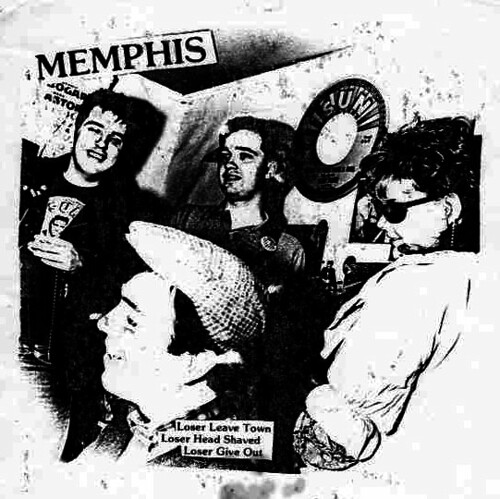
(Left to right: Dan Hopper, Ross Johnson, James Enck, Linda Heck)
I first met Dan Hopper sometime towards the end of my high school days, almost certainly late 1980 or early 1981. I was working at the puke-a-delic Steak and Ale on Poplar, with Jeff Green of later Grundies fame, and a guy named Mike Lowe, who went to Ridgeway High School and was a close friend of Dan's. In one of the frequent after-work parking lot parties that happened among the largely reprobate S&A employees, Dan turned up. I recognized him instantly from a year or two earlier, when I had gone to the Evergreen Theater, which was being run by my schoolmate Harmon Canon's family and used to show some great films, to see Rock and Roll High School featuring The Ramones. I had stepped into the men's room to find a considerably less lithe version of Joey Ramone standing at the urinals, chanting "Gabba Gabba Hey" and some other assorted Ramonespeak nonsense. This was Dan.
How all the pieces fall together, I'm not sure, but at some point in the early-ish phases of Pseudobop, Linda and Dan got together. They moved into a strange little shack in Binghampton, nicknamed Green Acres, for obvious reasons. This tiny house had apparently been rotated 90 degrees on its foundation at some point, and was in a bit of a state. Their landlord, the talented lunatic photographer Ronnie Goff, had the unique distinction of being both the only person I have ever met who actually looked like the Big Boy, as well as the only American I have ever met who proudly proclaimed that he was 100% pure Irish (I never dared mention Phil Lynott to him). All very strange.
I liked Dan, and if Linda liked him too, that was even better. He had a knowledge of retro pop culture and roots music which was very enlightening, possibly the product of having a couple of much older siblings, and he was very funny, most of the time. At the time I guess I felt that I was growing a bit exasperated with some of the knowing cleverness and iconoclasm of the "New Wave" scene, and desired a return to some sort of simpler, more honest, less self-conscious music, and that's probably where Dan's knowledge coincided with my curiosity.
He also knew a lot of interesting people. Through him I met Roy Barnes, whom I still consider to be one of the funniest people I have ever met, and who back in those days had a wide range of film ideas in various stages of development, including the (as far as I know) still unrealized "Car Trek," in which Dan in his Galaxy 500 boldly went where no man had gone before, to encounter hostile gay men on rollerskates in Overton Park, among other terrestrial menaces. Roy would later direct the music video for Linda Heck's "Professor of Love," which I wish I had a copy of, as well as a film called "Doom House," for which I wrote a largely unused soundtrack, recorded with Jack Adcock, Fields Trimble and Bob Fordyce. There was also his film "Gone Down South" featuring the Hellcats, to which I also contributed a horrible heavy metal caricature song which the sleazy A&R man plays for the Hellcats.
Incidentally, there is one remarkable bit of trivia in my life relating to Dan, Linda and Roy, which continues to illustrate, at least to me, the interconnectedness of human beings and the unlikely serendipity we can still encounter even on a planet of 6.8 billion souls. Soon after I arrived in Yamanashi, Japan in 1988 on the Japan Exchange and Teaching (JET) program, I found myself on a train with a number of other program participants, including a project member who had arrived the year before. His name was Jaime Cortez, and he was from California. We started talking, and I asked him where he was from. "Watsonville, California," he said. I replied, quite casually, "Do you happen to know a guy named Grady, who once ran for mayor?" I knew this bit of Watsonville trivia by virtue of having previously met Grady, who was a friend of Roy Barnes, during his earlier sabbatical in Memphis. To my eternal surprise and delight, Jaime responded, "Grady Miller, he was my best friend in high school!" We were both stunned. "Where are you from again?" Jaime enquired. Memphis. "Roy Barnes, of course I know Roy," Jaime continued, "And the musicians, Linda and Dan, do you know them? I remember they came to visit once."
Back to 1983. Dan was singing in a group with guitarist Tommy Diana (can anyone remember the name?), but at some point we started messing around with rockabilly and blues material, with me on guitar, Dan on vocals, and Linda on bass. There is a recording, made at Mark Edwards' house, of us plus Ross Johnson on drums, Kurt Wagner on steel guitar, and Kurt's friend Chuck Book on electric guitar, playing a very lame version of "Ubangi Stomp." This lineup played a few early gigs together, but eventually the band ended up as a four-piece.
Quite how Ross Johnson ended up in the band I know not. I knew of Ross and admired his work for years before we became friends in an ethnomusicology course at MSU, where we were lucky enough to be instructed by Dr. David Evans, a curious man of huge intellect and boundless enthusiasm for his subject area, but who was also apparently painfully shy and ill-at-ease with his role, and seemed to almost cower behind his desk when lecturing. The course was awesome (I seem to recall that Stax historian Rob Bowman was in the same class), however, and getting to know Ross was a further bonus.
Kings of the Western Bop was a name chosen by Dan, and was a slight bastardization of a title bestowed upon Elvis in a billing early in his career. Our repertoire consisted entirely of rockabilly/blues/60s garage covers, ranging from the relatively mainstream ("Come on Everybody," "Scratch My Back," "Twenty Flight Rock," "The Way I Walk") to the unusual ("Tongue-tied Jill," "If You Ever Get it Once," and a major-key straight-ahead country version of the Spider Man theme) and the downright unpleasant (our versions of "A Blind Man's Penis" and "Beaver Patrol," which frequently closed our sets). We played a number of times with Pseudobop, Four Neat Guys, Panther Burns, and once or twice opening for out-of-town rockabilly purist bands who were probably pretty appalled at what they saw/heard. The venue was usually our beloved Antenna, but there were also a couple of gigs which took place on Highland in the old movie theater, and I also vaguely remember a pretty embarrassing gig at legendary all-night bar The Toast. We also entered a local "Battle of the Bands" competition at the Cook Convention Center, which was really very much like something out of "School of Rock." Lisa McGaughran, a judge, bravely voted for us, but we lost out to a throng of hairmetal bands, proving that democracy in Memphis was still safe.
The band was generally pretty solid, if occasionally erratic, but Dan's vocals tended to verge on the painful - a fact not lost on him, to his credit. His in-between-song banter frequently included the phrase, "Another tuneless racket." Other typical pronouncements included "Some people like to hang glide, some people like to skydive, but we like to get drunk and drive reeeeeaal fast!" Fueled by seemingly unlimited unfiltered Lucky Strikes and the incomparable Schaefer beer served at the Antenna, Dan stalked the stage like a man desperately in search of his car keys, and usually treated us at least once per performance to a death-defying forward roll across the stage or dancefloor. It was like being in a musical cartoon.
At this great distance, I can't remember precisely what precipitated my departure from the band, but I suspect it was a combination of fatigue with some of the more chaotic and opaque aspects of life on Planet Dan, the difficult nature of his relationship with Linda, and, I also believe, the unfortunate disappearance of a beautiful Gretsch guitar Linda had which was mysteriously pawned and then vanished into the vortex of lost instruments, which I remember at the time really pissed me off. The band continued on with John Floyd on guitar, and I think Bobby Saucier on drums, but by this time I was out of the pan and into the fire of life with Four Neat Guys. Linda and Dan later moved to Virginia when Dan joined the Navy as a cook onboard a destroyer, if I recall correctly - fortunately, no international conflicts on the high seas arose as a result.
It was his time at sea and Linda's time of isolation in a strange place which seemingly prompted her to begin to write songs, and she returned to Memphis with a very respectable songbook and even a tape of home demos when I next connected with the two of them upon my return from my first stint in Japan in the summer of 1986. These became the early repertoire of Linda Heck and the Train Wreck, but that is another story.
Subscribe to:
Posts (Atom)

 Posts
Posts


